Review
. 2009 Dec;66(23):3727-42.
doi: 10.1007/s00018-009-0107-2. Epub 2009 Aug 2.

Retroelements and their impact on genome evolution and functioning

Affiliations
Review

Retroelements and their impact on genome evolution and functioning

Elena Gogvadze et al. Cell Mol Life Sci. 2009 Dec.

Abstract

Retroelements comprise a considerable fraction of eukaryotic genomes. Since their initial discovery by Barbara McClintock in maize DNA, retroelements have been found in genomes of almost all organisms. First considered as a "junk DNA" or genomic parasites, they were shown to influence genome functioning and to promote genetic innovations. For this reason, they were suggested as an important creative force in the genome evolution and adaptation of an organism to altered environmental conditions. In this review, we summarize the up-to-date knowledge of different ways of retroelement involvement in structural and functional evolution of genes and genomes, as well as the mechanisms generated by cells to control their retrotransposition.


Figures
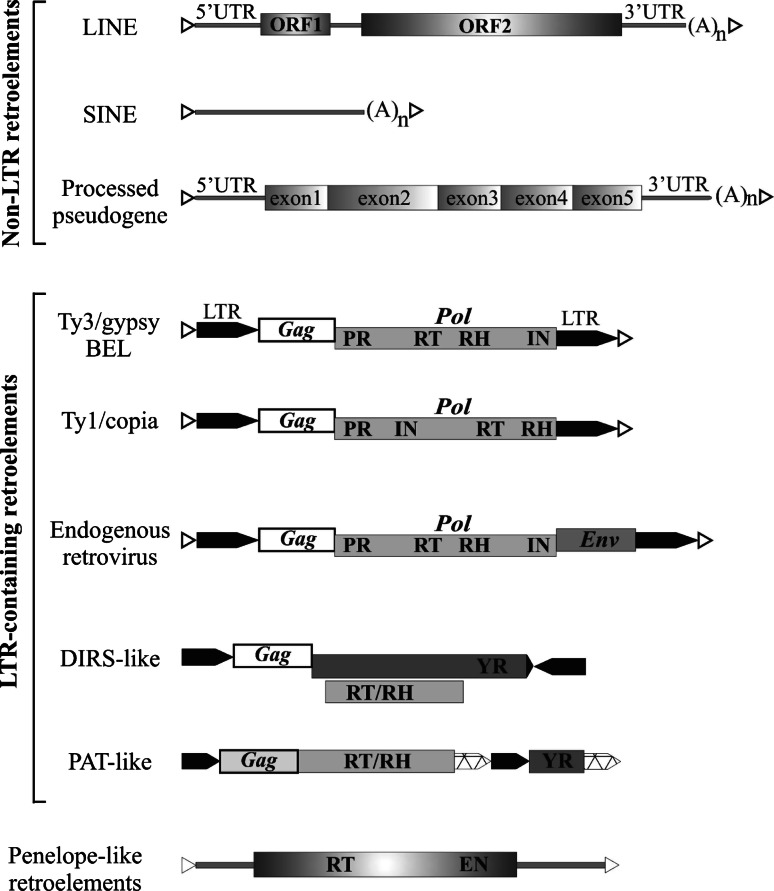
Fig. 1
Fig. 1
Schematic representation of different retroelements. White triangles short direct repeats (target site duplications), UTR untranslated region, ORF open reading frame, LTR long terminal repeat, PR protease, RT reverse transcriptase, RH ribonuclease H, IN integrase, Env envelope, YR tyrosine recombinase, EN endonuclease
Fig. 2
Fig. 2
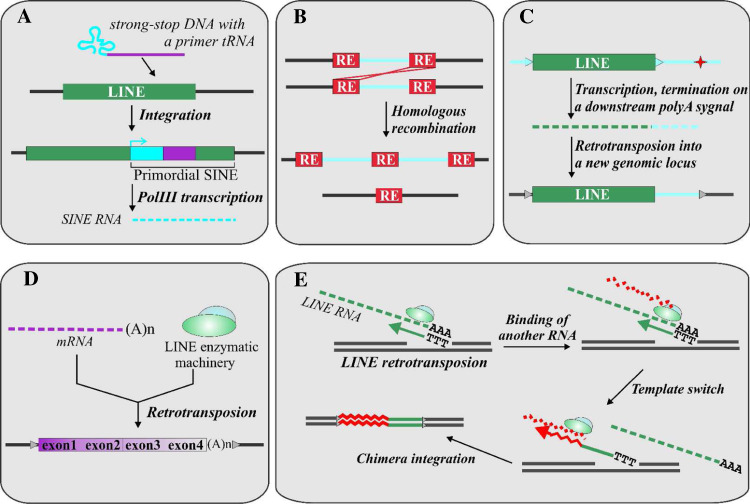
a Formation of tRNA-like SINEs as an example of a role of REs in generation of new genetic elements; b retroelements as substrates for recombination events; c transduction of 3′-flanking sequences; d formation of processed pseudogenes by LINE enzymatic machinery; e generation of chimeric elements by template switches during LINE retrotransposition
Fig. 3
Fig. 3
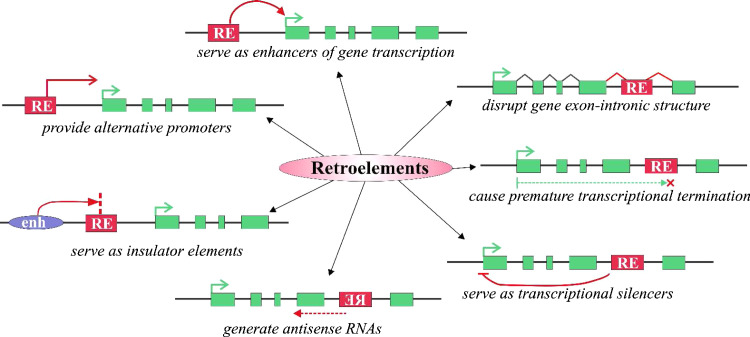
Different mechanisms of RE influence on gene transcription. Red boxes retroelements, green boxes gene exons, green arrow gene transcriptional start site, purple oval enhancer element

References

    1. Bohne A, Brunet F, Galiana-Arnoux D, Schultheis C, Volff JN. Transposable elements as drivers of genomic and biological diversity in vertebrates. Chromosome Res. 2008;16:203–215. doi: 10.1007/s10577-007-1202-6. - DOI - PubMed
    1. McClintock B. Controlling elements and the gene. Cold Spring Harb Symp Quant Biol. 1956;21:197–216. - PubMed
    1. Wessler SR. Transposable elements and the evolution of gene expression. Symp Soc Exp Biol. 1998;51:115–122. - PubMed
    1. Kapitonov VV, Jurka J. Molecular paleontology of transposable elements in the Drosophila melanogaster genome. Proc Natl Acad Sci USA. 2003;100:6569–6574. doi: 10.1073/pnas.0732024100. - DOI - PMC - PubMed
    1. International Human Genome Sequencing Consortium Initial sequencing and analysis of the human genome. Nature. 2001;409:860–921. doi: 10.1038/35057062. - DOI - PubMed

Publication types

LinkOut - more resources