. 2009 Oct;111(1):37-48.
doi: 10.1111/j.1471-4159.2009.06301.x. Epub 2009 Jul 23.

Chronic ethanol treatment potentiates ethanol-induced increases in interstitial nucleus accumbens endocannabinoid levels in rats

Affiliations

Chronic ethanol treatment potentiates ethanol-induced increases in interstitial nucleus accumbens endocannabinoid levels in rats

Lily Alvarez-Jaimes et al. J Neurochem. 2009 Oct.

Abstract

We employed in vivo microdialysis to characterize the effect of an ethanol challenge injection on endocannabinoid levels in the nucleus accumbens of ethanol-naïve and chronic ethanol-treated rats. Ethanol (0.75 and 2 g/kg, i.p.) dose-dependently increased dialysate 2-arachidonoylglycerol (to a maximum 157 +/- 20% of baseline) and decreased anandamide (to a minimum 52 +/- 9% of baseline) in ethanol-naïve rats. The endocannabinoid clearance inhibitor N-(4-hydrophenyl) arachidonoylamide (AM404; 3 mg/kg) potentiated ethanol effects on 2-arachidonoylglycerol levels but did not alter ethanol-induced decreases in anandamide. AM404 alone did not alter dialysate levels of either endocannabinoid. Then, we characterized the effect of ethanol challenge on nucleus accumbens endocannabinoid levels in rats previously maintained on an ethanol-containing liquid diet. Ethanol challenge produced a greater and more prolonged increase in 2-arachidonoylglycerol (to a maximum 394 +/- 135% of baseline) in ethanol-experienced than in ethanol-naïve rats. The profile in ethanol-experienced rats was similar to that produced by AM404 pre-treatment in ethanol-naïve rats. AM404 in ethanol-experienced rats led to a further enhancement in the 2-arachidonoylglycerol response to ethanol challenge (to a maximum 704 +/- 174% of baseline). Our findings demonstrate that ethanol-induced increases in nucleus accumbens 2-arachidonoylglycerol are potentiated in animals with a history of ethanol consumption.


Figures
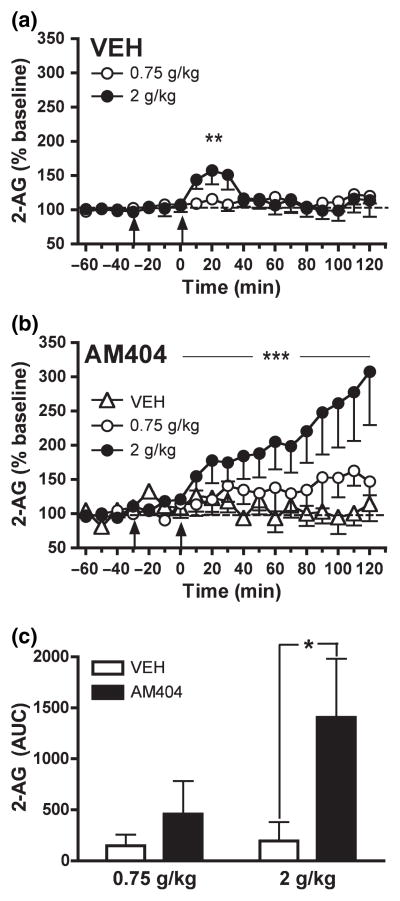
Fig. 1
Fig. 1
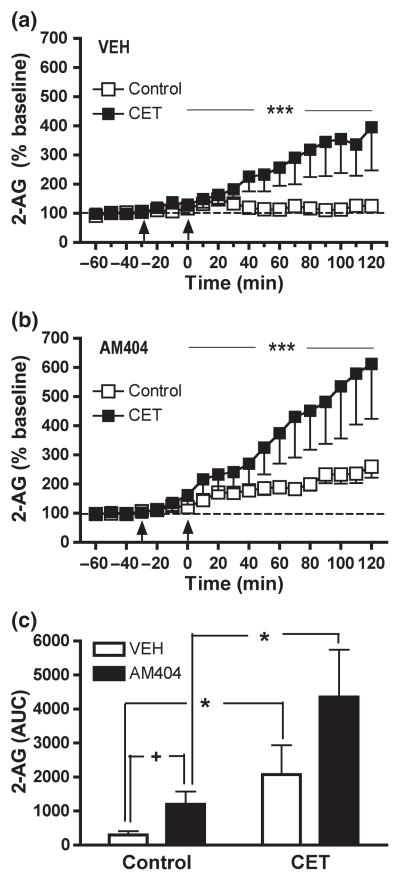
Dose-dependent effect of acute EtOH administration (0.75 and 2 g/kg, i.p.) on NAC dialysate 2-AG levels from rats pre-treated with (a) vehicle (n = 11) and (b) AM404 (3 mg/kg, i.p.; n = 17). Data are expressed as the percentage change from baseline levels (mean ± SEM). (c) The AUC data summarize the effect of AM404 pre-treatment on EtOH-induced changes in dialysate 2-AG levels. The EC clearance inhibitor, AM404, potentiated EtOH-induced increases in dialysate NAC 2-AG (see Results section for details). Vehicle and AM404 pre-treatment is indicated by arrow at −30 min. EtOH injection is indicated by arrow at time point zero. *p < 0.05 denote significant differences from vehicle. **p < 0.01 and ***p < 0.001 denotes a significant dose-dependent effect.
Fig. 2
Fig. 2
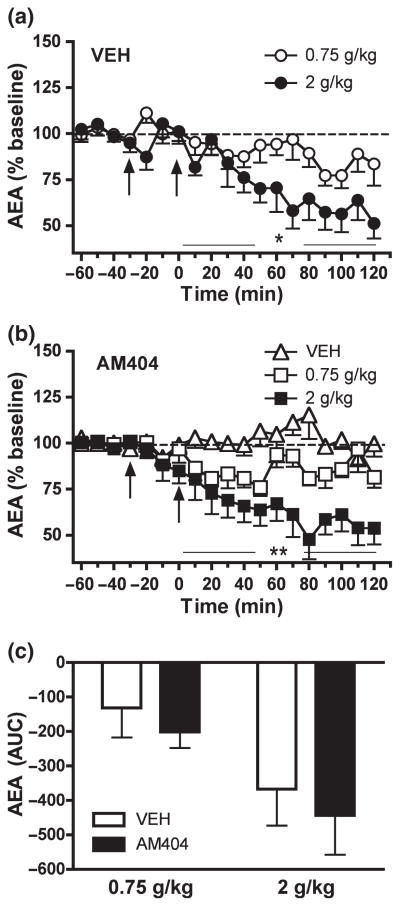
Dose-dependent effect of acute EtOH administration (0.75 and 2 g/kg, i.p.) on NAC dialysate AEA levels from rats pre-treated with (a) vehicle (n = 11) and (b) AM404 (3 mg/kg, i.p.; n = 17). Data are expressed as the percentage change from baseline levels (mean ± SEM). (c) The AUC data summarize the effect of AM404 pre-treatment on EtOH-induced changes in dialysate AEA levels. The EC clearance inhibitor, AM404, did not alter EtOH-induced decreases in dialysate AEA (see Results section for details). Vehicle and AM404 pre-treatment is indicated by arrow at −30 min. EtOH injection is indicated by arrow at time point zero. *p < 0.05 and **p < 0.01 denotes a significant dose-dependent effect.
Fig. 3
Fig. 3
CET significantly enhanced EtOH-induced increases in NAC dialysate 2-AG as compared to EtOH-naïve control rats (control: n = 9; CET: n = 6) (a). Inhibition of EC clearance mechanisms by AM404 potentiated EtOH-induced increases in dialysate 2-AG levels in control (n = 10) and CET (n = 6) (b). Data are expressed as the percentage change from baseline levels (mean ± SEM). (c) The AUC data summarize the effect of AM404 pre-treatment on the 2-AG response to EtOH challenge in control and CET rats. CET does not alter the effect of AM404 on EtOH-induced increases in NAC 2-AG (see Results section for details). Vehicle and AM404 pre-treatment is indicated by arrow at −30 min. EtOH injection is indicated by arrow at time point zero. +p < 0.05 denotes significant differences from vehicle. *p < 0.05 denotes a significant effect of EtOH history in vehicle-pre-treated rats. **p < 0.01 denotes a significant effect of EtOH history in AM404-pre-treated rats. ***p < 0.001 denotes a significant effect of EtOH history in vehicle- and AM404-pre-treated rats as determined by Two-Way Repeated measures ANOVA.
Fig. 4
Fig. 4
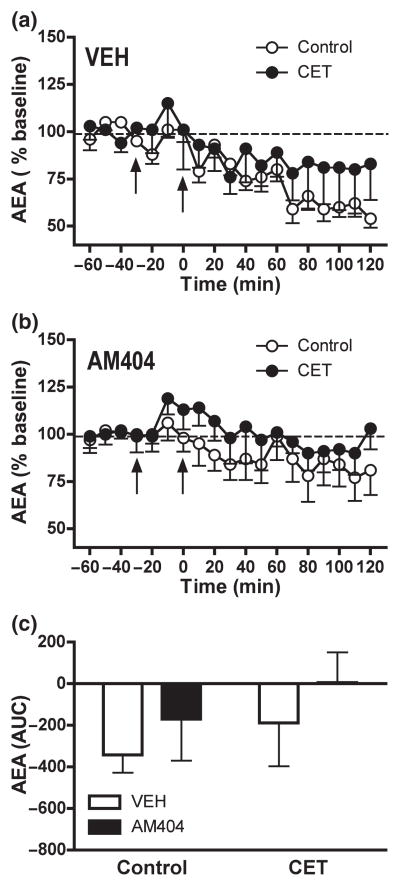
CET did not significantly alter EtOH-induced decreases in NAC dialysate AEA observed in control rats (control: n = 9; CET: n = 6) (a). EtOH challenge did not significantly alter NAC AEA levels in either control (n = 10) or CET (n = 6) rats pre-treated with AM404 (b). Data are expressed as the percentage change from baseline levels (mean ± SEM). (c) The AUC data summarize the effect of AM404 pre-treatment on the 2-AG response to EtOH challenge in control and CET rats. Vehicle and AM404 pre-treatment is indicated by arrow at −30 min. EtOH injection is indicated by arrow at time point zero.
Fig. 5
Fig. 5
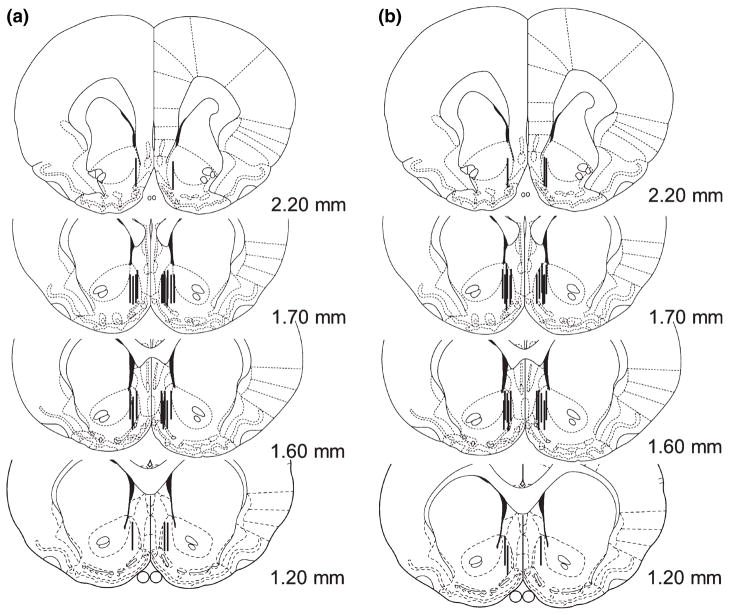
Schematic representation of the location of dialysis probe membranes within the NAC shell in Experiments 1 (n = 28) (a) and 2 (n = 31) (b). Distances shown are in mm from Bregma (Paxinos and Watson 1998).

References

    1. Arnone M, Maruani J, Chaperon F, Thiébot M, Poncelet M, Soubrie P, Le Fur G. Selective inhibition of sucrose and ethanol intake by SR 141716, an antagonist of central cannabinoid (CB1) receptors. Psychopharmacology. 1997;132:104–106. - PubMed
    1. Basavarajappa BS, Hungund LH. Chronic ethanol increases the cannabinoid receptor agonist anandamide and its precursor N-Arachidonoylphosphatidylethanolamine in SK-N-SH cells. J Neurochem. 1999;72:522–528. - PubMed
    1. Basavarajappa BS, Hungund BL. Role of the endocannabinoid system in the development of tolerance to alcohol. Alcohol Alcohol. 2005;40:15–24. - PubMed
    1. Basavarajappa BS, Saito M, Cooper TB, Basalingappa LH. Activation of arachidonic acid-specific phospholipase A2 in human neuroblastoma cells after chronic alcohol exposure: prevention by GM1 ganglioside. Alcohol Clin Exp Res. 1997;21:1199–1203. - PubMed
    1. Basavarajappa BS, Cooper TB, Basalingappa LH. Chronic ethanol administration down-regulates cannabinoid receptors in mouse brain synaptic plasma membrane. Brain Res. 1998;793:212–218. - PubMed

Publication types

MeSH terms