


Randomized trial of emergency endoscopic sclerotherapy versus emergency portacaval shunt for acutely bleeding esophageal varices in cirrhosis
- PMID: 19651060
- PMCID: PMC6420230
- DOI: 10.1016/j.jamcollsurg.2009.02.059
Randomized trial of emergency endoscopic sclerotherapy versus emergency portacaval shunt for acutely bleeding esophageal varices in cirrhosis
Abstract
Background: The mortality rate of bleeding esophageal varices in cirrhosis is highest during the period of acute bleeding. This is a report of a randomized trial that compared endoscopic sclerotherapy (EST) with emergency portacaval shunt (EPCS) in cirrhotic patients with acute variceal hemorrhage.
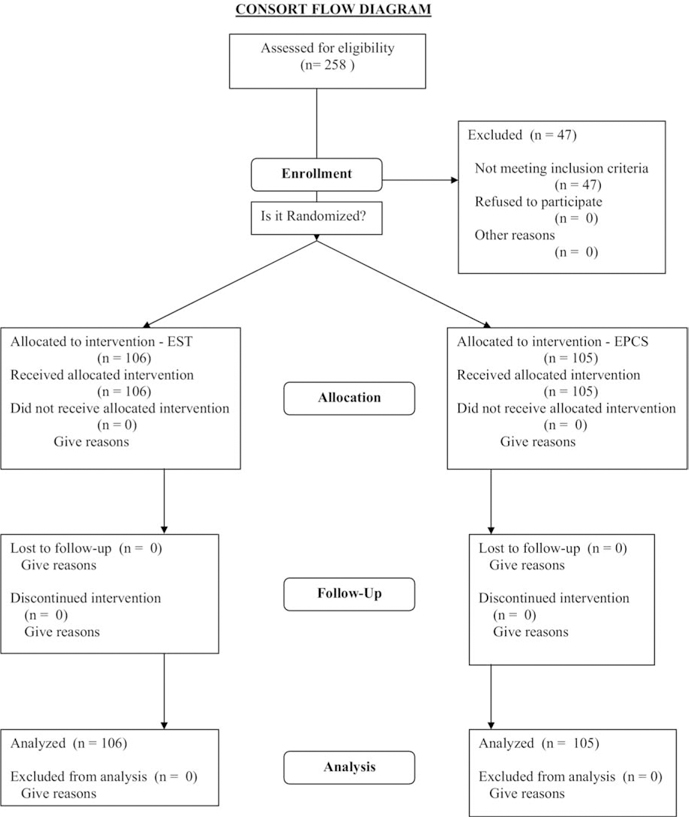
Study design: A total of 211 unselected consecutive patients with cirrhosis and acutely bleeding esophageal varices who required at least 2 U of blood transfusion were randomized to EST (n=106) or EPCS (n=105). Diagnostic workup was completed within 6 hours and EST or EPCS was initiated within 8 hours of initial contact. Longterm EST was performed according to a deliberate schedule. Ninety-six percent of patients underwent more than 10 years of followup, or until death.
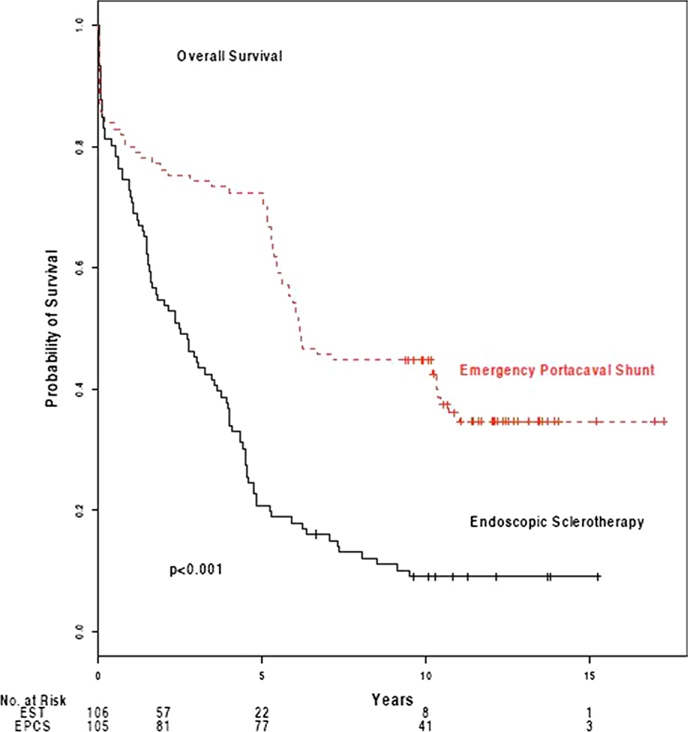
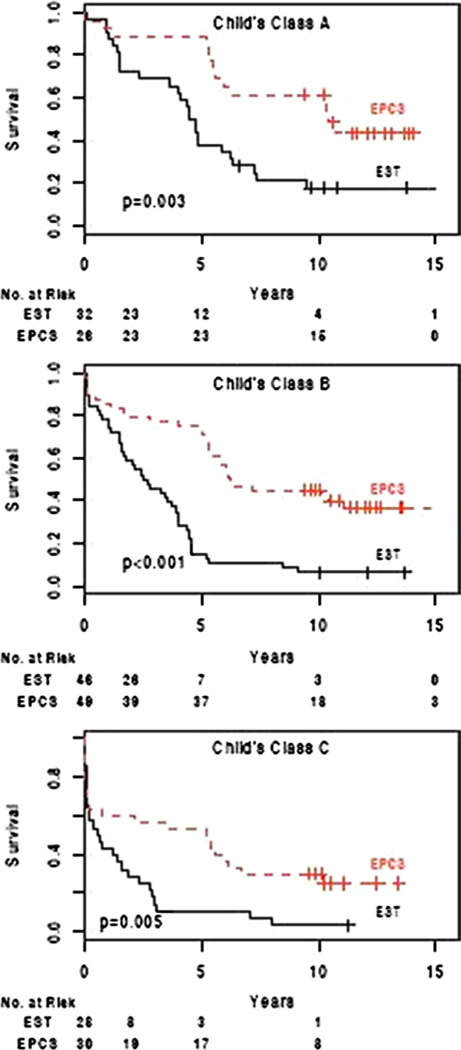
Results: The percent of patients in Child's risk classes were A, 27.5; B, 45.0; and C, 27.5. EST achieved permanent control of bleeding in only 20% of patients; EPCS permanently controlled bleeding in every patient (p< or =0.001). Requirement for blood transfusions was greater in the EST group than in the EPCS patients. Compared with EST, survival after EPCS was significantly higher at all time intervals and in all Child's classes (p< or =0.001). Recurrent episodes of portal-systemic encephalopathy developed in 35% of EST patients and 15% of EPCS patients (p< or =0.01).
Conclusions: EPCS permanently stopped variceal bleeding, rarely became occluded, was accomplished with a low incidence of portal-systemic encephalopathy, and compared with EST, produced greater longterm survival. The widespread practice of using surgical procedures mainly as salvage for failure of endoscopic therapy is not supported by the results of this trial (clinicaltrials.gov #NCT00690027).
Figures
References
-
- Graham DY, Smith H. The course of patients after variceal hemorrhage. Gastroenterology 1981;80:800–809. - PubMed
-
- Smith JL, Graham DY. Variceal hemorrhage: a critical evaluation of survival analysis. Gastroenterology 1982;82:968–973. - PubMed
-
- Burroughs AK, Mezzanotte G, Phillips A, et al. Cirrhotics with variceal hemorrhage: the importance of the time interval between admission and the start of analysis for survival and rebleeding rates. Hepatology 1969;9:801–807. - PubMed
-
- Bornman PC, Krige JE, Terblanche J. Management of oesophageal varices. Lancet 1994;353:1079–1084. - PubMed
Publication types
MeSH terms
Associated data
Grants and funding
LinkOut - more resources
Full Text Sources
Medical
Research Materials
