


Trends in the United States in the treatment of distal radial fractures in the elderly
- PMID: 19651943
- PMCID: PMC2714808
- DOI: 10.2106/JBJS.H.01297
Trends in the United States in the treatment of distal radial fractures in the elderly
Abstract
Background: Traditionally, distal radial fractures in the elderly have been treated nonoperatively with casting. However, since the introduction of the volar locking plating system in 2000, there has been an interest in the use of more aggressive treatment methods. The purpose of the present study was to assess changing trends in the treatment of distal radial fractures in elderly patients in the United States.
Methods: We evaluated a 5% sample of Medicare data from 1996 to 1997 and a 20% sample from 1998 to 2005. Information on four treatment methods (closed treatment, percutaneous pin fixation, internal fixation, and external fixation) was extracted from the dataset. Other available data were diagnosis, physician specialty, and patient age, sex, and race. We calculated frequencies and rates to compare the utilization of different treatments over time.
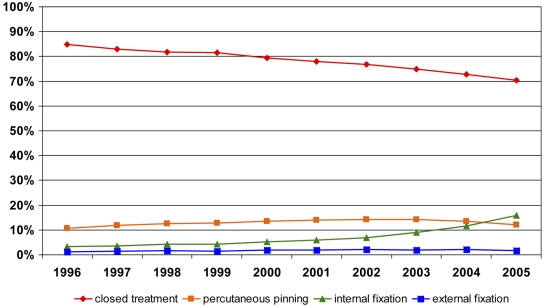
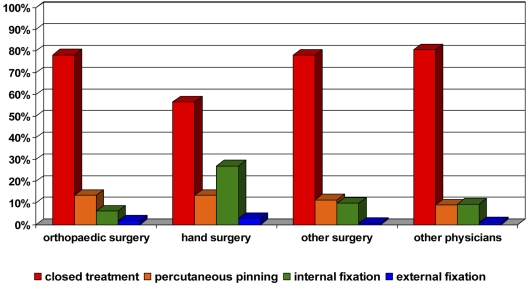
Results: Over the ten-year time period examined, the rate of internal fixation of distal radial fractures in the elderly increased fivefold, from 3% in 1996 to 16% in 2005. Closed treatment, however, remained the predominant method (used for 82% of the fractures in 1996 and 70% in 2005). Fractures in patients with an age of eighty-five years or more were significantly more likely to be treated in a closed fashion (p < 0.0001). There was a large variation among physician specialties with regard to the fixation methods that were used. Orthopaedic surgeons were significantly more likely to use closed treatment than hand surgeons were, whereas hand surgeons were significantly more likely to use internal fixation than orthopaedic surgeons were.
Conclusions: Since 2000, although the majority of distal radial fractures are still treated nonoperatively, there has been an increase in the use of internal fixation and a concurrent decrease in the rate of closed treatment of distal radial fractures in the elderly in the United States.
Figures
References
-
- Cummings SR, Black DM, Rubin SM. Lifetime risks of hip, Colles', or vertebral fracture and coronary heart disease among white postmenopausal women. Arch Intern Med. 1989;149:2445-8. - PubMed
-
- Beharrie AW, Beredjiklian PK, Bozentka DJ. Functional outcomes after open reduction and internal fixation for treatment of displaced distal radius fractures in patients over 60 years of age. J Orthop Trauma. 2004;18:680-6. - PubMed
-
- Mackenney PJ, McQueen MM, Elton R. Prediction of instability in distal radial fractures. J Bone Joint Surg Am. 2006;88:1944-51. - PubMed
-
- Strange-Vognsen HH. Intraarticular fractures of the distal end of the radius in young adults. A 16 (2-26) year follow-up of 42 patients. Acta Orthop Scand. 1991;62:527-30. - PubMed
-
- Grewal R, MacDermid JC. The risk of adverse outcomes in extra-articular distal radius fractures is increased with malalignment in patients of all ages but mitigated in older patients. J Hand Surg [Am]. 2007;32:962-70. - PubMed
Publication types
MeSH terms
Grants and funding
LinkOut - more resources
Full Text Sources
Medical
