. 2009 Aug;91(8):1985-94.
doi: 10.2106/JBJS.H.01038.

Far cortical locking can reduce stiffness of locked plating constructs while retaining construct strength

Affiliations

Far cortical locking can reduce stiffness of locked plating constructs while retaining construct strength

Michael Bottlang et al. J Bone Joint Surg Am. 2009 Aug.

Abstract

Background: Several strategies to reduce construct stiffness have been proposed to promote secondary bone healing following fracture fixation with locked bridge plating constructs. However, stiffness reduction is typically gained at the cost of construct strength. In the present study, we tested whether a novel strategy for stiffness reduction, termed far cortical locking, can significantly reduce the stiffness of a locked plating construct while retaining its strength.

Methods: Locked plating constructs and far cortical locking constructs were tested in a diaphyseal bridge plating model of the non-osteoporotic femoral diaphysis to determine construct stiffness in axial compression, torsion, and bending. Subsequently, constructs were dynamically loaded until failure in each loading mode to determine construct strength and failure modes. Finally, failure tests were repeated in a validated model of the osteoporotic femoral diaphysis to determine construct strength and failure modes in a worst-case scenario of bridge plating in osteoporotic bone.

Results: Compared with the locked plating constructs, the initial stiffness of far cortical locking constructs was 88% lower in axial compression (p < 0.001), 58% lower in torsion (p < 0.001), and 29% lower in bending (p < 0.001). Compared with the locked plating constructs, the strength of far cortical locking constructs was 7% lower (p = 0.005) and 16% lower (p < 0.001) under axial compression in the non-osteoporotic and osteoporotic diaphysis, respectively. However, far cortical locking constructs were 54% stronger (p < 0.001) and 9% stronger (p = 0.04) under torsion and 21% stronger (p < 0.001) and 20% stronger (p = 0.02) under bending than locked plating constructs in the non-osteoporotic and osteoporotic diaphysis, respectively. Within the initial stiffness range, far cortical locking constructs generated nearly parallel interfragmentary motion. Locked plating constructs generated significantly less motion at the near cortex adjacent to the plate than at the far cortex (p < 0.01).

Conclusions: Far cortical locking significantly reduces the axial stiffness of a locked plating construct. This gain in flexibility causes only a modest reduction in axial strength and increased torsional and bending strength.


Figures
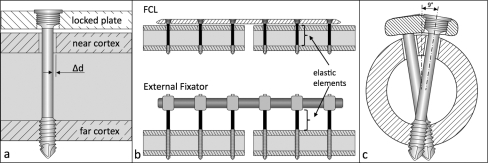
Fig. 1
Fig. 1
a: Illustration depicting the far cortical locking screw for unicortical fixation in the far cortex, enabling elastic flexion of the screw shaft within the motion envelope (Δd) in the near cortex. b: Mechanically, the far cortical locking (FCL) construct functions as an internal fixator that derives axial flexibility by cantilever bending of the far cortical locking screw shafts similar to an external fixator that derives elasticity from fixation pin flexion. c: A staggered and converging far cortical locking screw arrangement was implemented to improve construct strength in torsion.
Fig. 2
Fig. 2
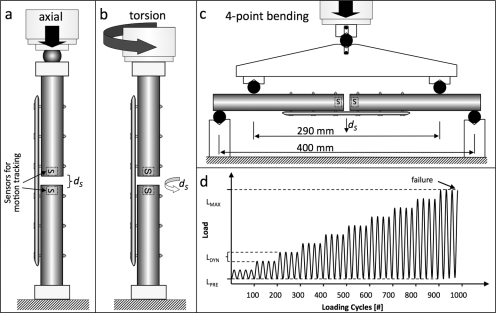
a, b, and c: Construct stiffness and strength were evaluated under three loading conditions: axial compression (a), torsion (b), and four-point bending in a gap-closing direction (c). Motion-tracking sensors (S) captured subsidence (ds). d: A progressive dynamic loading protocol was used to ensure that construct failure was attained for each construct and loading mode within a reasonable number of load cycles (<10,000 cycles). After application of a static pre-load (LPRE), dynamic loading (LDYN) was applied and was increased until constructs failed at peak load LMAX.
Fig. 3
Fig. 3
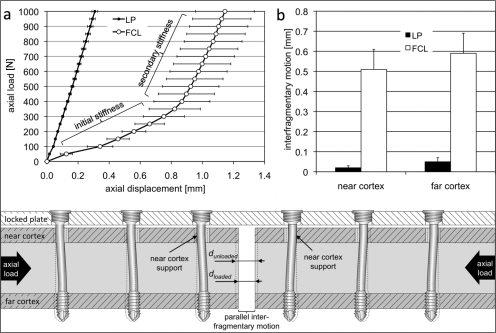
Stiffness comparison between locked plating (LP) and far cortical locking (FCL) constructs. a: Far cortical locking constructs exhibited a biphasic stiffness profile. In axial loading, far cortical locking constructs had a low initial stiffness within the near cortex motion envelope that allowed for approximately 0.8 mm of axial motion before reaching the secondary stiffness due to near-cortex support. b: At 200 N of loading, the initial stiffness of far cortical locking constructs induced comparable amounts of interfragmentary motion at the near and the far cortex. This fracture-site motion was one order of magnitude greater than that in locked plating constructs. The cross-sectional view of a far cortical locking construct at the bottom of the figure illustrates elastic deformation of far cortical locking screws and the resulting parallel interfragmentary motion.
Fig. 4
Fig. 4
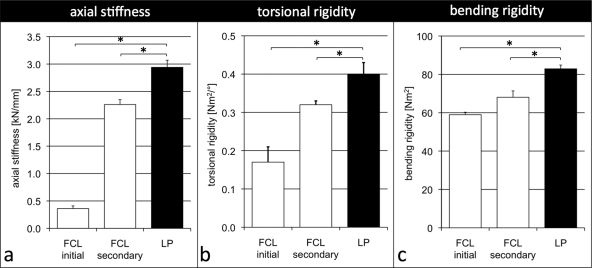
The initial stiffness of far cortical locking (FCL) constructs was 88% lower in axial compression (a), 58% lower in torsion (b), and 29% lower in bending (c) compared with locked plating (LP) constructs. At elevated loading, the far cortical locking construct stiffness increased to within 22%, 20%, and 18% of the locked plating construct stiffness in compression, torsion, and bending, respectively. *Significant (p < 0.001).
Fig. 5
Fig. 5
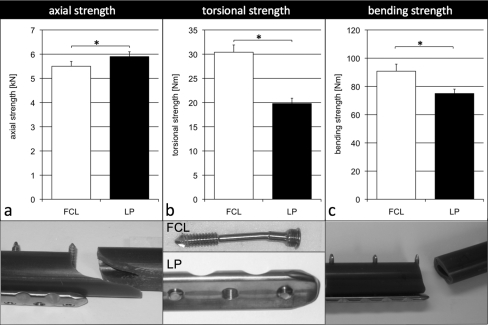
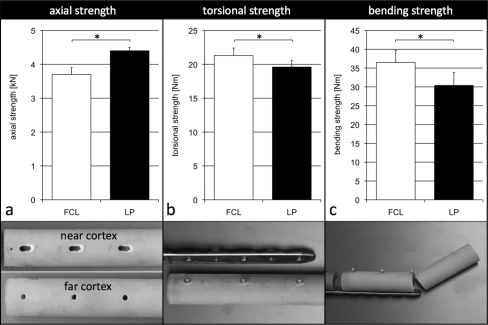
In the non-osteoporotic diaphysis, the strength of the far cortical locking (FCL) constructs in axial compression (a) was 7% less than that of locked plating (LP) constructs. In torsion (b) and bending (c), far cortical locking constructs were 54% and 21% stronger than locked plating constructs, respectively. In axial compression, both constructs failed as a result of fracture of the diaphysis through the screw hole at the plate end. In torsion, far cortical locking constructs failed as a result of subsidence due to screw shaft bending whereas locked plating constructs failed as a result of screw breakage between the plate and the bone. In bending, both constructs failed as a result of fracture through the screw hole at the plate end. *Significant (p ≤ 0.005).
Fig. 6
Fig. 6
In the osteoporotic diaphysis, the strength of far cortical locking (FCL) constructs in axial compression (a) was 16% less than that of locked plating (LP) constructs. In torsion (b) and bending (c), far cortical locking constructs were 9% and 20% stronger than locked plating constructs, respectively. In axial compression, both constructs failed as a result of subsidence due to screw bending and migration in the near cortex. In torsion, far cortical locking constructs failed as a result of subsidence due to screw shaft bending and locked plating constructs failed as a result of screw breakage between the plate and the bone. In bending, both constructs failed as a result of fracture through the screw hole at the plate end. *Significant (p ≤ 0.05).

References

    1. Claes LE, Heigele CA, Neidlinger-Wilke C, Kaspar D, Seidl W, Margevicius KJ, Augat P. Effects of mechanical factors on the fracture healing process. Clin Orthop Relat Res. 1998;355 Suppl:S132-47. - PubMed
    1. Perren SM, Allgöwer M, Cordey J, Russenberger M. Developments of compression plate techniques for internal fixation of fractures. Prog Surg. 1973;12:152-79. - PubMed
    1. Kolodziej P, Lee FS, Patel A, Kassab SS, Shen KL, Yang KH, Mast JW. Biomechanical evaluation of the schuhli nut. Clin Orthop Relat Res. 1998;347:79-85. - PubMed
    1. Ramotowski W, Granowski R. Zespol. An original method of stable osteosynthesis. Clin Orthop Relat Res. 1991;272:67-75. - PubMed
    1. Ring D, Kloen P, Kadzielski J, Helfet D, Jupiter JB. Locking compression plates for osteoporotic nonunions of the diaphyseal humerus. Clin Orthop Relat Res. 2004;425:50-4. - PubMed

Publication types