Relation between socioeconomic status and body mass index: evidence of an indirect path via television use
- PMID: 19652105
- PMCID: PMC3719170
- DOI: 10.1001/archpediatrics.2009.78
Relation between socioeconomic status and body mass index: evidence of an indirect path via television use
Abstract
Objective: To test the hypothesis that media use mediates the relation between socioeconomic status (SES) and body mass index (BMI).
Design: Analysis of 2 large cross-sectional surveys, 1 from Germany and 1 from the United States.
Setting: Twenty-seven public schools in northern Germany; telephone interviews in the United States.
Participants: A total of 4810 German children and adolescents aged 10 to 17 years (mean age, 12.8 years); 4473 US children and adolescents aged 12 to 16 years (mean age, 14.0 years) recruited using random-digit-dial methods. Main Exposures Media exposure was assessed via survey questions about the presence of a television in the bedroom, television screen time, computer and video game screen time, and movie viewing. The SES was derived from type of school (German sample) or parental reports of their own education and family income (US sample).
Main outcome measures: The BMI was assessed by the use of self-reports in both samples, supplemented by parental reports (US sample) for height and weight.
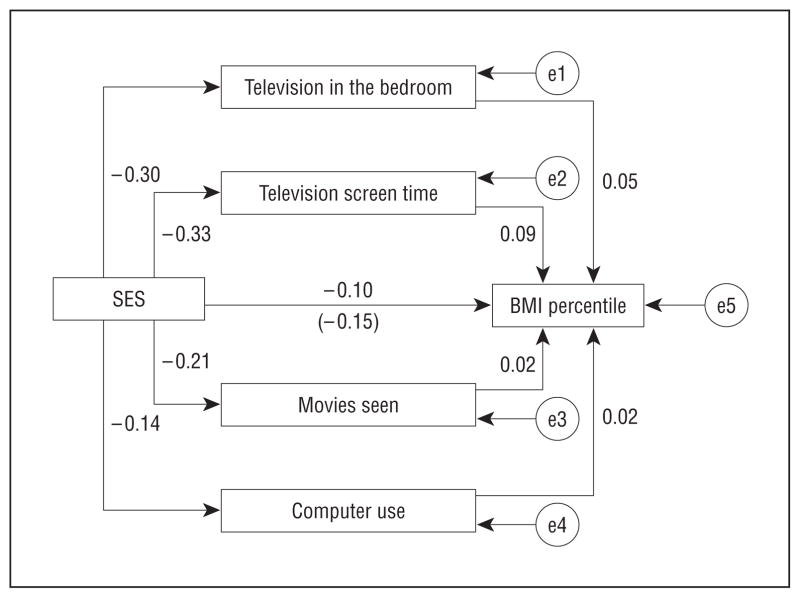
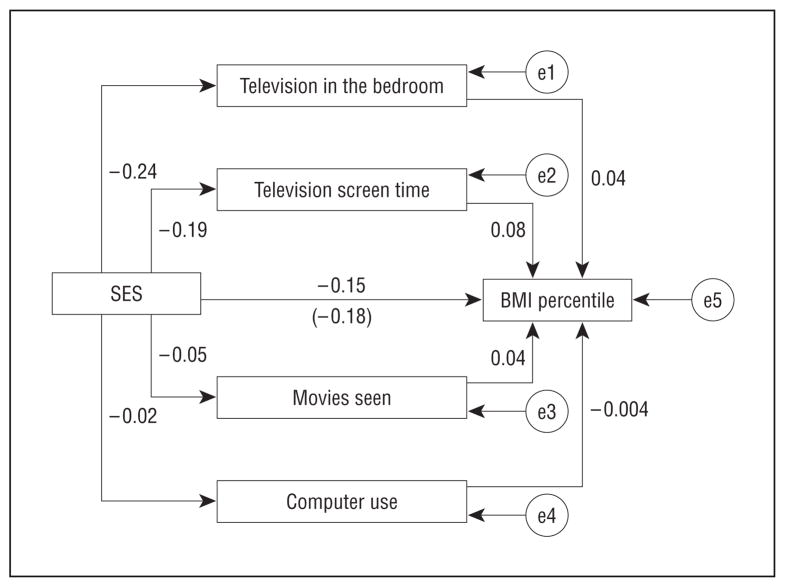
Results: In both samples, SES was inversely associated with BMI, and media use was directly associated with BMI. The effect of SES on overweight was partially mediated by media exposure, which explained 35% of the SES-BMI association in the German sample and 16% in the US sample. In both groups, television in the bedroom and television screen time had statistically significant indirect paths, whereas video game use and movie viewing did not.
Conclusions: Students from low-SES backgrounds are at higher risk for overweight in part because of higher levels of television viewing. The change of media use habits could modify this health disparity.
Figures
References
-
- World Health Organization. Obesity: Preventing and Managing the Global Epidemic. Geneva, Switzerland: World Health Organization; 1998. - PubMed
-
- Hedley AA, Ogden CL, Johnson CL, Carroll MD, Curtin LR, Flegal KM. Prevalence of overweight and obesity among US children, adolescents, and adults, 1999–2002. JAMA. 2004;291(23):2847–2850. - PubMed
-
- Luo J, Hu FB. Time trends of obesity in pre-school children in China from 1989 to 1997. Int J Obes Relat Metab Disord. 2002;26(4):553–558. - PubMed
-
- Padez C, Fernandes T, Mourão I, Moreira P, Rosado V. Prevalence of overweight and obesity in 7–9–year-old Portuguese children: trends in body mass index from 1970–2002. Am J Hum Biol. 2004;16(6):670–678. - PubMed
-
- Sarlio-Lähteenkorva S, Lissau I, Lahelma E. The social patterning of relative body weight and obesity in Denmark and Finland. Eur J Public Health. 2006;16(1):36–40. - PubMed