


Plasticity of heart rate signalling and complexity with exercise training in obese individuals with and without type 2 diabetes
- PMID: 19652657
- PMCID: PMC2761497
- DOI: 10.1038/ijo.2009.145
Plasticity of heart rate signalling and complexity with exercise training in obese individuals with and without type 2 diabetes
Abstract
Objective: To examine the responsiveness of cardiac autonomic function and baroreflex sensitivity (BRS) to exercise training in obese individuals without (OB) and with type 2 diabetes (ObT2D).
Design: Subjects were tested in the supine position and in response to a sympathetic challenge before and after a 16-week aerobic training program. All testing was conducted in the morning following a 12-h fast.
Subjects: A total of 34 OB and 22 ObT2D men and women (40-60 years of age) were studied.
Measurements: Heart rate variability (HRV) was measured at rest via continuous ECG (spectral analysis with the autoregressive approach) and in response to upright tilt. The dynamics of heart rate complexity were analyzed with sample entropy and Lempel-Ziv entropy, and BRS was determined via the sequence technique. Subjects were aerobically trained 4 times per week for 30-45 min for 16 weeks.
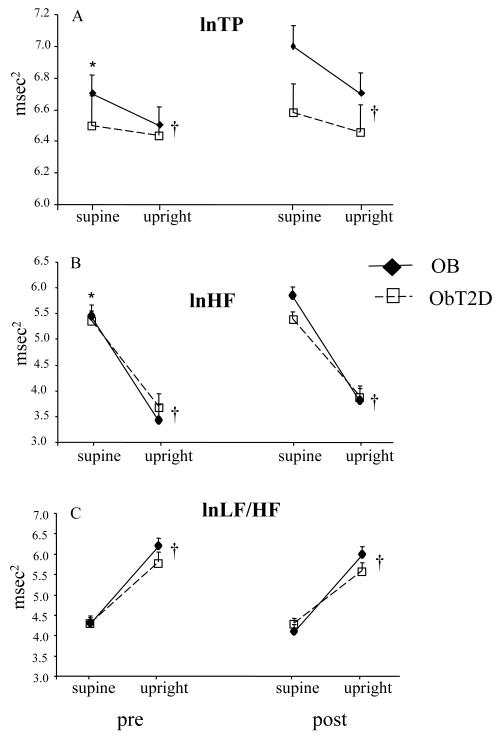
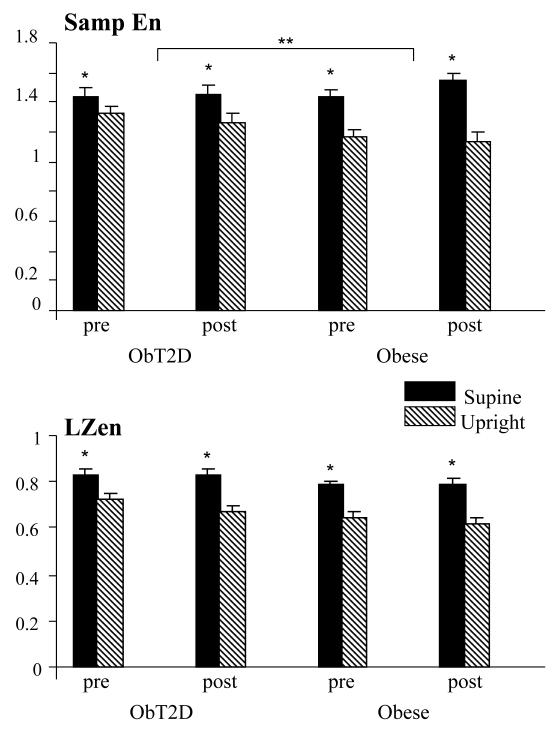
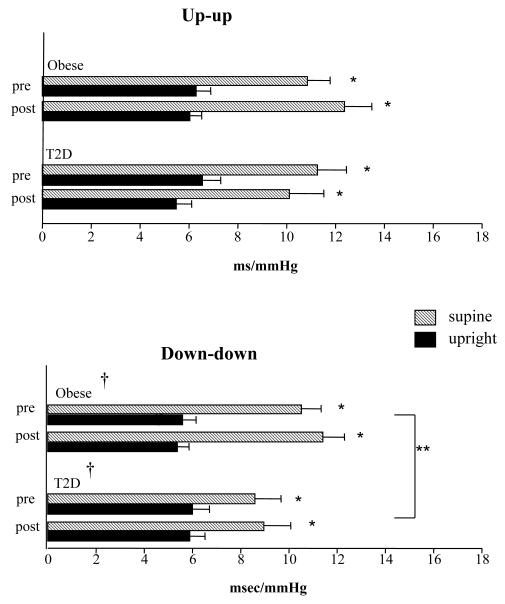
Results: Resting HR decreased and total power (lnTP, ms(2)) of HRV increased in response to exercise training (P<0.05). High frequency power (lnHF) increased in OB subjects but not in OBT2D, and no changes occurred in ln low frequency/HF power with training. Upright tilt decreased lnTP and lnHF and increased LF/HF (P<0.01) but there were no group differences in the magnitude of these changes nor were they altered with training in either group. Tilt also decreased complexity (sample entropy and Lempel-Ziv entropy; P<0.001), but there was no group or training effect on complexity. BRS decreased with upright tilt (P<0.01) but did not change with training. Compared to OB subjects the ObT2D had less tilt-induced changes in BRS.
Conclusion: Exercise training improved HRV and parasympathetic modulation (lnHF) in OB subjects but not in ObT2D, indicating plasticity in the autonomic nervous system in response to this weight-neutral exercise program only in the absence of diabetes. HR complexity and BRS were not altered by 16 weeks of training in either OB or ObT2D individuals.
Figures
References
-
- Maser RE, Lenhard MJ. Obesity is not a confounding factor for performing autonomic function tests in individuals with diabetes mellitus. Diabetes Obes Metab. 2002;4:113–17. - PubMed
-
- Emdin M, Gastaldelli A, Muscelli E, et al. Hyperinsulinemia and autonomic nervous system dysfunction in obesity: effects of weight loss. Circulation. 2001;103:513–19. - PubMed
-
- Heart rate variability. Standards of measurement, physiological interpretation, and clinical use. Task Force of the European Society of Cardiology and the North American Society of Pacing and Electrophysiology. Eur Heart J. 1996;17(3):354–81. - PubMed
-
- Reland S, Ville NS, Wong S, Senhadji L, Carre F. Does the level of chronic physical activity alter heart rate variability in healthy older women? Clin Sci (Lond) 2004;107(1):29–35. - PubMed
-
- De Meersman RE. Respiratory sinus arrhythmia alteration following training in endurance athletes. Eur J Appl Physiol Occup Physiol. 1992;64(5):434–6. - PubMed
Publication types
MeSH terms
Substances
Grants and funding
LinkOut - more resources
Full Text Sources
Other Literature Sources
Medical
Research Materials
Miscellaneous
