. 2009 Nov;19(11):1235-47.
doi: 10.1093/glycob/cwp116. Epub 2009 Aug 4.

AftD, a novel essential arabinofuranosyltransferase from mycobacteria

Affiliations

AftD, a novel essential arabinofuranosyltransferase from mycobacteria

Henrieta Skovierová et al. Glycobiology. 2009 Nov.

Abstract

Arabinogalactan (AG) and lipoarabinomannan (LAM) are the two major cell wall (lipo)polysaccharides of mycobacteria. They share arabinan chains made of linear segments of alpha-1,5-linked D-Araf residues with some alpha-1,3-branching, the biosynthesis of which offers opportunities for new chemotherapeutics. In search of the missing arabinofuranosyltransferases (AraTs) responsible for the formation of the arabinan domains of AG and LAM in Mycobacterium tuberculosis, we identified Rv0236c (AftD) as a putative membrane-associated polyprenyl-dependent glycosyltransferase. AftD is 1400 amino acid-long, making it the largest predicted glycosyltransferase of its class in the M. tuberculosis genome. Assays using cell-free extracts from recombinant Mycobacterium smegmatis and Corynebacterium glutamicum strains expressing different levels of aftD indicated that this gene encodes a functional AraT with alpha-1,3-branching activity on linear alpha-1,5-linked neoglycolipid acceptors in vitro. The disruption of aftD in M. smegmatis resulted in cell death and a decrease in its activity caused defects in cell division, reduced growth, alteration of colonial morphology, and accumulation of trehalose dimycolates in the cell envelope. Overexpression of aftD in M. smegmatis, in contrast, induced the accumulation of two arabinosylated compounds with carbohydrate backbones reminiscent of that of LAM and a degree of arabinosylation dependent on aftD expression levels. Altogether, our results thus indicate that AftD is an essential AraT involved in the synthesis of the arabinan domain of major mycobacterial cell envelope (lipo)polysaccharides.


Figures
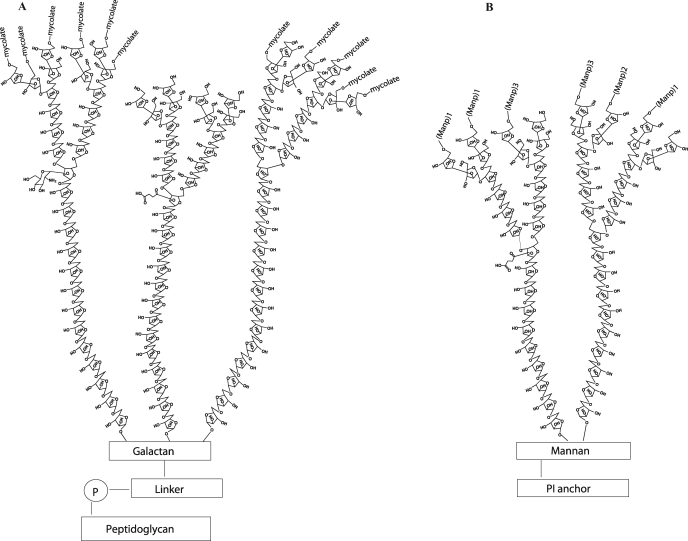
Fig. 1
Fig. 1
Structures of the arabinan domains of arabinogalactan (A) and lipoarabinomannan (B). See text for details.
Fig. 2
Fig. 2
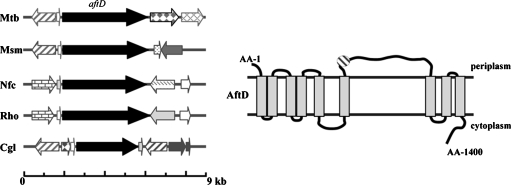
Comparison of the aftD locus within Corynebacterianeae (A) and topology of AftD (B). Mtb, Mycobacterium tuberculosis; Msm, M. smegmatis; Nfc, Nocardia farcinica; Rho, Rhodococcus sp. RHA1_1; Cgl, Corynebacterium glutamicum ATCC 13032. The genomic regions flanking aftD are not well conserved among mycobacteria and other Corynebacterianeae (orthologous genes are highlighted accordingly). AftD is a hydrophobic protein predicted to span the membrane nine times. The hatched circle indicates the position of the predicted GT-C motif of the enzyme (DE-X19-PP) (Berg et al. 2007).
Fig. 3
Fig. 3
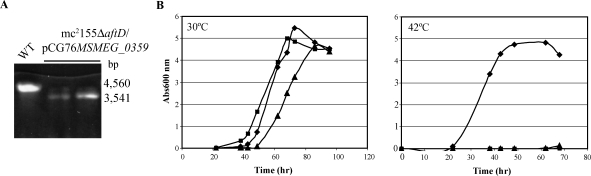
aftD is an essential gene of M. smegmatis mc2155. (A) Evidence for allelic replacement at the aftD locus of M. smegmatis in the presence of a rescue copy of this gene expressed from an episomal plasmid. Allelic exchange mutants were rescued with the aftD gene from M. smegmatis expressed from pCG76MSMEG_0359. Allelic replacement was confirmed by PCR using primers smg0236c.3 and smg0236c.6 (see Material and methods). The WT 4560-bp amplification signal is replaced by a 3541-bp fragment in the mutants due to the 2219-bp AgeI deletion in the aftD gene and insertion of a 1.2 kb-kanamycin resistance cassette. (B) Growth characteristics of WT mc2155 (diamonds) and two independent mc2155ΔMSMEG_0359/pCG76MSMEG_0359 conditional mutants (squares and triangles) in the LB-Kan-Tween80 medium at 30°C (where the rescue plasmid replicates) and 42°C (where the rescue plasmid is lost).
Fig. 4
Fig. 4
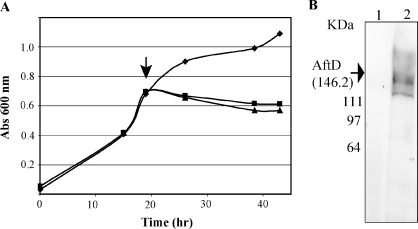
Production of a recombinant form of AftD in M. smegmatis mc2155 using the inducible pJAM2 system. (A) Growth characteristics of mc2155/pJAM2 (diamonds) and two independent mc2155/pJAMRv0236c clones (squares and triangles) in the MM63 medium before and after induction with acetamide (indicated by an arrow). (B) Production of a recombinant C-ter His6-tagged form of AftD from M. tb 8-h post-induction with acetamide was detected by Western blot using a monoclonal anti-His tag antibody in the mc2155/pJAMRv0236c strain (lane 2) but not in the control strain, mc2155/pJAM2 (lane 1).
Fig. 5
Fig. 5
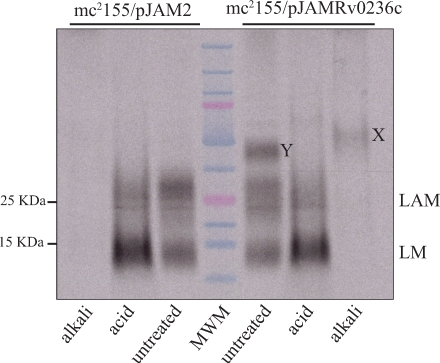
Effect of overexpressing aftD on the lipoglycan content of M. smegmatis. Autoradiogram of the lipoglycans extracted from identical amounts of mc2155/pJAM2 and mc2155/pJAMRv0236c cells labeled with [U-14C]glucose and separated on a Tricine SDS–PAGE gel. The positions of products X and Y are indicated. Samples were either untreated or submitted to mild-acid (acid) or mild-alkali (alkali) treatments. MWM, molecular weight marker.
Fig. 6
Fig. 6
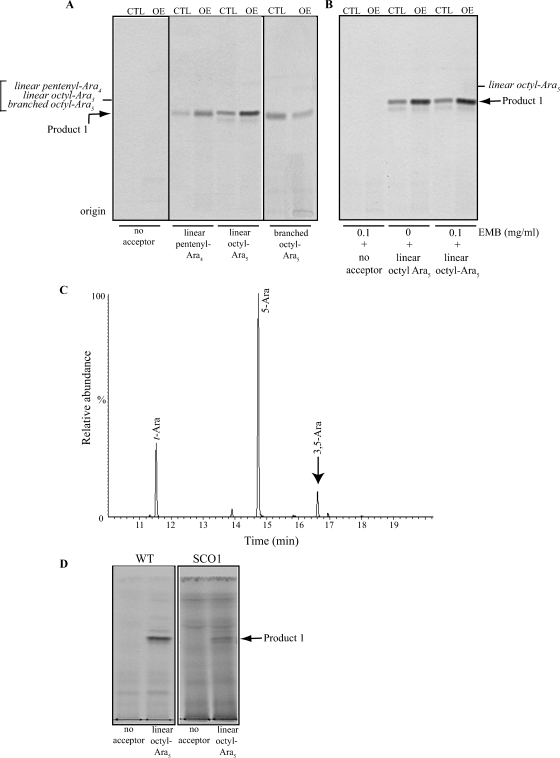
Arabinofuranosyltransferase assays using synthetic arabinosyl acceptors. (A) TLC autoradiographs of the products of the reactions using mc2155/pJAM2 (CTL) and mc2155/pJAMRv0236c (OE) cell-free extracts as enzyme sources, p[14C]Rpp as the donor substrate and different synthetic arabinofuranosyl acceptors. The lower minor product formed in the reaction utilizing a linear Ara5 acceptor is likely to result from the activity of a β-1,2 AraT, consistent with previous studies using mycobacterial extracts and short linear Araf acceptors (Birch et al. 2008). The synthesis of this product is not affected by the overexpression of aftD. (B) The same assays using linear Ara5 acceptor were run in the presence of 0.1 mg/mL ethambutol (EMB). Samples were prepared and analyzed as described under Material and methods. Twenty percent of each reaction was loaded onto the TLC plate. The products of the reactions were identified by co-migration with synthetic arabinofuranosyl standards (italicized). The presence of different aglycon moieties (pentenyl or octyl) on the synthetic acceptors accounts for the similar Rf of the radiolabeled Ara5 and Ara6 products on the TLC plate. (C) GC/MS analysis of the Ara6 product of the reaction. The per-O-methylated purified product was hydrolyzed with 2 M TFA, reduced, per-O-acetylated, and analyzed as described under Material and methods. (D) Assays using WT mc2155 (WT) and SCO1 cell-free extracts, p[14C]Rpp as the donor substrate and linear synthetic Ara5 as the acceptor substrate.
Fig. 7
Fig. 7
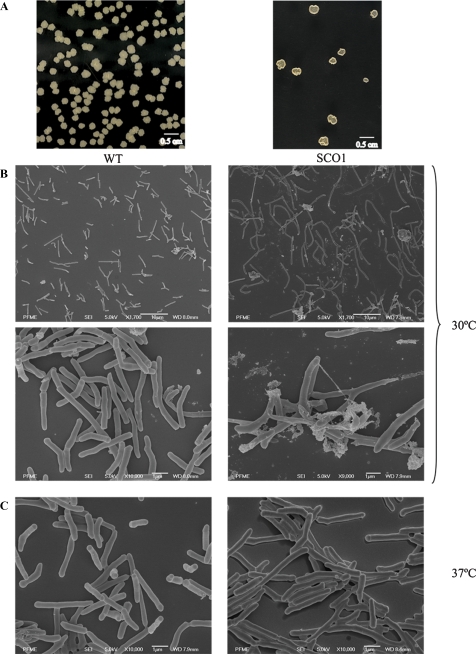
Morphology of the aftD single crossover strain of M. smegmatis. (A) Colony morphology of WT M. smegmatis mc2155 and the aftD single crossover strain SCO1 on LB agar plates at 30°C. (B and C) Scanning electron micrographs of the same strains cultured in 7H9-ADC-Tween 80 broth at 30 (B) or 37°C (C).
Fig. 8
Fig. 8
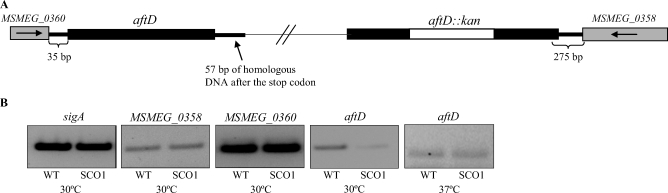
RT-PCR analysis of the expression of aftD and adjacent genes in M. smegmatis mc2155 and the aftD single crossover strain SCO1. (A) Schematic representation of the aftD genomic region in the single crossover strain SCO1. The thin line symbolizes the body of the integrated plasmid, pPR27MSMEG_0359KX, and is not represented to scale. The lengths of the intergenic regions are indicated. (B) RT-PCR analysis of the sigA, MSMEG_0358, aftD, and MSMEG_0360 transcripts in WT M. smegmatis mc2155 and the aftD single crossover strain SCO1. One quarter of the RT-PCR reactions were analyzed on 1% agarose gels.
Fig. 9
Fig. 9
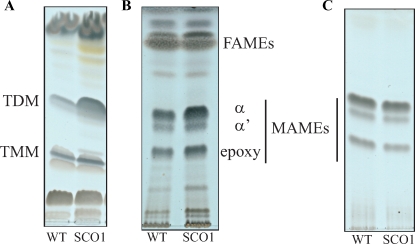
Analysis of the extractable lipids and cell wall-bound mycolates from M. smegmatis mc2155 and the aftD single crossover strain SCO1. (A) Equal amounts of total cellular lipids from WT M. smegmatis mc2155 and the aftD single crossover strain SCO1 were analyzed by TLC developed in the solvent system chloroform/methanol/water (20:4:0.5). (B) Fatty acid methyl esters (FAMEs) and mycolic acid methyl esters (MAMEs) prepared from the same amount of WT and SCO1 extractable lipids and (C) cell wall-bound MAMEs prepared from the same amount of WT and SCO1 cells were analyzed by TLC developed thrice in the solvent system n-hexane/ethyl acetate (95:5). TLC plates were revealed by spraying with cupric sulfate (10% in a 8% phosphoric acid solution) and heating. Analyses reveal an increase in the MAME content of the extractable lipids from strain SCO1 (B) consistent with the greater quantities of TDM recovered from this strain (A).

References

    1. Alderwick LJ, Seidel M, Sahm H, Besra GS, Eggeling L. Identification of a novel arabinosyl transferase (AftA) involved in cell wall arabinan biosynthesis in Mycobacterium tuberculosis. J Biol Chem. 2006;281:15653–15661. - PubMed
    1. Berg S, Kaur D, Jackson M, Brennan PJ. The glycosyltransferases of Mycobacterium tuberculosis- roles in the synthesis of arabinogalactan, lipoarabinomannan, and other glycoconjugates. Glycobiology. 2007;17:35R–56R. - PubMed
    1. Berg S, Starbuck J, Torrelles JB, Vissa VD, Crick DC, Chatterjee C, Brennan PJ. Roles of the conserved proline and glycosyltransferase motifs of EmbC in biosynthesis of lipoarabinomannan. J Biol Chem. 2005;280:5651–5663. - PubMed
    1. Bhamidi S, Scherman MS, Rithner CD, Prenni JE, Chatterjee D, Khoo K-H, McNeil MR. The identification and location of succinyl residues and the characterization of the interior arabinan region allows for a model of the complete primary structure of Mycobacterium tuberculosis mycolyl arabinogalactan. J Biol Chem. 2008;283:12992–13000. - PMC - PubMed
    1. Birch HL, Alderwick LJ, Bhatt A, Rittmann D, Krumbach K, Singh A, Bai Y, Lowary TL, Eggeling L, Besra GS. Biosynthesis of mycobacterial arabinogalactan: Identification of a novel α(1→3) arabinofuranosyltransferase. Mol Microbiol. 2008;69:1191–1206. - PMC - PubMed

Publication types

MeSH terms