Low doses of bisphenol A promote human seminoma cell proliferation by activating PKA and PKG via a membrane G-protein-coupled estrogen receptor
- PMID: 19654912
- PMCID: PMC2717129
- DOI: 10.1289/ehp.0800367
Low doses of bisphenol A promote human seminoma cell proliferation by activating PKA and PKG via a membrane G-protein-coupled estrogen receptor
Abstract
Background: Fetal exposure to environmental estrogens may contribute to hypofertility and/or to testicular germ cell cancer. However, many of these xenoestrogens have only a weak affinity for the classical estrogen receptors (ERs,) which is 1,000-fold less potent than the affinity of 17beta-estradiol (E(2)). Thus, several mechanisms have been suggested to explain how they could affect male germ cell proliferation at low environmental relevant concentrations.
Objectives: In this study we aimed to explore the possible promoting effect of bisphenol A (BPA) on human testicular seminoma cells. BPA is a well-recognized estrogenic endocrine disruptor used as a monomer to manufacture poly carbonate plastic and released from resin-lined food or beverage cans or from dental sealants.
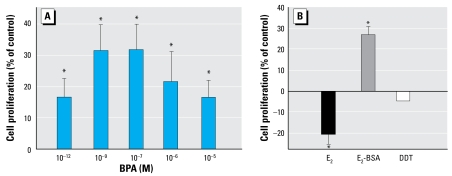
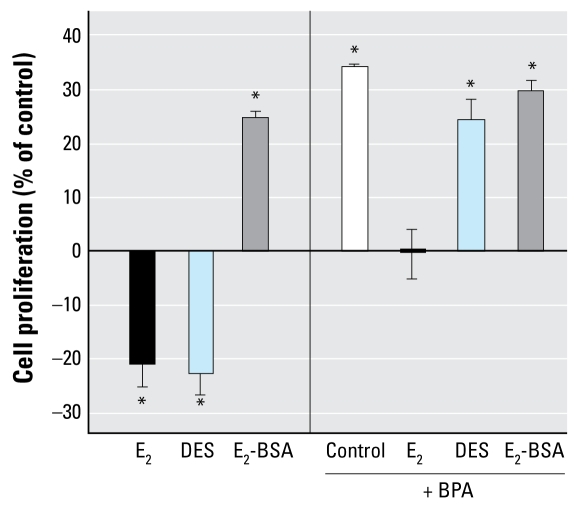
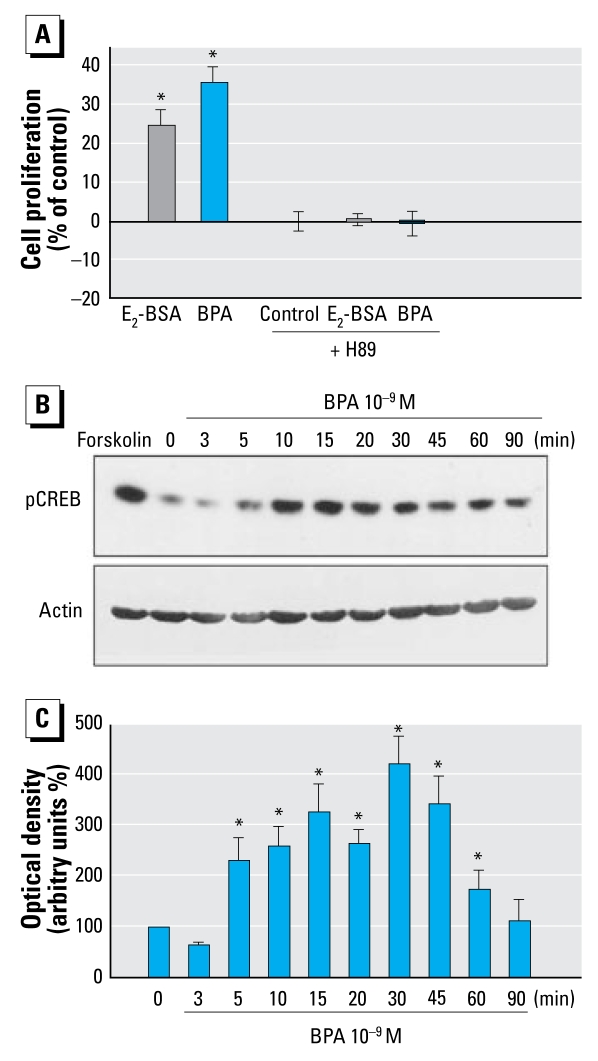
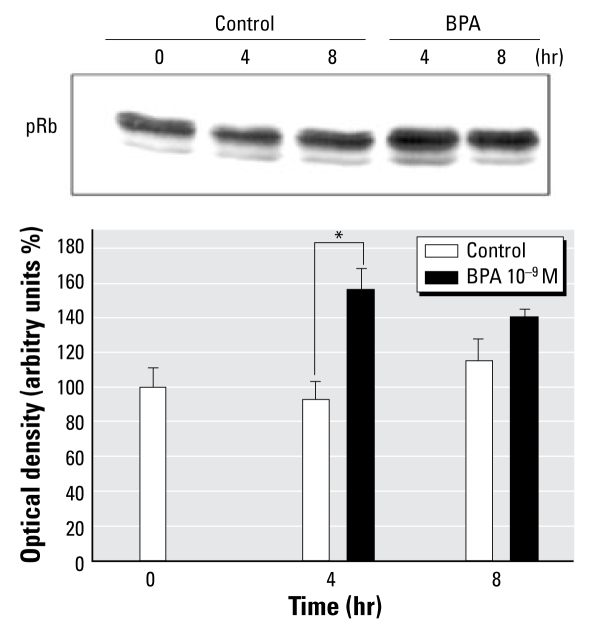
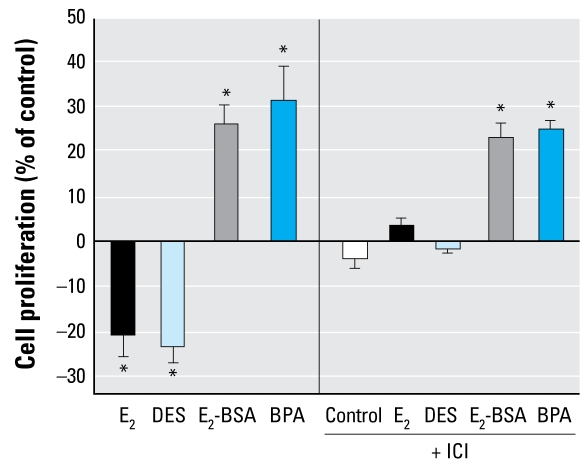
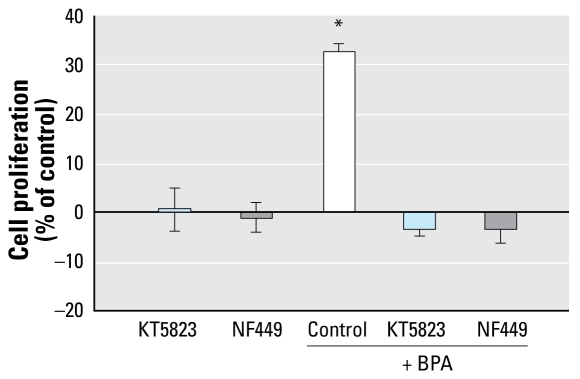
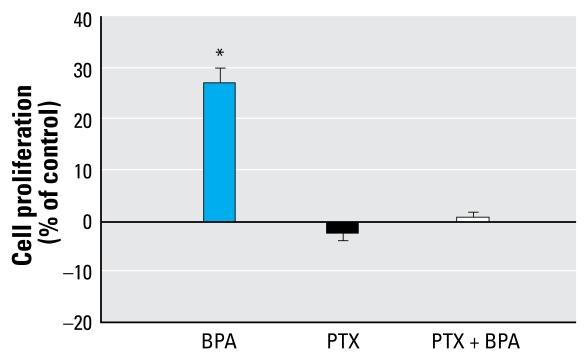
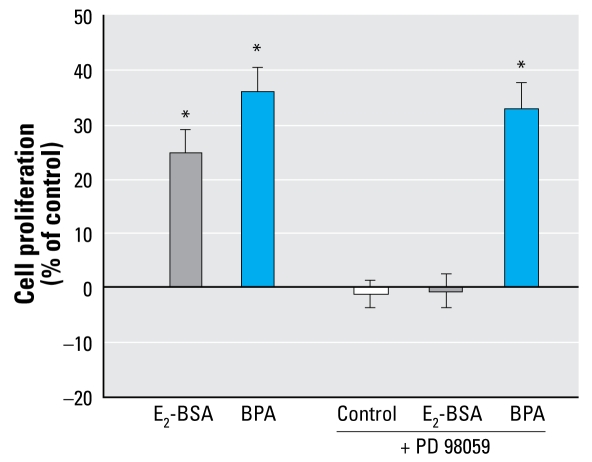
Methods and results: BPA at very low concentrations (10(-9) to 10(-12) M) similar to those found in human fluids stimulated JKT-1 cell proliferation in vitro. BPA activated both cAMP-dependent protein kinase and cGMP-dependent protein kinase pathways and triggered a rapid (15 min) phosphorylation of the transcription factor cAMP response-element-binding protein (CREB) and the cell cycle regulator retinoblastoma protein (Rb). This nongenomic activation did not involve classical ERs because it could not be reversed by ICI 182780 (an ER antagonist) or reproduced either by E(2) or by diethylstilbestrol (a potent synthetic estrogen), which instead triggered a suppressive effect. This activation was reproduced only by E(2) coupled to bovine serum albumin (BSA), which is unable to enter the cell. As with E(2)-BSA, BPA promoted JKT-1 cell proliferation through a G-protein-coupled nonclassical membrane ER (GPCR) involving a Galpha(s) and a Galpha(i)/Galpha(q) subunit, as shown by the reversible effect observed by the corresponding inhibitors NF449 and pertussis toxin.
Conclusion: This GPCR-mediated nongenomic action represents--in addition to the classical ER-mediated effect--a new basis for evaluating xenoestrogens such as BPA that, at low doses and with a high affinity for this GPCR, could interfere with the developmental programming of fetal germ cell proliferation and/or differentiation when they cross the placenta.
Keywords: ER; GPCR; PKA; PKG; bisphenol A; estrogen receptor; testicular germ cell cancer.
Figures
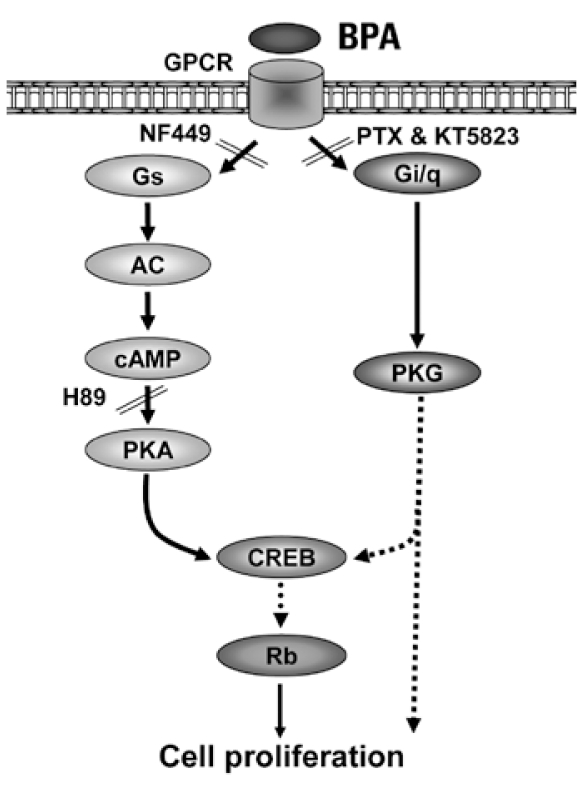
References
-
- Albanito L, Madeo A, Lappano R, Vivacqua A, Rago V, Carpino A, et al. G protein-coupled receptor 30 (GPR30) mediates gene expression changes and growth response to 17β-estradiol and selective GPR30 ligand G-1 in ovarian cancer cells. Cancer Res. 2007;67(4):1859–1866. - PubMed
-
- Alonso-Magdalena P, Laribi O, Ropero AB, Fuentes E, Ripoll C, Soria B, et al. Low doses of bisphenol A and diethyl-stilbestrol impair Ca2+ signals in pancreatic α-cells through a nonclassical membrane estrogen receptor within intact islets of Langerhans. Environ Health Perspect. 2005;113:969–977. - PMC - PubMed
-
- Belcher SM, Le HH, Spurling L, Wong JK. Rapid estrogenic regulation of extracellular signal-regulated kinase 1/2 signaling in cerebellar granule cells involves a G protein- and protein kinase A-dependent mechanism and intracellular activation of protein phosphatase 2A. Endocrinology. 2005;146(12):5397–5406. - PubMed
-
- Biles JE, McNeal TP, Begley TH, Hollifield HC. Determination of bisphenol-A in reusable polycarbonate food-contact plastics and migration to food simulation liquids. J Agric Food Chem. 1997;45:3541–3545.
Publication types
MeSH terms
Substances
LinkOut - more resources
Full Text Sources
Research Materials