


Walking speed-related changes in stride time variability: effects of decreased speed
- PMID: 19656364
- PMCID: PMC2731039
- DOI: 10.1186/1743-0003-6-32
Walking speed-related changes in stride time variability: effects of decreased speed
Abstract
Background: Conflicting results have been reported regarding the relationship between stride time variability (STV) and walking speed. While some studies failed to establish any relationship, others reported either a linear or a non-linear relationship. We therefore sought to determine the extent to which decrease in self-selected walking speed influenced STV among healthy young adults.
Methods: The mean value, the standard deviation and the coefficient of variation of stride time, as well as the mean value of stride velocity were recorded while steady-state walking using the GAITRite system in 29 healthy young adults who walked consecutively at 88%, 79%, 71%, 64%, 58%, 53%, 46% and 39% of their preferred walking speed.
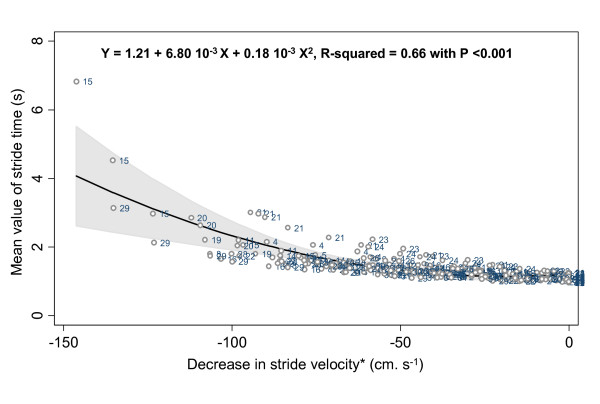
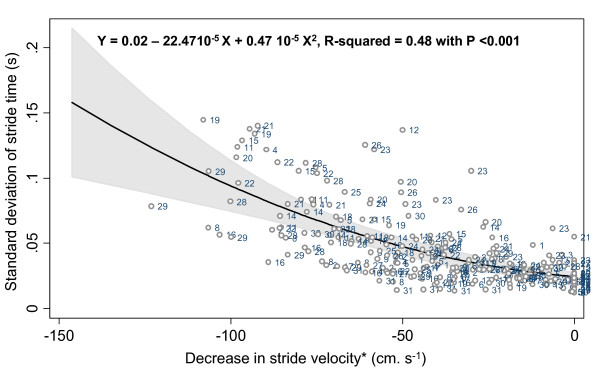
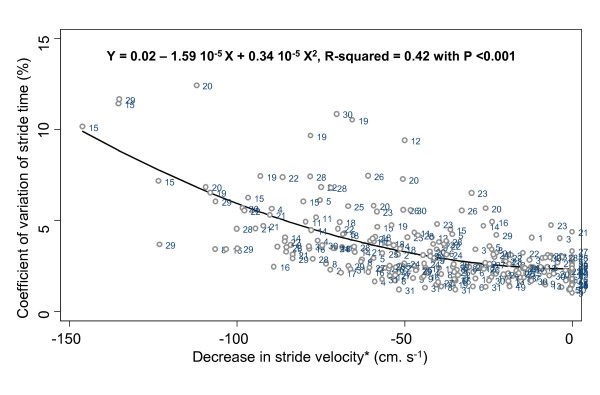
Results: The decrease in stride velocity increased significantly mean values, SD and CoV of stride time (p < 0.001), whereas the repetition of trials (p = 0.534, p = 0.177 and p = 0.691 respectively for mean, SD, CoV); and step asymmetry (p = 0.971, p = 0.150 and p = 0.288 for mean, SD and CoV) had no significant effect. Additionally, the subject's effect was significant for all stride parameters (p < 0.001). The relationship between a decrease in walking speed and all stride parameters (i.e., mean values, SD and CoV of stride time) was significantly quadratic and showed higher STV at a slow speed (p < 0.001).
Conclusion: The results support the assumption that gait variability increases while walking speed decreases and, thus, gait might be more unstable when healthy subjects walk slower compared with their preferred walking speed. Furthermore, these results highlight that a decrease in walking speed can be a potential confounder while evaluating STV.
Figures
References
-
- Nutt JG, Marsden CD, Thompson PD. Human walking and higher-level gait disorders, particularly in the elderly. Neurology. 1993;43:268–79. - PubMed
-
- Gabell A, Nayak US. The effect of age on variability in gait. J Gerontol. 1984;39:662–6. - PubMed
-
- Newell KM, Corcos DM. Issues in variability and motor control. In: Newell KM, Corcos DM, editor. Variability and motor control. Champaign: Human Kinetics; 1993. pp. 1–12.
-
- Beauchet O, Berrut G. Gait and dual-task: definition, interest, and perspectives in the elderly. Psychol Neuropsychiatr Vieil. 2006;4:215–25. - PubMed
MeSH terms
LinkOut - more resources
Full Text Sources
