


Effects of agarose mould compliance and surface roughness on self-assembled meniscus-shaped constructs
- PMID: 19658151
- PMCID: PMC2766101
- DOI: 10.1002/term.191
Effects of agarose mould compliance and surface roughness on self-assembled meniscus-shaped constructs
Abstract
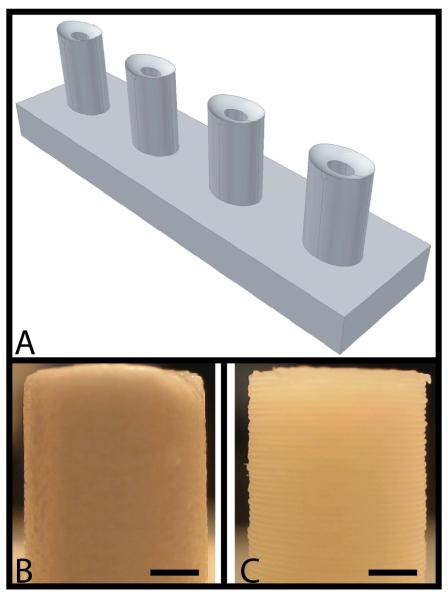
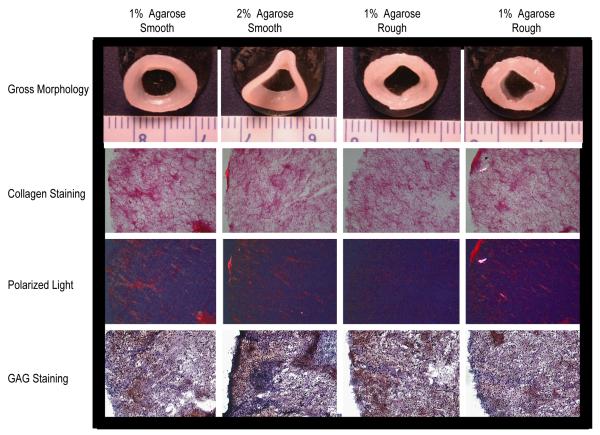
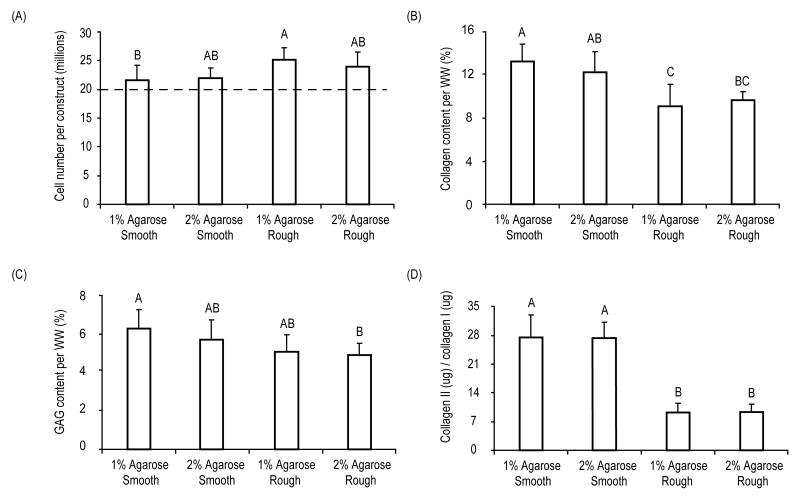
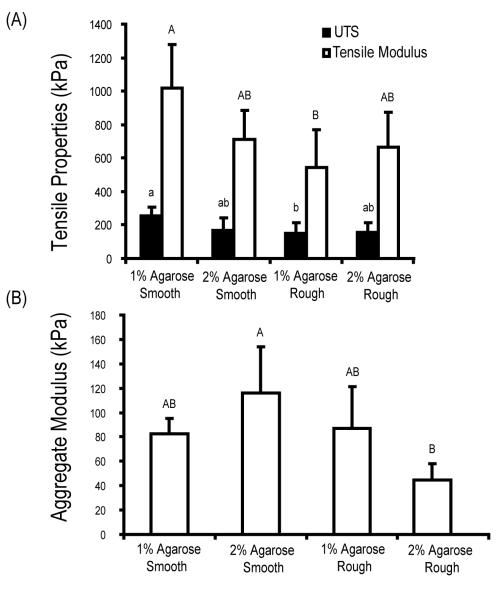
The meniscus is a fibrocartilaginous tissue that is critically important to the loading patterns within the knee joint. If the meniscus structure is compromised, there is little chance of healing, due to limited vascularity in the inner portions of the tissue. Several tissue-engineering techniques to mimic the complex geometry of the meniscus have been employed. Of these, a self-assembly, scaffoldless approach employing agarose moulds avoids drawbacks associated with scaffold use, while still allowing the formation of robust tissue. In this experiment two factors were examined, agarose percentage and mould surface roughness, in an effort to consistently obtain constructs with adequate geometric properties. Co-cultures of ACs and MCs (50:50 ratio) were cultured in smooth or rough moulds composed of 1% or 2% agarose for 4 weeks. Morphological results showed that constructs formed in 1% agarose moulds, particularly smooth moulds, were able to maintain their shape over the 4 week culture period. Significant increases were observed for the collagen II:collagen I ratio, total collagen, GAG and tensile and compressive properties in smooth wells. Cell number per construct was higher in the rough wells. Overall, it was observed that the topology of an agarose surface may be able to affect the phenotypic properties of cells that are on that surface, with smooth surfaces supporting a more chondrocytic phenotype. In addition, wells made from 1% agarose were able to prevent construct buckling potentially, due to their higher compliance.
Copyright (c) 2009 John Wiley & Sons, Ltd.
Figures
References
-
- Adkisson HD, Gillis MP, Davis EC, Maloney W, Hruska KA. In vitro generation of scaffold independent neocartilage. Clin Orthop Relat Res. 2001;(391 Suppl):S280–94. - PubMed
-
- Allen KD, Athanasiou KA. Effect of passage and topography on gene expression of temporomandibular joint disc cells. Tissue Eng. 2007;13(1):101–10. - PubMed
-
- Altman GH, Horan RL, Martin I, Farhadi J, Stark PR, Volloch V, Richmond JC, Vunjak-Novakovic G, Kaplan DL. Cell differentiation by mechanical stress. Faseb J. 2002;16(2):270–2. - PubMed
-
- Aufderheide AC, Athanasiou KA. Assessment of a bovine co-culture, scaffold-free method for growing meniscus-shaped constructs. Tissue Eng. 2007;13(9):2195–205. - PubMed
-
- Awad HA, Erickson GR, Guilak F. Biomaterials for cartilage tissue engineering. In: Lewandrowski KU, Wise DL, Trantolo DJ, Gresser JD, Yaszemski MJ, Altobelli DE, Wise DL, Trantolo DJ, Gresser JD, Yaszemski MJ, editors. Tissue engineering and biodegradable equivalents: scientific and clinical applications. Marcel Dekker Inc.; New York, NY: 2002. pp. 267–299. others.
Publication types
MeSH terms
Substances
Grants and funding
LinkOut - more resources
Full Text Sources
Other Literature Sources
