


Severe hypoxia induces chemo-resistance in clinical cervical tumors through MVP over-expression
- PMID: 19660100
- PMCID: PMC2728103
- DOI: 10.1186/1748-717X-4-29
Severe hypoxia induces chemo-resistance in clinical cervical tumors through MVP over-expression
Abstract
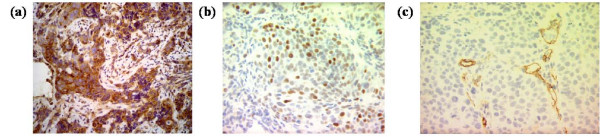
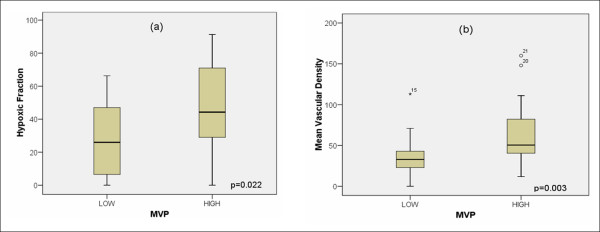
Oxygen molecule modulates tumour response to radiotherapy. Higher radiation doses are required under hypoxic conditions to induce cell death. Hypoxia may inhibit the non-homologous end-joining DNA repair through down regulating Ku70/80 expression. Hypoxia induces drug resistance in clinical tumours, although the mechanism is not clearly elucidated. Vaults are ribonucleoprotein particles with a hollow barrel-like structure composed of three proteins: major vault protein (MVP), vault poly(ADP-ribose) polymerase, and telomerase associated protein-1 and small untranslated RNA. Over-expression of MVP has been associated with chemotherapy resistance. Also, it has been related to poor outcome in patients treated with radiotherapy alone. The aim of the present study was to assess the relation of Major Vault Protein expression and tumor hypoxia in clinical cervical tumors. MVP, p53 and angiogenesis, together with tumor oxygenation, were determined in forty-three consecutive patients suffering from localized cervix carcinoma. High MVP expression was related to severe hypoxia compared to low MVP expressing tumors (p = 0.022). Tumors over-expressing MVP also showed increased angiogenesis (p = 0.003). Besides it, in this study we show for the first time that severe tumor hypoxia is associated with high MVP expression in clinical cervical tumors. Up-regulation of MVP by hypoxia is of critical relevance as chemotherapy is currently a standard treatment for those patients. From our results it could be suggested that hypoxia not only induces increased genetic instability, oncogenic properties and metastatization, but through the correlation observed with MVP expression, another pathway of chemo and radiation resistance could be developed.
Figures
References
-
- Tatum JL, Kelloff GJ, Gillies RJ, Arbeit JM, Brown JM, Chao KS, Chapman JD, Eckelman WC, Fyles AW, Giaccia AJ, Hill RP, Koch CJ, Krishna MC, Krohn KA, Lewis JS, Mason RP, Melillo G, Padhani AR, Powis G, Rajendran JG, Reba R, Robinson SP, Semenza GL, Swartz HM, Vaupel P, Yang D, Croft B, Hoffman J, Liu G, Stone H, Sullivan D. Hypoxia: importance in tumor biology, noninvasive measurement by imaging, and value of its measurement in the management of cancer therapy. Int J Radiat Biol. 2006;82:699–757. doi: 10.1080/09553000601002324. - DOI - PubMed
Publication types
MeSH terms
Substances
LinkOut - more resources
Full Text Sources
Medical
Research Materials
Miscellaneous
