


Altered coronary microvascular serotonin receptor expression after coronary artery bypass grafting with cardiopulmonary bypass
- PMID: 19660281
- PMCID: PMC2843817
- DOI: 10.1016/j.jtcvs.2009.05.032
Altered coronary microvascular serotonin receptor expression after coronary artery bypass grafting with cardiopulmonary bypass
Abstract
Objective: We evaluated roles of serotonin 1B and 2A receptors, thromboxane synthase and receptor, and phospholipases A(2) and C in response to cardiopulmonary bypass.
Methods: Patients' atrial tissues were harvested before and after cardiopulmonary bypass with cardioplegia (n = 13). Coronary microvessels were assessed for vasoactive response to serotonin with and without inhibitors of serotonin 1B and 2A receptors and phospholipases A(2) and C. Expressions of serotonin receptor messenger RNA were determined with reverse transcriptase polymerase chain reaction. Expressions of serotonin receptors and thromboxane A(2) receptor and synthase proteins were determined with immunoblotting and immunohistochemistry.
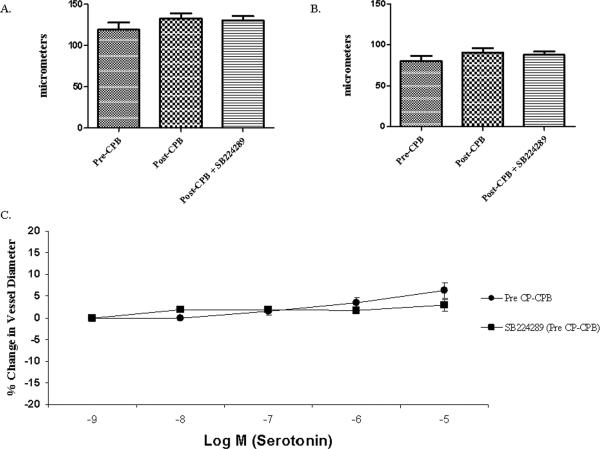
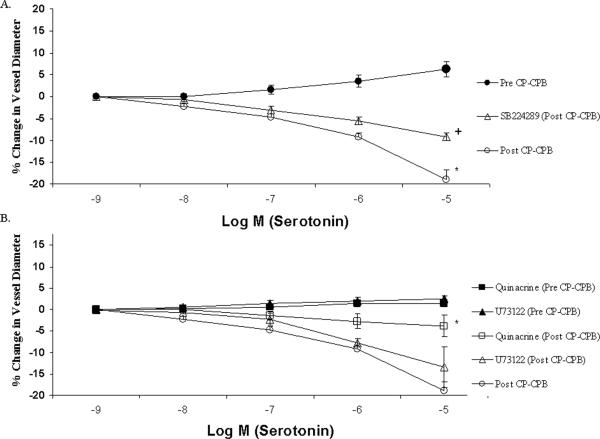
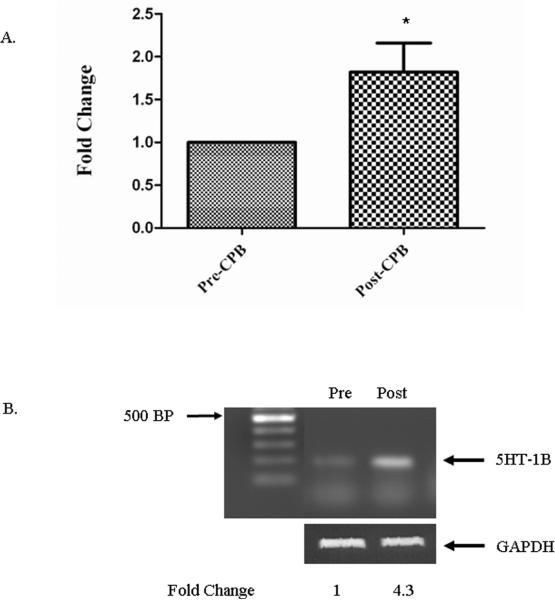
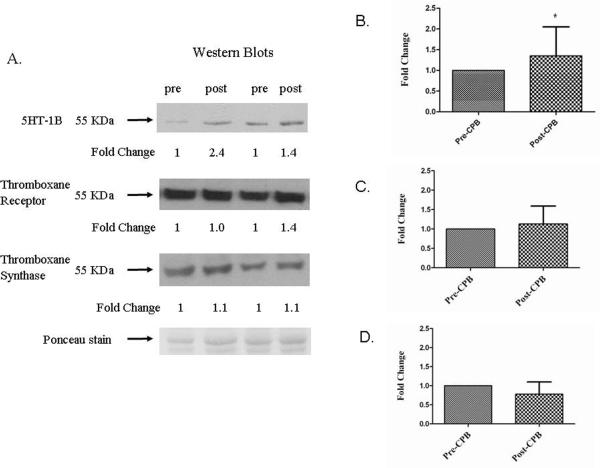
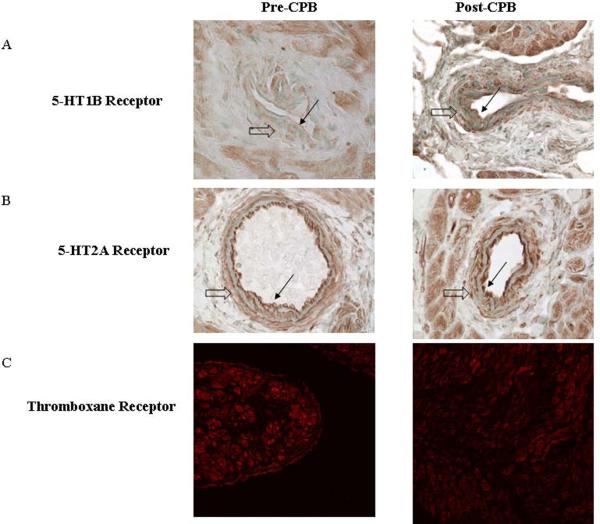
Results: Microvessel exposure to serotonin elicited 7.3% +/- 2% relaxation before bypass, changing to contraction of -19.2% +/- 2% after bypass (P <.001). Additions of specific serotonin 1B receptor antagonist and inhibitor of phospholipase A(2) resulted in significantly decreased contraction, -8.6% +/- 1% (P < .001) and 2.8% +/- 3% (P = .001), respectively. Serotonin 1B receptor messenger RNA expression increased 1.82 +/- 0.34-fold after bypass (p = .044); serotonin 2A receptor messenger RNA expression did not change. Serotonin 1B but not 2A receptor protein expression increased after bypass by 1.35 +/- 0.7-fold (P = .0413). Thromboxane synthase and receptor expressions were unchanged after bypass. Serotonin 1B receptor increased mainly in arterial smooth muscle. There were no appreciable differences in arterial expressions of thromboxane synthase or receptor.
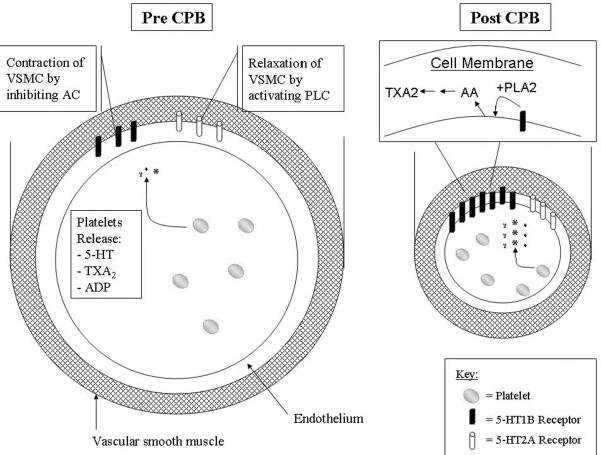
Conclusions: Serotonin-induced vascular dysfunction after cardiopulmonary bypass with cardioplegic arrest may be mediated by increased expression of serotonin 1B receptor and subsequent phospholipase A(2) activation in myocardial coronary smooth muscle.
Copyright 2010 The American Association for Thoracic Surgery. Published by Mosby, Inc. All rights reserved.
Figures
References
-
- Sellke FW, Li J, Stamler A, Lopez JJ, Thomas KA, Simons M. Angiogenesis induced by acidic fibroblast growth factor as an alternative method of revascularization for chronic myocardial ischemia. Surgery. 1996 Aug;120(2):182–8. - PubMed
-
- Luscher TF, Tanner FC, Tschudi MR, Noll G. Endothelial dysfunction in coronary artery disease. Annu Rev Med. 1993;44:395–418. - PubMed
-
- Perrault LP, Mahlberg F, Breugnot C, Bidouard J-P, Villeneuve N, Vilaine J-P, et al. Hypercholesterolemia Increases Coronary Endothelial Dysfunction, Lipid Content, and Accelerated Atherosclerosis After Heart Transplantation. Arterioscler Thromb Vasc Biol. 2000 March 1;20(3):728–36. 2000. - PubMed
-
- Buxton AE, Hirshfeld JW, Jr., Untereker WJ, Goldberg S, Harken AH, Stephenson LW, et al. Perioperative coronary arterial spasm: long-term follow-up. Am J Cardiol. 1982 Sep;50(3):444–51. - PubMed
-
- Skarvan K, Graedel E, Hasse J, Stulz P, Pfisterer M. Coronary artery spasms after coronary artery bypass surgery. Anesthesiology. 1984 Sep;61(3):323–7. - PubMed
MeSH terms
Substances
Grants and funding
LinkOut - more resources
Full Text Sources
Medical
