


Dissecting protein function and signaling using protein microarrays
- PMID: 19660979
- PMCID: PMC2811369
- DOI: 10.1016/j.cbpa.2009.06.027
Dissecting protein function and signaling using protein microarrays
Abstract
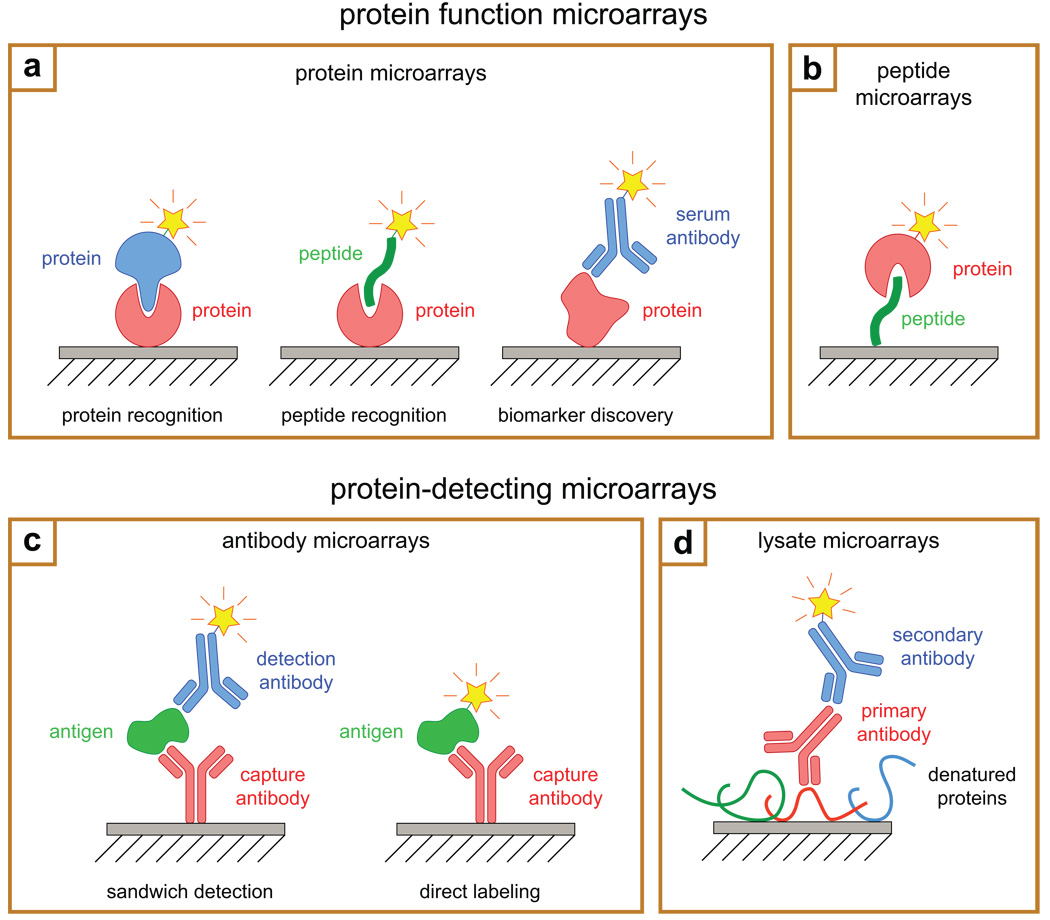
Although many methods exist to study the recognition and signaling properties of proteins in isolation, it remains a challenge to perform these investigations on a system-wide or proteome-wide scale and within the context of biological complexity. Protein microarray technology provides a powerful tool to assess the selectivity of protein-protein interactions in high-throughput and to quantify the abundances and post-translational modification states of many different proteins in complex mixtures. Here, we provide an overview of the various applications of protein microarray technology and compare the strengths and technical challenges associated with each approach. Overall, we conclude that if this technology is to have a substantial impact on our understanding of cell biology and physiology, increased emphasis must be placed on obtaining rigorously controlled quantitative data from protein function microarrays and on assessing the selectivity of reagents used in conjunction with protein-detecting microarrays.
Figures
References
-
- Kodadek T. Protein microarrays: prospects and problems. Chem Biol. 2001;8:105–115. - PubMed
-
- MacBeath G, Schreiber SL. Printing proteins as microarrays for high-throughput function determination. Science. 2000;289:1760–1763. - PubMed
-
- Newman JR, Keating AE. Comprehensive identification of human bZIP interactions with coiled-coil arrays. Science. 2003;300:2097–2101. - PubMed
-
-
Grigoryan G, Reinke AW, Keating AE. Design of protein-interaction specificity gives selective bZIP-binding peptides. Nature. 2009;458:859–864.. This study is a recent example of using protein microarrays to study molecular selectivity within a family of closely related proteins. Microarrays of human basic-region leucine zipper (bZIP) transcription factors were used to characterize the binding selectivity of computationally designed synthetic bZIP ligands.
-
Publication types
MeSH terms
Substances
Grants and funding
LinkOut - more resources
Full Text Sources
Other Literature Sources
