Marriage protects men from clinically meaningful elevations in C-reactive protein: results from the National Social Life, Health, and Aging Project (NSHAP)
- PMID: 19661186
- PMCID: PMC3625249
- DOI: 10.1097/PSY.0b013e3181b4c4f2
Marriage protects men from clinically meaningful elevations in C-reactive protein: results from the National Social Life, Health, and Aging Project (NSHAP)
Abstract
Objective: To examine the association between marital status and C-reactive protein (CRP) levels after accounting for a range of relevant of demographic, subjective, and objective health indicators and psychological variables. Minor elevations in CRP (>3 mg/L) are a nonspecific marker of systemic inflammation and predict the future onset of cardiovascular disease.
Methods: Data from the National Social Life, Health, and Aging Project (NSHAP), a population-based study of community-dwelling older adults in the United States, were used to study CRP elevations. Home-based interviews were conducted with the entire NSHAP sample, a subset of whom provided whole blood samples for the CRP analyses. The final sample consisted of 1715 participants (n = 838 men) with an average age of 69.51 years. Multiple and logistic regression analyses were conducted, using CRP as a continuous and dichotomous outcome variable.
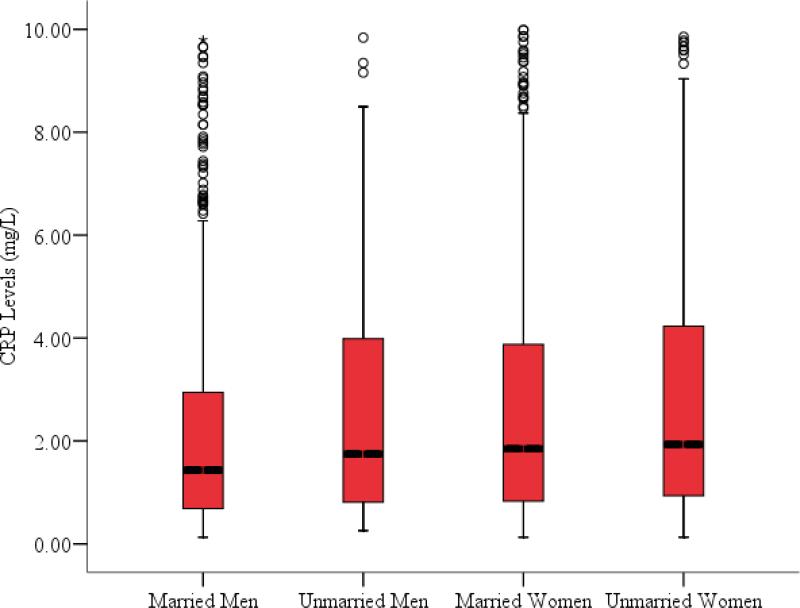
Results: Across the entire NSHAP sample, married men demonstrated the lowest levels of CRP. After adjusting for the competing predictors, marriage remained a unique protective factor against elevated CRP for men (odds ratio = 0.56, 95% Confidence Interval = 0.39-0.79). The absolute risk reduction (for being classified in the high-risk CRP group) associated with being a married man was roughly equivalent to that observed for adults who were normotensive, nonsmokers, and those with a normal body mass index.
Conclusions: Remaining married in late adulthood affords men unique and robust protection against elevated levels of CRP. The findings are discussed in terms of the pathways linking marital status and health outcomes among older adults.
Figures
References
-
- House JS, Landis KR, Umberson D. Social relationships and health. Science. 1988;241:540–545. - PubMed
-
- Kiecolt-Glaser J, Newton TL. Marriage and health: His and hers. Psychological Bulletin. 2001;127:472–503. - PubMed
-
- Ryff CD, Singer BH. Emotions, social relationships, and health. Oxford University Press; New York: 2001.
-
- Uchino BN. Social support and physical health: Understanding the health consequences of relationships. Yale University Press; 2004.
-
- Waite LJ, Gallagher M. Why married people are happier; healthier; and better off financially. Broadway Books; New York: 2000. The Case for Marriage.
Publication types
MeSH terms
Substances
Grants and funding
LinkOut - more resources
Full Text Sources
Research Materials
Miscellaneous