


Brain phospholipid arachidonic acid half-lives are not altered following 15 weeks of N-3 polyunsaturated fatty acid adequate or deprived diet
- PMID: 19661256
- PMCID: PMC2817583
- DOI: 10.1194/jlr.M000786
Brain phospholipid arachidonic acid half-lives are not altered following 15 weeks of N-3 polyunsaturated fatty acid adequate or deprived diet
Abstract
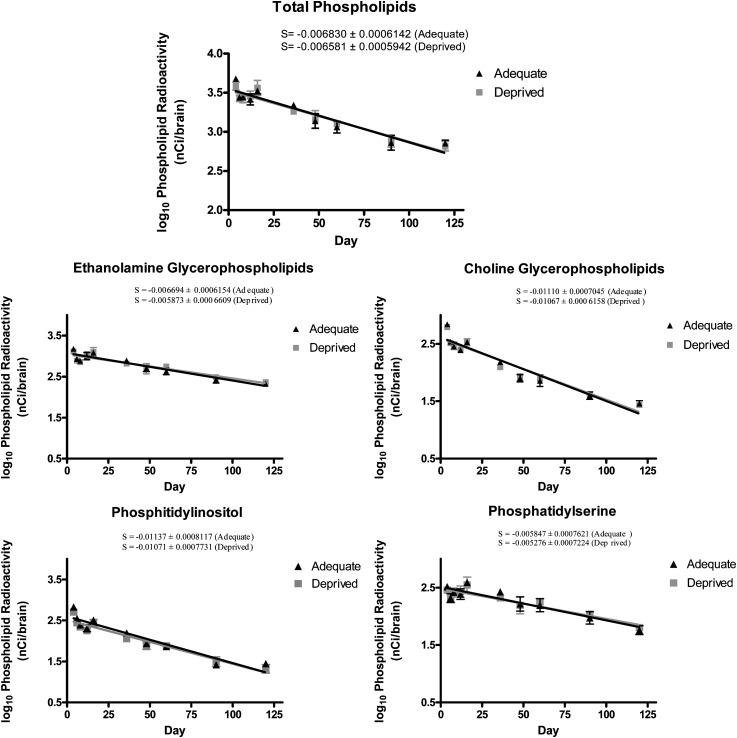
Previous studies have infused radiolabeled arachidonic acid (AA) into rat brains and followed AA esterification into phospholipids for up to 24 h; however, the half-life of AA in rat brain phospholipids is unknown. Eighteen day old rats were fed either an n-3 PUFA adequate or deprived diet for 15 weeks. Following the 15 weeks, 40 microCi of [(3)H] AA was injected intracerebroventricularly into the right lateral ventricle using stereotaxic surgery and returned to their dietary treatment. From 4-120 days after [(3)H] AA administration, brains were collected for chemical analyses. The half-life of AA in rat brain phospholipids was 44 +/- 4 days for the n-3 PUFA adequate group and 46 +/- 4 days for the n-3 PUFA deprived group, which closely approximates the predicted half-life previously reported, based on the rate of entry from the plasma unesterified pool, suggesting the plasma unesterified pool is a major contributor to brain uptake of AA. Furthermore, unlike a previous report in which the half-life of brain phospholipid docosahexaenoic acid (DHA) was increased in n-3 PUFA deprived rats, n-3 PUFA deprivation did not significantly alter the AA half-life, suggesting different mechanisms exist to maintain brain concentrations of AA and DHA.
Figures
References
-
- Salem N., Jr., Litman B., Kim H. Y., Gawrisch K. 2001. Mechanisms of action of docosahexaenoic acid in the nervous system. Lipids. 36: 945–959. - PubMed
-
- Alessandri J. M., Guesnet P., Vancassel S., Astorg P., Denis I., Langelier B., Aid S., Poumes-Ballihaut C., Champeil-Potokar G., Lavialle M. 2004. Polyunsaturated fatty acids in the central nervous system: evolution of concepts and nutritional implications throughout life. Reprod. Nutr. Dev. 44: 509–538. - PubMed
-
- Demar J. C., Jr., Ma K., Chang L., Bell J. M., Rapoport S. I. 2005. Alpha-linolenic acid does not contribute appreciably to docosahexaenoic acid within brain phospholipids of adult rats fed a diet enriched in docosahexaenoic acid. J. Neurochem. 94: 1063–1076. - PubMed
Publication types
MeSH terms
Substances
LinkOut - more resources
Full Text Sources
