


Tissue factor and PAR2 signaling in the tumor microenvironment
- PMID: 19661489
- PMCID: PMC2806842
- DOI: 10.1161/ATVBAHA.108.177428
Tissue factor and PAR2 signaling in the tumor microenvironment
Abstract
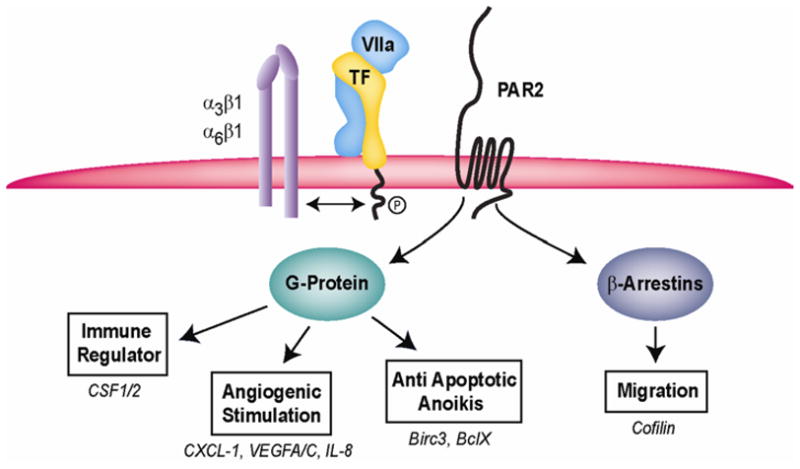
Diverse oncogenic transformations result in the constitutive expression of tissue factor (TF) in cancer cells. The local and systemic activation of the coagulation cascade has long been a recognized hallmark for aggressive cancer, but genetic mouse models and new experimental therapeutics have only recently demonstrated crucial roles for TF initiated cell signaling in the pathogenesis of cancer. On tumor cells, the TF-VIIa binary complex mediates activation of protease activated receptor (PAR) 2 and thereby shapes the tumor microenvironment by inducing an array of proangiogenic and immune modulating cytokines, chemokines, and growth factors. PAR2 also uniquely triggers tumor cell migration by G protein-independent pathways through beta-arrestin scaffolding. Metastatic tumor cells use additional signaling networks of the coagulation cascade by activating PAR1 through thrombin or the ternary TF-VIIa-Xa signaling complex in the vascular and potentially lymphatic system. Selective antagonists of TF-VIIa-PAR2 signaling may be used as antiangiogenic therapy without increasing the risk of bleeding, whereas coagulation and associated signaling pathways on platelets and other host cells may be targeted for therapeutic benefit in advanced cancer and metastatic disease.
Figures
References
-
- Ten Cate H, Falanga A. Overview of the postulated mechanisms linking cancer and thrombosis. Pathophysiol Haemost Thromb. 2007;36:122–30. - PubMed
-
- Hron G, Kollars M, Weber H, Sagaster V, Quehenberger P, Eichinger S, Kyrle PA, Weltermann A. Tissue factor-positive microparticles: cellular origin and association with coagulation activation in patients with colorectal cancer. Thromb Haemost. 2007;97:119–23. - PubMed
-
- Coughlin SR. Thrombin signalling and protease-activated receptors. Nature. 2000;407:258–64. - PubMed
Publication types
MeSH terms
Substances
Grants and funding
LinkOut - more resources
Full Text Sources
Other Literature Sources
Miscellaneous
