Review
. 2009 Dec;66(23):3755-75.
doi: 10.1007/s00018-009-0114-3. Epub 2009 Aug 7.

Operons

Affiliations
Review

Operons

Anne E Osbourn et al. Cell Mol Life Sci. 2009 Dec.

Abstract

Operons (clusters of co-regulated genes with related functions) are common features of bacterial genomes. More recently, functional gene clustering has been reported in eukaryotes, from yeasts to filamentous fungi, plants, and animals. Gene clusters can consist of paralogous genes that have most likely arisen by gene duplication. However, there are now many examples of eukaryotic gene clusters that contain functionally related but non-homologous genes and that represent functional gene organizations with operon-like features (physical clustering and co-regulation). These include gene clusters for use of different carbon and nitrogen sources in yeasts, for production of antibiotics, toxins, and virulence determinants in filamentous fungi, for production of defense compounds in plants, and for innate and adaptive immunity in animals (the major histocompatibility locus). The aim of this article is to review features of functional gene clusters in prokaryotes and eukaryotes and the significance of clustering for effective function.


Figures

Fig. 1
Fig. 1
The Escherichia coli lac regulon. lacI encodes the lac repressor, which in its active form inhibits the transcription of the structural genes by binding an operator. The genes within the lac operon (lacZYA) are transcribed as a single mRNA. Expression is induced by lactose under conditions of carbon starvation. Expression of lacZYA is positively regulated by an activator whose production is controlled by the concentration of extracellular glucose
Fig. 2
Fig. 2
Mechanisms of operon formation in bacteria (adapted from Ref. [9]). ORFans are genes that lack identifiable homologues outside a group of closely related bacteria. Most ORFans are functional protein-encoding genes that are under purifying selection and so are likely to contribute to the fitness of the organism. They were probably acquired from bacteriophage
Fig. 3
Fig. 3
Different levels of regulation of the aflatoxin gene cluster in the fungus, Aspergillus nidulans. The genes for aflatoxin biosynthesis are clustered in a 70-kb region and encode at least 23 co-regulated transcripts (not all cluster genes are shown in this diagram). The positive regulatory gene aflR lies within the gene cluster and is required for the transcriptional activation of most, if not all, pathway genes. aflR also regulates three genes outside the aflatoxin gene cluster. LaeA is a master regulator of secondary metabolism in the Aspergilli and is required for AlfR-mediated expression of the aflatoxin biosynthetic cluster. LaeA also controls transcription of gene clusters for other secondary metabolites and is believed to act via chromatin remodeling. Histone deacetylase (HdaA) performs an opposing role to LaeA and functions to repress gene expression in this region. Synthesis of secondary metabolites in the Aspergilli is linked to environmental stimuli and development. In the light asexual development (sporulation) is induced and genes involved in aflatoxin are not expressed. Darkness induces sexual development with associated induction of metabolite production, mediated by the proteins VelB and VeA. Adapted from [33]
Fig. 4
Fig. 4
The allantoin degradation pathway—an adaptation to growth under oxygen-limiting conditions in Saccharomyces cerevisiae. In the classical purine degradation pathway, xanthine is converted to urate and then to allantoin, in two successive oxidation steps catalyzed by the peroxisomal enzymes xanthine dehydrogenase (XDH) and urate oxidase (UOX). XDH genes are present in filamentous fungi but not in yeasts. To use purine derivatives as a nitrogen source yeasts must therefore import urate, allantoin or allantoate from outside the cell. Yeasts that lack the DAL cluster (e.g., Kluyveromyces lactis, Saccharomyces kluyveri, and Zygosaccharomyces rouxii) are all able to grow on urate as a sole nitrogen source, presumably using urate permease (UAP) to import it, UOX to oxidize it and the DAL pathway enzymes to break it down to urea. In contrast, S. cerevisiae and Saccharomyces castelli have lost the ability to use urate, have no UOX or UAP genes, and instead import allantoin. The allantoin permease gene DAL4 is a duplicate of the uracil permease gene FUR4. The Dal4 and Fur4 proteins are members of a purine-related transporter family. The subsequent degradation steps involve the same DAL pathway genes in all yeasts, but in S. cerevisiae and S. castelli the genes have been organized into a cluster and the malate synthase gene MLS1 has been duplicated to produce DAL7. MLS1 and DAL7 both encode malate synthase but they are regulated differently. The glyoxylate cycle gene MLS1 is glucose repressed, whereas DAL7 is nitrogen-repressed. The reaction catalyzed by UOX requires molecular oxygen as a substrate and takes place in the peroxisome. Biochemical reorganization of the purine degradation pathway to enable import of allantoin instead of urate eliminates the oxygen-requiring step mediated by UOX and coincided with the formation of the DAL gene cluster. This biochemical reorganization may have been driven by selection for ability to grow under conditions of oxygen limitation. Reproduced from [76]
Fig. 5
Fig. 5
The birth of the DAL gene cluster. The DAL gene cluster on S. cerevisiae chromosome IX (red) lies within a sister region between chromosomes IX and XI (genes shown in pale yellow). The corresponding region in K. waltii, a yeast species that does not contain the DAL gene cluster, contains a merge from these two chromosomes (genes shown at the bottom in pale blue). The K. waltii orthologues of the six DAL genes are scattered around the genome (upper left). DAL1, DAL2, DAL3, and DCG1 apparently transposed to the cluster site, while DAL4 and DAL7 were formed by duplication of FUR4 and MLS1. The region of the K. waltii corresponding to the site into which the DAL cluster has inserted is indicated with a red circle. Adapted from [76]
Fig. 6
Fig. 6
Activation of expression of the DAL genes. The DAL gene cluster lies within an HZAD domain, in which histone H2A is replaced by the histone variant H2A.Z (Htz1) [83]. H2A.Z protects euchromatin from the ectopic spread of silent heterochromatin (the region of Sir2-effected silencing closer to the telomere), and is present in (and enables expression of) the DAL1, DAL2, DCG1 and DAL3 genes but not DAL4 or DAL7. Interestingly, while DAL1, DAL2, DCG1 and DAL3 are all single copy genes, DAL4 and DAL7 were generated by duplication of progenitor genes that remain at their original sites in the S. cerevisiae genome. The exchange of histone H2A for H2A.Z is mediated by the Swr1 chromatin remodeling complex [182]. The region between the DAL1 and DAL4 genes binds the transcription repressor Sum1, which in turn recruits Hst1 (a paralog of Sir2), which deacetylates histones H3 and H4
Fig. 7
Fig. 7
The thalianol gene cluster in Arabidopsis. The A. thaliana gene cluster consists of four contiguous co-expressed genes encoding an oxidosqualene cyclase (THAS), two different types of cytochrome P450 (THAH and THAD) and a BAHD acyltransferase [101]. The organization of the equivalent region from the related crucifer, A. lyrata, is shown. The structure of the BAHD acyltransferase gene in A. lyrata is different (indicated by a split gene) and there is a 100-kb insertion in this region. dS number of synonymous substitutions per synonymous site; dN number of nonsynonymous substitutions per nonsynonymous site. Adapted from Ref. [125]
Fig. 8
Fig. 8
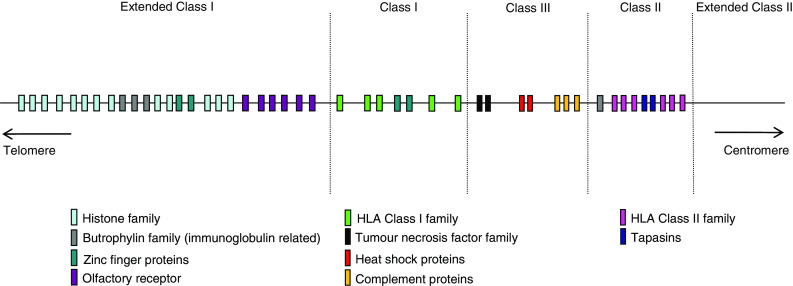
The human major histocompatibility complex (MHC). A representation of the distribution of genes from large or immunologically important gene families across the ~7.5 Mb extended MHC on the short arm of human chromosome 6. Each coloured block represents multiple genes and the number of blocks indicates their approximate abundance. Single genes, which are interspersed throughout, are not shown. Also not shown are the 157 tRNA loci that lie in the extended Class I region. The drawing is not to scale
Fig. 9
Fig. 9
Confocal image of septuple in situ hybridization exhibiting the spatial expression of Hox gene transcripts in a developing Drosophila embryo, with the chromosomal organization of the Hox gene cluster shown below: lab labial, pb proboscipedia (not shown in the in situ hybridization), Dfd deformed, Scr sex combs reduced, Antp antennapedia, Ubx ultrabithorax, Abd-A abdominal-A, Abd-B abdominal-B. The in situ hybridization image has been reproduced with permission from [183]
Fig. 10
Fig. 10
The mouse β-globin locus. The four mouse β-like globin genes are located downstream of an array of DNAse I hypersensitive sites (vertical bars). The first four DNAse I hypersensitive sites upstream of form the locus control region (LCR). Activation of the βmajor locus occurs in four steps [151, 184]: (I) an LCR subcomplex is assembled over the LCR; (II), (III) GATA-1 occupies the LCR and βmajor promoter and recruits the SWI/SNF chromatin remodeling complex; and (IV) SWI/SNF-dependent chromatin looping and final assembly of the promoter complex occur simultaneously, and are followed by recruitment of Pol II and activation of βmajor transcription. Adapted from [184]
Fig. 11
Fig. 11
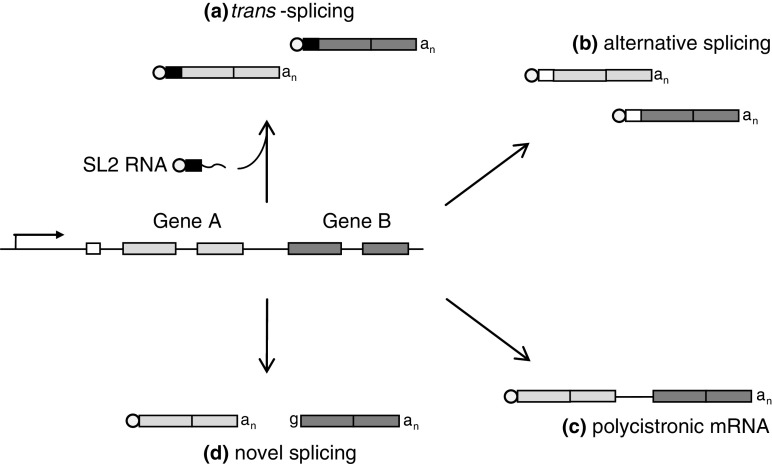
Different strategies for the processing of eukaryotic operons. a The operons of Caenorhabditis elegans produce a polycistronic pre-mRNA that is processed into two or more mature monocistronic mRNAs by the trans-splicing machinery. The spliced leader sequence (black box) is derived from a spliced leader (SL) RNA which carries the 5′ RNA cap (circle) [156]. b Alternative splicing of a polycistronic pre-mRNA can produce two mature mRNAs with a common first exon (white box) as observed at the conserved cholinergic locus [185]. c In some cases, such as for the Drosophila stoned locus, mature polycistronic mRNAs can be translated directly [167]. The downstream CDS is likely to be translated through ribosome reinitiation, leaky scanning or internal ribosome entry. d Also in Drosophila, at least one polycistronic pre-mRNA is spliced via a novel mechanism that results in a conventional capped monocistronic mRNA for the upstream gene and an uncapped monocistronic mRNA for the downstream gene [170]. The uncapped transcript is stable and appears to be translated

References

    1. Koonin E. Evolution of genome architecture. Int J Biochem Cell Biol. 2009;41:298–306. doi: 10.1016/j.biocel.2008.09.015. - DOI - PMC - PubMed
    1. Hurst LD, Pal C, Lercher MJ. The evolutionary dynamics of eukaryotic gene order. Nat Rev Genet. 2004;5:299–310. doi: 10.1038/nrg1319. - DOI - PubMed
    1. Jacob F, Perrin D, Sanchez C, Monod J. L’operon: Groupe de genes a l’expression coordonne par un operateur. C R Acad Sci. 1960;245:1727–729.
    1. Jacob F, Monod J (1961) On the regulation of gene activity. In: Cold Spring Harbor Symposium Quantitative Biology 26, pp 193–211
    1. Jacob F, Monod J. Genetic regulatory mechanisms in the synthesis of proteins. J Mol Biol. 1961;3:318–356. doi: 10.1016/S0022-2836(61)80072-7. - DOI - PubMed

Publication types

LinkOut - more resources