. 2009 Aug;119(8):2412-22.
doi: 10.1172/jci38650.

Hepatic energy state is regulated by glucagon receptor signaling in mice

Affiliations

Hepatic energy state is regulated by glucagon receptor signaling in mice

Eric D Berglund et al. J Clin Invest. 2009 Aug.

Abstract

The hepatic energy state, defined by adenine nucleotide levels, couples metabolic pathways with energy requirements. This coupling is fundamental in the adaptive response to many conditions and is impaired in metabolic disease. We have found that the hepatic energy state is substantially reduced following exercise, fasting, and exposure to other metabolic stressors in C57BL/6 mice. Glucagon receptor signaling was hypothesized to mediate this reduction because increased plasma levels of glucagon are characteristic of metabolic stress and because this hormone stimulates energy consumption linked to increased gluconeogenic flux through cytosolic phosphoenolpyruvate carboxykinase (PEPCK-C) and associated pathways. We developed what we believe to be a novel hyperglucagonemic-euglycemic clamp to isolate an increment in glucagon levels while maintaining fasting glucose and insulin. Metabolic stress and a physiological rise in glucagon lowered the hepatic energy state and amplified AMP-activated protein kinase signaling in control mice, but these changes were abolished in glucagon receptor- null mice and mice with liver-specific PEPCK-C deletion. 129X1/Sv mice, which do not mount a glucagon response to hypoglycemia, displayed an increased hepatic energy state compared with C57BL/6 mice in which glucagon was elevated. Taken together, these data demonstrate in vivo that the hepatic energy state is sensitive to glucagon receptor activation and requires PEPCK-C, thus providing new insights into liver metabolism.


Figures
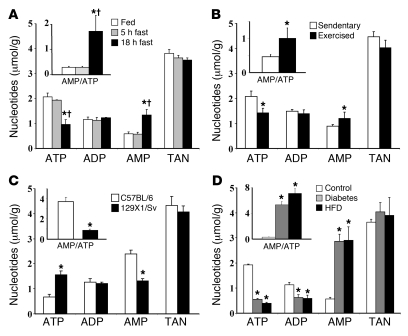
Figure 1
Figure 1. Metabolic stress reduces hepatic energy state in C57BL/6 mice.
Hepatic adenine nucleotides measured by HPLC in mice following (A) a 5- or 18-hour fast (n = 6–8/group), (B) maximal treadmill exercise (starting at 10 m/min, adding 4 m/min every 3 minutes, after a 5-hour fast; n = 6–8/group), (C) insulin-induced hypoglycemic clamp (n = 6–8/group), and (D) with STZ-induced diabetes (1 s.c. injection of 150 mg/kg; n = 6/group) or fed a high-fat diet (HFD; 60% fat by kcal for 9 weeks) and after fasting for 5 hours (n = 4/group). Hepatic AMP/ATP ratios are also shown for each condition. TAN content is the sum total of ATP, ADP, and AMP. All mice were 12 weeks of age and on a C57BL/6 background except in the experiments shown in C, in which 129X1/Sv mice were also studied. Mice were compared with respective controls (fed, C57BL/6, and 5-hour-fasted chow-fed mice). Data are presented as mean ± SEM. *P < 0.05 compared with controls. P < 0.05 compared with 5-hour-fasted mice.
Figure 2
Figure 2. Glucagon receptor is required for metabolic stress–induced reductions in hepatic energy state.
Hepatic adenine nucleotides measured by HPLC in Gcgr+/+ and Gcgr–/– littermate mice (n = 8/group) following (A) an 18-hour overnight fast and (B) maximal treadmill exercise (starting at 10 m/min and adding 4 m/min every 3 minutes, after a 5-hour fast). Mice were compared with fed controls or with mice that remained sedentary on the treadmill for 30 minutes. (C) Hepatic AMP/ATP ratios for each condition shown in A and B. There were no differences between fed and 5-hour-fasted control mice. Data are presented as mean ± SEM. *P < 0.05 compared with all other groups. **P < 0.05 compared with Gcgr+/+ control mice. #P < 0.05 compared with Gcgr–/–.
Figure 3
Figure 3. Hepatic PEPCK-C is required for fasting-induced reduction in energy state.
Hepatic adenine nucleotides measured by HPLC in Pcklox/lox and littermate Pcklox/loxAlb-cre mice (n = 8/group) following an 18-hour overnight fast. Mice were compared with fed controls. Hepatic AMP/ATP ratios for each group is shown on right. Data are presented as mean ± SEM. *P < 0.05 compared with fed Pcklox/lox mice.
Figure 4
Figure 4. The hyperglucagonemic-euglycemic clamp protocol permits an increment in glucagon levels without hyperglycemia or hyperinsulinemia.
(A) Plasma glucagon, (B) plasma insulin, (C) blood glucose, and (D) GIR in 5-hour-fasted, 12-week-old Gcgr+/+ and Gcgr–/– littermate mice on a C57BL/6 background during a hyperglucagonemic-euglycemic clamp (n = 7–9/group). At –60 minutes (equilibration), mice were infused with phloridzin (80 μg/kg/min) and a variable GIR to achieve and maintain euglycemia (~8.5 mmol/l). At 0 minutes, glucagon (10 ng/kg/min) was infused during a 120-minute experimental period. Blood glucose was measured every 5 minutes during equilibration and every 10 minutes during the experimental period. Basal glucose and hormone levels are the mean ± SEM of samples taken at –15 and –5 min. Clamp hormones are the mean ± SEM of samples taken at 100 and 120 minutes. *P < 0.05 compared with Gcgr+/+ vehicle-injected control mice.
Figure 5
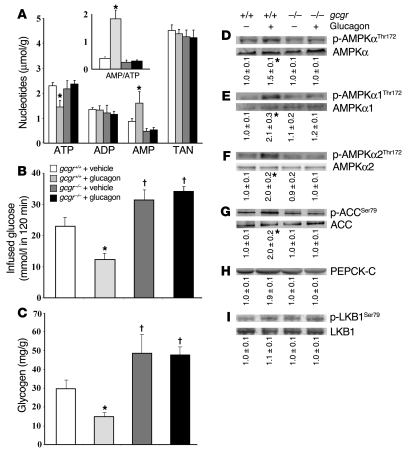
Figure 5. Glucagon lowers the hepatic energy state sufficient to activate AMPK.
(A) Hepatic adenine nucleotides measured by HPLC, (B) total glucose infused, and (C) hepatic glycogen in 5-hour-fasted 12-week-old Gcgr+/+ and Gcgr–/– littermate mice on a C57BL/6 background following a hyperglucagonemic-euglycemic clamp (n = 7–9/group). Hepatic AMP/ATP ratios are shown for each group in the inset of A. (DI) Representative immunoblots for p-AMPKαThr172/total AMPKα, p-AMPKα1Thr172/AMPKα1, p-AMPKα2Thr172/AMPKα2, p-ACCSer79/ACC, PEPCK-C, and p-LKB1Ser428/LKB1 content. All blots are normalized to GAPDH. Data are mean ± SEM. The numbers beneath each lane are arbitrary units normalized to vehicle-infused Gcgr+/+ mice. *P < 0.05 compared with all other groups. P < 0.05 compared with Gcgr+/+ mice.
Figure 6
Figure 6. Liver-specific deletion of PEPCK-C blunts the effect of glucagon during a hyperglucagonemic-euglycemic clamp.
(A) Plasma glucagon, (B) plasma insulin, (C) blood glucose, and (D) GIR in 5-hour-fasted, 12-week-old Pcklox/lox and littermate Pcklox/loxAlb-cre mice during a hyperglucagonemic-euglycemic clamp (n = 7–9/group). At –60 min (equilibration), mice were infused with phloridzin (80 μg/kg/min) and a variable GIR to achieve and maintain euglycemia (~8.0 mmol/l). At 0 minutes, glucagon (10 ng/kg/min) was infused during a 90-minute experimental period. Blood glucose was measured every 5 minutes during equilibration and every 10 minutes during the experimental period. Basal glucose and hormone levels are the mean ± SEM of samples taken at –15 and –5 minutes. Clamp hormones are the mean ± SEM of samples taken at 70 and 90 minutes. *P < 0.05 compared with Pcklox/lox vehicle control mice.
Figure 7
Figure 7. Hepatic PEPCK-C is required to mediate metabolic stress– and glucagon-induced reductions in hepatic energy state.
(A) Hepatic adenine nucleotides measured by HPLC in 5-hour-fasted 12-week-old Pcklox/lox and littermate Pcklox/loxAlb-cre mice following a hyperglucagonemic-euglycemic clamp (n = 7–9/group). Hepatic AMP/ATP ratios are shown for each group on the right. (BE) Representative immunoblots for p-AMPKαThr172/total AMPKα, p-ACCSer79/ACC, PEPCK-C, and p-LKB1Ser428/LKB1 content. The numbers beneath each lane are arbitrary units normalized to vehicle-infused Pcklox/loxAlb-cre mice. (F) Hepatic PEPCK-C protein content relative to hepatic AMP/ATP ratios in mice from all metabolic stress and/or clamp conditions in C57BL/6, 129X1/Sv, Gcgr+/+, Gcgr–/–, Pcklox/lox, and Pcklox/loxAlb-cre mice. PEPCK-C protein content was determined by immunoblot and normalized to C57BL/6 mice in the fed state. Data are mean ± SEM. *P < 0.05 compared with all other groups.

References

    1. Hardie D.G., Hawley S.A. AMP-activated protein kinase: the energy charge hypothesis revisited. Bioessays. 2001;23:1112–1119. doi: 10.1002/bies.10009. - DOI - PubMed
    1. Cheung P.C., Salt I.P., Davies S.P., Hardie D.G., Carling D. Characterization of AMP-activated protein kinase gamma-subunit isoforms and their role in AMP binding. Biochem. J. 2000;346:659–669. doi: 10.1042/0264-6021:3460659. - DOI - PMC - PubMed
    1. Cohen P.F., Colman R.F. Diphosphopyridine nucleotide dependent isocitrate dehydrogenase from pig heart. Charactgerization of the active substrate and modes of regulation. Biochemistry. 1972;11:1501–1508. doi: 10.1021/bi00758a027. - DOI - PubMed
    1. Ercan N., Gannon M.C., Nuttall F.Q. Allosteric regulation of liver phosphorylase a: revisited under approximated physiological conditions. Arch. Biochem. Biophys. 1996;328:255–264. doi: 10.1006/abbi.1996.0171. - DOI - PubMed
    1. Ercan-Fang N., et al. Integrated effects of multiple modulators on human liver glycogen phosphorylase a. Am. J. Physiol. Endocrinol. Metab. 2002;283:E29–E37. - PubMed

Publication types