. 2009 Sep;8(5):573-83.
doi: 10.1111/j.1474-9726.2009.00508.x. Epub 2009 Aug 6.

Effects of myostatin deletion in aging mice

Affiliations

Effects of myostatin deletion in aging mice

Michael R Morissette et al. Aging Cell. 2009 Sep.

Abstract

Inhibitors of myostatin, a negative regulator of skeletal muscle mass, are being developed to mitigate aging-related muscle loss. Knock-out (KO) mouse studies suggest myostatin also affects adiposity, glucose handling and cardiac growth. However, the cardiac consequences of inhibiting myostatin remain unclear. Myostatin inhibition can potentiate cardiac growth in specific settings (Morissette et al., 2006), a concern because of cardiac hypertrophy is associated with adverse clinical outcomes. Therefore, we examined the systemic and cardiac effects of myostatin deletion in aged mice (27-30 months old). Heart mass increased comparably in both wild-type (WT) and KO mice. Aged KO mice maintained twice as much quadriceps mass as aged WT; however, both groups lost the same percentage (36%) of adult muscle mass. Dual-energy X-ray absorptiometry revealed increased bone density, mineral content, and area in aged KO vs. aged WT mice. Serum insulin and glucose levels were lower in KO mice. Echocardiography showed preserved cardiac function with better fractional shortening (58.1% vs. 49.4%, P = 0.002) and smaller left ventricular diastolic diameters (3.41 vs. 2.71, P = 0.012) in KO vs. WT mice. Phospholamban phosphorylation was increased 3.3-fold in KO hearts (P < 0.05), without changes in total phospholamban, sarco(endo)plasmic reticulum calcium ATPase 2a or calsequestrin. Aged KO hearts showed less fibrosis by Masson's Trichrome staining. Thus, myostatin deletion does not affect aging-related increases in cardiac mass and appears beneficial for bone density, insulin sensitivity and heart function in senescent mice. These results suggest that clinical interventions designed to inhibit skeletal muscle mass loss with aging could have beneficial effects on other organ systems as well.


Figures
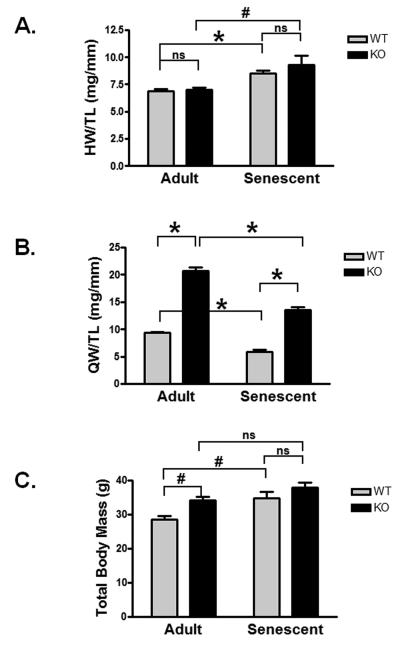
Figure 1
Figure 1. Morphometric changes in senescent mice
A) Heart/tibial length (mg/mm) [adult WT, KO, senescent WT, KO; n=9,10,7,4] B) quadriceps mass/tibial length (g/mm) [adult WT, KO, senescent WT, KO; n=5,7,7,4], and C) total body (g) [adult WT, KO, senescent WT, KO; n=9,10,8,4] are shown for male adult and senescent WT and KO mice. Age range: Adult: aged 15-20 weeks; Senescent: aged 27-30 months. Data are presented as mean±SEM. #p<0.01, *p<0.001.
Figure 2
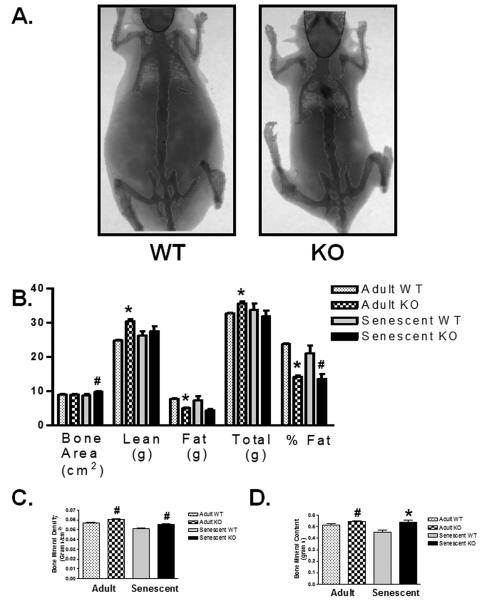
Figure 2. DEXA scan of body and bone composition in senescent mice
A) Representative DEXA scan images of senescent WT and KO mice. B) Bone area, lean mass, fat mass, total body mass, % body fat, C) bone mineral density, D) and bone mineral content as measured by DEXA scan for adult and senescent WT and KO mice. [adult WT, KO, senescent WT, KO; n=5,5,7,6 for bone measurements; n=5,5,10,8 for all other measurements]. Data are presented as mean ± SEM. #p<0.05, *p<0.01 vs age-matched WT.
Figure 3
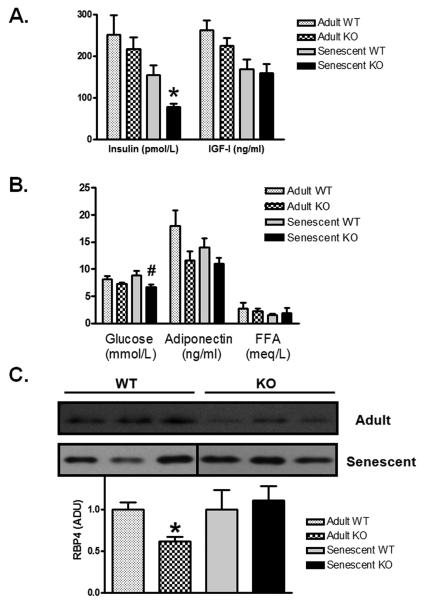
Figure 3. Decreased insulin and glucose levels in aged KO mice
Serum measurements from adult and senescent WT and KO mice are shown for A) insulin [adult WT, KO, senescent WT, KO; n=3,5,15,11], IGF-I [adult WT, KO, senescent WT, KO; n=3,5,10,6], B) glucose [adult WT, KO, senescent WT, KO; n=7,13,14,10], adiponectin [adult WT, KO, senescent WT, KO; n=3,5,15,11], free fatty acids [adult WT, KO, senescent WT, KO; n=3,5,11,6]. C) A representative western blot of RBP4 from serum (1μl) of adult and senescent WT and KO mice with compiled data normalized to age-matched WT [adult WT, KO, senescent WT, KO; n=3,5,11,10]. Data are presented as fold age-matched WT mean±SEM. #p<0.05, *p<0.01 vs age-matched WT.
Figure 4
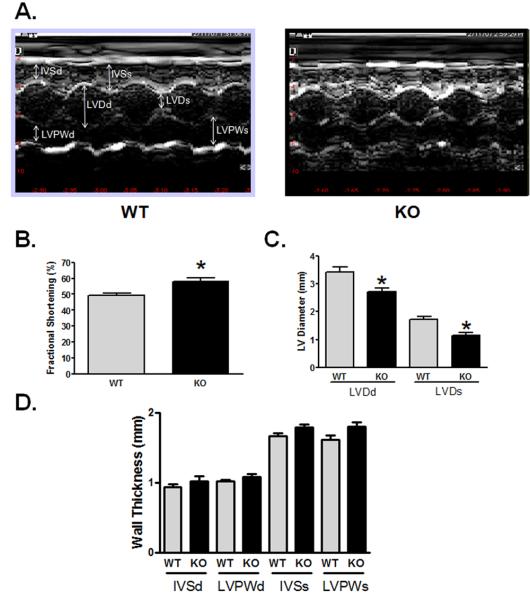
Figure 4. Echocardiographic data show preserved function and smaller LV dimensions in senescent myostatin KO mice
A) Representative m-mode images from WT (left) and KO (right) mice. Bar graphs depict cumulative echocardiographic measurements obtained in conscious male mice 27-30 months old, with heart rates between 650-750 beats per minute (p=ns between WT and KO) [WT, KO; n=8,7]. B) Fractional shortening, C) LV Diameter, D) LV Wall thickness. Abbreviations used: LV, left ventricle; LVDd, LV end-diastolic dimension: LVDs, LV end-systolic dimension; IVSd, intraventricular septum end-diastolic dimension; LVPWd, LV posterior wall end-diastolic dimension; IVSs, intraventricular septum end-systolic dimension; LVPWs, LV posterior wall end-systolic dimension. Data are presented as mean±SEM. *p<0.01.
Figure 5
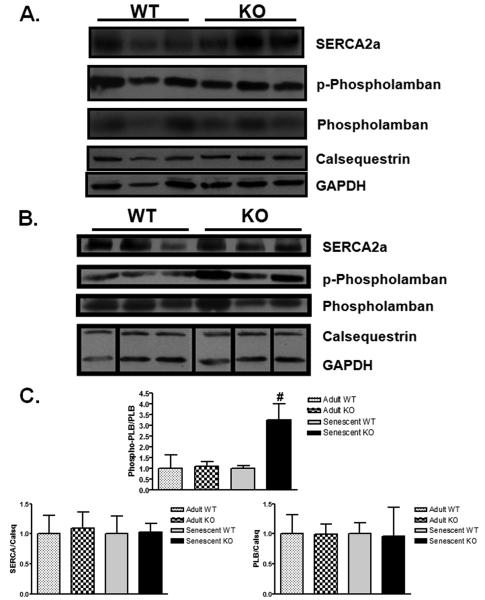
Figure 5. Increased ratio of phospho- to total phospholamban in senescent myostatin KO hearts
A) Western blot analysis from whole heart lysates of sarcoplasmic reticulum proteins involved in calcium handling from adult and senescent WT and KO mice. B) Bar graphs represent compiled western blot data normalized to age-matched WT control. [n=3 in each group]. Data are presented as fold age-matched WT mean ± SEM. #p<0.05 vs age-matched WT.
Figure 6
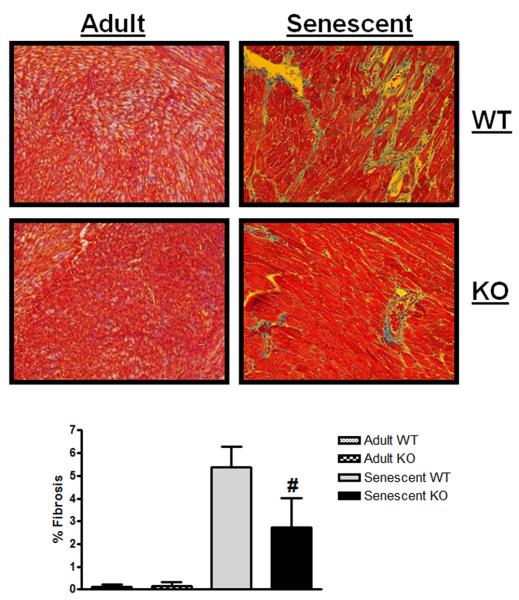
Figure 6. Senescent myostatin KO mice display less cardiac fibrosis
Representative 20X images from Masson's trichrome stained heart sections from adult and senescent WT and KO mice are displayed with percent fibrosis data compiled below [adult WT, KO, senescent WT, KO; n=3,3,4,4]. Data are presented as mean ± SEM. #p<0.05 vs age-matched WT.

References

    1. Alcendor RR, Gao S, Zhai P, Zablocki D, Holle E, Yu X, Tian B, Wagner T, Vatner SF, Sadoshima J. Sirt1 regulates aging and resistance to oxidative stress in the heart. Circ Res. 2007;100:1512–1521. - PubMed
    1. Amthor H, Macharia R, Navarrete R, Schuelke M, Brown SC, Otto A, Voit T, Muntoni F, Vrbova G, Partridge T, Zammit P, Bunger L, Patel K. Lack of myostatin results in excessive muscle growth but impaired force generation. Proc Natl Acad Sci U S A. 2007;104:1835–1840. - PMC - PubMed
    1. Hedrich H, editor. In The Laboratory Mouse. Elsevier; 2004. Gerontology.
    1. Barger JL, Kayo T, Vann JM, Arias EB, Wang J, Hacker TA, Wang Y, Raederstorff D, Morrow JD, Leeuwenburgh C, Allison DB, Saupe KW, Cartee GD, Weindruch R, Prolla TA. A low dose of dietary resveratrol partially mimics caloric restriction and retards aging parameters in mice. PLoS ONE. 2008;3:e2264. - PMC - PubMed
    1. Baur JA, Pearson KJ, Price NL, Jamieson HA, Lerin C, Kalra A, Prabhu VV, Allard JS, Lopez-Lluch G, Lewis K, Pistell PJ, Poosala S, Becker KG, Boss O, Gwinn D, Wang M, Ramaswamy S, Fishbein KW, Spencer RG, Lakatta EG, Le Couteur D, Shaw RJ, Navas P, Puigserver P, Ingram DK, de Cabo R, Sinclair DA. Resveratrol improves health and survival of mice on a high-calorie diet. Nature. 2006;444:337–342. - PMC - PubMed

Publication types

MeSH terms