


Continuous terlipressin versus vasopressin infusion in septic shock (TERLIVAP): a randomized, controlled pilot study
- PMID: 19664253
- PMCID: PMC2750187
- DOI: 10.1186/cc7990
Continuous terlipressin versus vasopressin infusion in septic shock (TERLIVAP): a randomized, controlled pilot study
Abstract
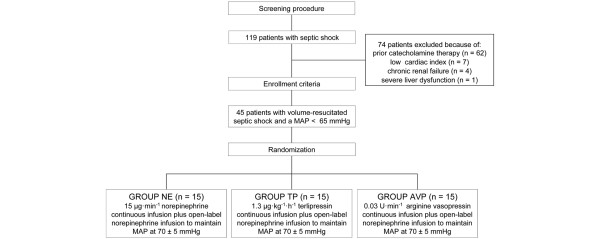
Introduction: Recent clinical data suggest that early administration of vasopressin analogues may be advantageous compared to a last resort therapy. However, it is still unknown whether vasopressin and terlipressin are equally effective for hemodynamic support in septic shock. The aim of the present prospective, randomized, controlled pilot trial study was, therefore, to compare the impact of continuous infusions of either vasopressin or terlipressin, when given as first-line therapy in septic shock patients, on open-label norepinephrine requirements.
Methods: We enrolled septic shock patients (n = 45) with a mean arterial pressure below 65 mmHg despite adequate volume resuscitation. Patients were randomized to receive continuous infusions of either terlipressin (1.3 microg.kg-1.h-1), vasopressin (.03 U.min-1) or norepinephrine (15 microg.min-1; n = 15 per group). In all groups, open-label norepinephrine was added to achieve a mean arterial pressure between 65 and 75 mmHg, if necessary. Data from right heart and thermo-dye dilution catheterization, gastric tonometry, as well as laboratory variables of organ function were obtained at baseline, 12, 24, 36 and 48 hours after randomization. Differences within and between groups were analyzed using a two-way ANOVA for repeated measurements with group and time as factors. Time-independent variables were compared with one-way ANOVA.
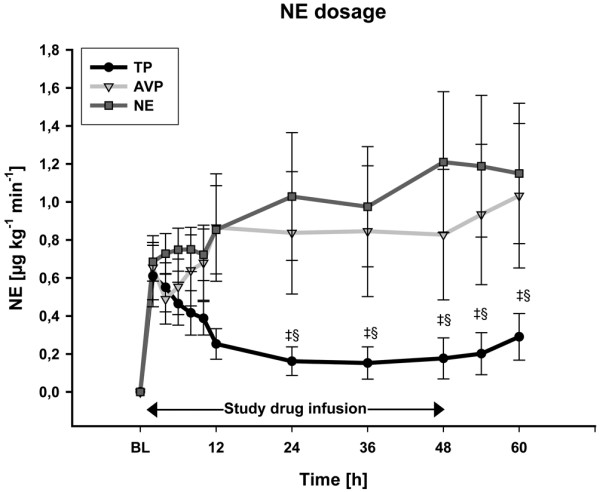
Results: There were no differences among groups in terms of systemic and regional hemodynamics. Compared with infusion of .03 U of vasopressin or 15 microg.min-1 of norepinephrine, 1.3 microg.kg-1.h-1 of terlipressin allowed a marked reduction in catecholamine requirements (0.8 +/- 1.3 and 1.2 +/- 1.4 vs. 0.2 +/- 0.4 microg.kg-1.min-1 at 48 hours; each P < 0.05) and was associated with less rebound hypotension (P < 0.05). At the end of the 48-hour intervention period, bilirubin concentrations were higher in the vasopressin and norepinephrine groups as compared with the terlipressin group (2.3 +/- 2.8 and 2.8 +/- 2.5 vs. 0.9 +/- 0.3 mg.dL-1; each P < 0.05). A time-dependent decrease in platelet count was only observed in the terlipressin group (P < 0.001 48 hours vs. BL).
Conclusions: The present study provides evidence that continuous infusion of low-dose terlipressin--when given as first-line vasopressor agent in septic shock--is effective in reversing sepsis-induced arterial hypotension and in reducing norepinephrine requirements.
Trial registration: ClinicalTrials.gov NCT00481572.
Figures
Comment in
-
Terlipressin or europressin?Crit Care. 2009;13(5):192. doi: 10.1186/cc8035. Epub 2009 Oct 7. Crit Care. 2009. PMID: 19832999 Free PMC article.
References
-
- Dellinger RP, Levy MM, Carlet JM, Bion J, Parker MM, Jaeschke R, Reinhart K, Angus DC, Brun-Buisson C, Beale R, Calandra T, Dhainaut JF, Gerlach H, Harvey M, Marini JJ, Marshall J, Ranieri M, Ramsay G, Sevransky J, Taylor Thompson B, Townsend S, Vender JS, Zimmerman JL, Vincent JL. Surviving Sepsis Campaign: International guidelines for management of severe sepsis and septic shock: 2008. Crit Care Med. 2008;36:296–327. doi: 10.1097/01.CCM.0000298158.12101.41. - DOI - PubMed
-
- Russell JA, Walley KR, Singer J, Gordon AC, Hébert PC, Cooper DJ, Holmes CL, Mehta S, Granton JT, Storms MM, Cook DJ, Presneill JJ, Ayers D. VASST Investigators. Vasopressin versus norepinephrine infusion in patients with septic shock. N Engl J Med. 2008;358:877–887. doi: 10.1056/NEJMoa067373. - DOI - PubMed
Publication types
MeSH terms
Substances
Associated data
LinkOut - more resources
Full Text Sources
Other Literature Sources
Medical
Miscellaneous
