


A fungal phylogeny based on 82 complete genomes using the composition vector method
- PMID: 19664262
- PMCID: PMC3087519
- DOI: 10.1186/1471-2148-9-195
A fungal phylogeny based on 82 complete genomes using the composition vector method
Abstract
Background: Molecular phylogenetics and phylogenomics have greatly revised and enriched the fungal systematics in the last two decades. Most of the analyses have been performed by comparing single or multiple orthologous gene regions. Sequence alignment has always been an essential element in tree construction. These alignment-based methods (to be called the standard methods hereafter) need independent verification in order to put the fungal Tree of Life (TOL) on a secure footing. The ever-increasing number of sequenced fungal genomes and the recent success of our newly proposed alignment-free composition vector tree (CVTree, see Methods) approach have made the verification feasible.
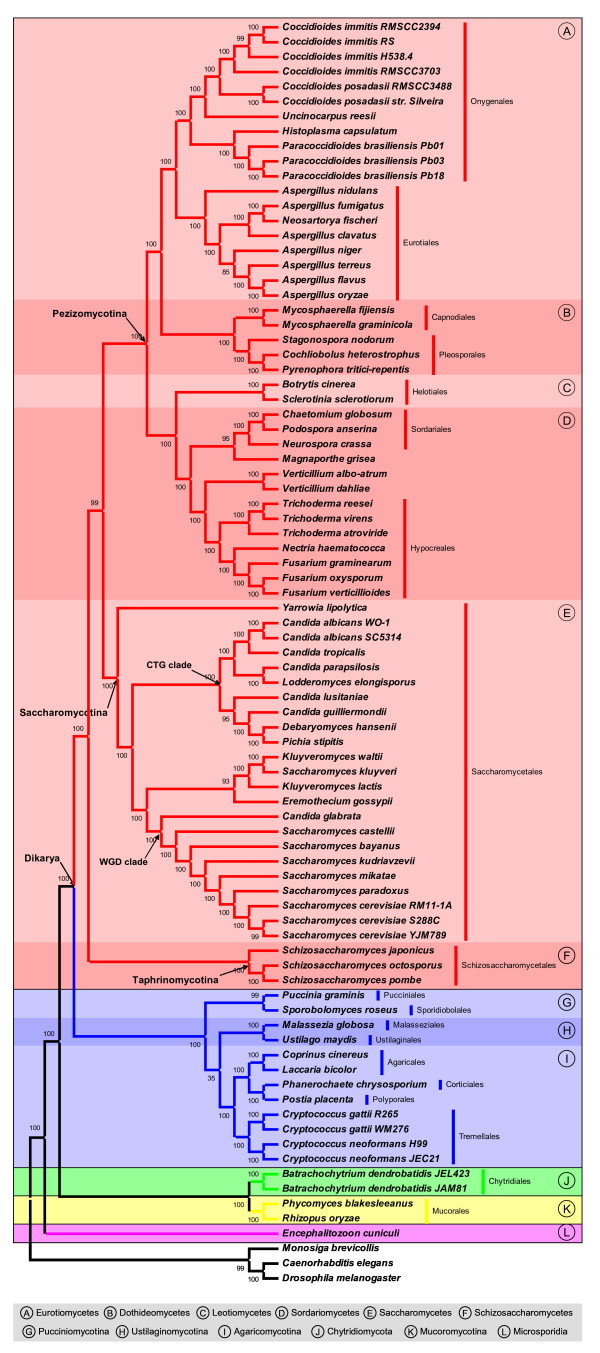
Results: In all, 82 fungal genomes covering 5 phyla were obtained from the relevant genome sequencing centers. An unscaled phylogenetic tree with 3 outgroup species was constructed by using the CVTree method. Overall, the resultant phylogeny infers all major groups in accordance with standard methods. Furthermore, the CVTree provides information on the placement of several currently unsettled groups. Within the sub-phylum Pezizomycotina, our phylogeny places the Dothideomycetes and Eurotiomycetes as sister taxa. Within the Sordariomycetes, it infers that Magnaporthe grisea and the Plectosphaerellaceae are closely related to the Sordariales and Hypocreales, respectively. Within the Eurotiales, it supports that Aspergillus nidulans is the early-branching species among the 8 aspergilli. Within the Onygenales, it groups Histoplasma and Paracoccidioides together, supporting that the Ajellomycetaceae is a distinct clade from Onygenaceae. Within the sub-phylum Saccharomycotina, the CVTree clearly resolves two clades: (1) species that translate CTG as serine instead of leucine (the CTG clade) and (2) species that have undergone whole-genome duplication (the WGD clade). It places Candida glabrata at the base of the WGD clade.
Conclusion: Using different input data and methodology, the CVTree approach is a good complement to the standard methods. The remarkable consistency between them has brought about more confidence to the current understanding of the fungal branch of TOL.
Figures
References
-
- Hawksworth DL. The magnitude of fungal diversity: the 1.5 million species estimate revisited. Mycol Res. 2002;105(12):1422–1432. doi: 10.1017/S0953756201004725. - DOI
-
- James TY, Kauff F, Schoch CL, Matheny PB, Hofstetter V, Cox CJ, Celio G, Gueidan C, Fraker E, Miadlikowska J, Lumbsch HT, Rauhut A, Reeb V, Arnold AE, Amtoft A, Stajich JE, Hosaka K, Sung GH, Johnson D, O'Rourke B, Crockett M, Binder M, Curtis JM, Slot JC, Wang Z, Wilson AW, Schüssler A, Longcore JE, O'Donnell K, Mozley-Standridge S, Porter D, Letcher PM, Powell MJ, Taylor JW, White MM, Griffith GW, Davies DR, Humber RA, Morton JB, Sugiyama J, Rossman AY, Rogers JD, Pfister DH, Hewitt D, Hansen K, Hambleton S, Shoemaker RA, Kohlmeyer J, Volkmann-Kohlmeyer B, Spotts RA, Serdani M, Crous PW, Hughes KW, Matsuura K, Langer E, Langer G, Untereiner WA, Lücking R, Büdel B, Geiser DM, Aptroot A, Diederich P, Schmitt I, Schultz M, Yahr R, Hibbett DS, Lutzoni F, McLaughlin DJ, Spatafora JW, Vilgalys R. Reconstructing the early evolution of Fungi using a six-gene phylogeny. Nature. 2006;443(7113):818–822. doi: 10.1038/nature05110. - DOI - PubMed
-
- Hibbett DS, Binder M, Bischoff JF, Blackwell M, Cannon PF, Eriksson OE, Huhndorf S, James T, Kirk PM, Lücking R, Lumbsch HT, Lutzoni F, Matheny PB, McLaughlin DJ, Powell MJ, Redhead S, Schoch CL, Spatafora JW, Stalpers JA, Vilgalys R, Aime MC, Aptroot A, Bauer R, Begerow D, Benny GL, Castlebury LA, Crous PW, Dai YC, Gams W, Geiser DM, Griffith GW, Gueidan C, Hawksworth DL, Hestmark G, Hosaka K, Humber RA, Hyde KD, Ironside JE, Köljalg U, Kurtzman CP, Larsson KH, Lichtwardt R, Longcore J, Miadlikowska J, Miller A, Moncalvo JM, Mozley-Standridge S, Oberwinkler F, Parmasto E, Reeb V, Rogers JD, Roux C, Ryvarden L, Sampaio JP, Schüssler A, Sugiyama J, Thorn RG, Tibell L, Untereiner WA, Walker C, Wang Z, Weir A, Weiss M, White MM, Winka K, Yao YJ, Zhang N. A higher-level phylogenetic classification of the Fungi. Mycol Res. 2007;111(Pt 5):509–547. doi: 10.1016/j.mycres.2007.03.004. - DOI - PubMed
