Review
. 2009 Aug;25(8):361-7.
doi: 10.1016/j.tig.2009.07.001. Epub 2009 Aug 6.

Genetics of complex neurological disease: challenges and opportunities for modeling epilepsy in mice and rats

Affiliations
Review

Genetics of complex neurological disease: challenges and opportunities for modeling epilepsy in mice and rats

Wayne N Frankel. Trends Genet. 2009 Aug.

Abstract

Currently, approximately 20 genetic variants are known to cause Mendelian forms of human epilepsy, leaving a vast heritability undefined. Rodent models for genetically complex epilepsy have been studied for many years, but only recently have strong candidate genes emerged, including Cacna1 g in the GAERS rat model of absence epilepsy and Kcnj10 in the low seizure threshold of DBA/2 mice. In parallel, a growing number of mouse mutations studied on multiple strain backgrounds reveal the impact of genetic modifiers on seizure severity, incidence or form--perhaps mimicking the complexity seen in humans. The field of experimental genetics in rodents is poised to study discrete epilepsy mutations on a diverse choice of strain backgrounds to develop better models and identify modifiers. But, it must find the right balance between embracing the strain diversity available, with the ability to detect and characterize genetic effects. Using alternative strain backgrounds when studying epilepsy mutations will enhance the modeling of epilepsy as a complex genetic disease.


Figures
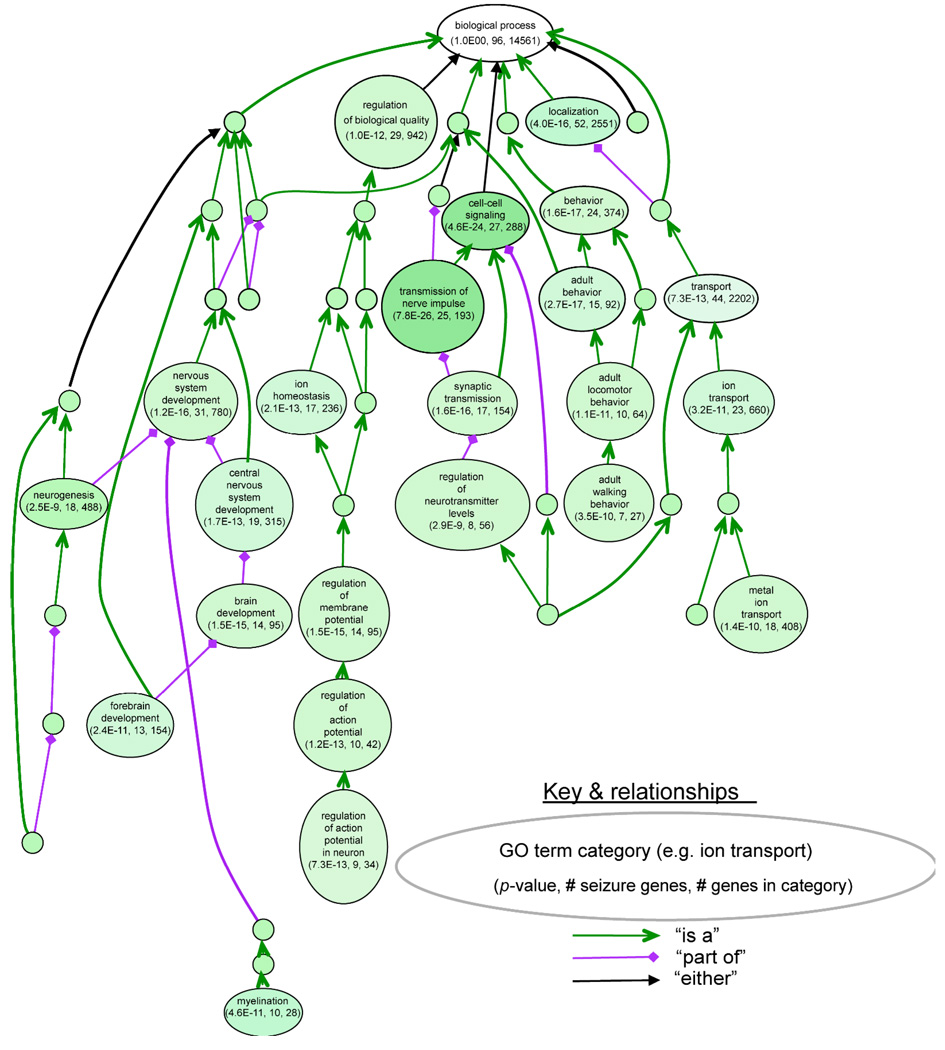
Figure 1
Figure 1. Classification of 101 mouse seizure genes using gene-ontology functional annotation
This analysis was done using VLAD, a multipurpose prototype tool for visualizing and analyzing gene-ontology (GO) annotation data for sets of genes (http://proto.informatics.jax.org/prototypes/vlad-1.0.3/). Here VLAD was used to determine the overrepresentation of the 101 mouse seizure genes relative to total number of genes in each GO class for a biological process. Each large bubble shows a specific GO class, with the number of seizure genes in the class, the number of total genes in the class (from the Mouse Genome Informatics, MGI, database), and a P-value to estimate the relative overrepresentation of seizure genes in that class (see http://proto.informatics.jax.org/prototypes/vlad-1.0.3/ for methods). The arrows indicate the “parent-child” relationship of GO classes to one another; small, unlabelled bubbles are classes that were not significantly overrepresented. The existence of multiple larger bubbles containing significant class overrepresentations is indicative of multiple etiologies for seizure disorders in mice.
Figure 2
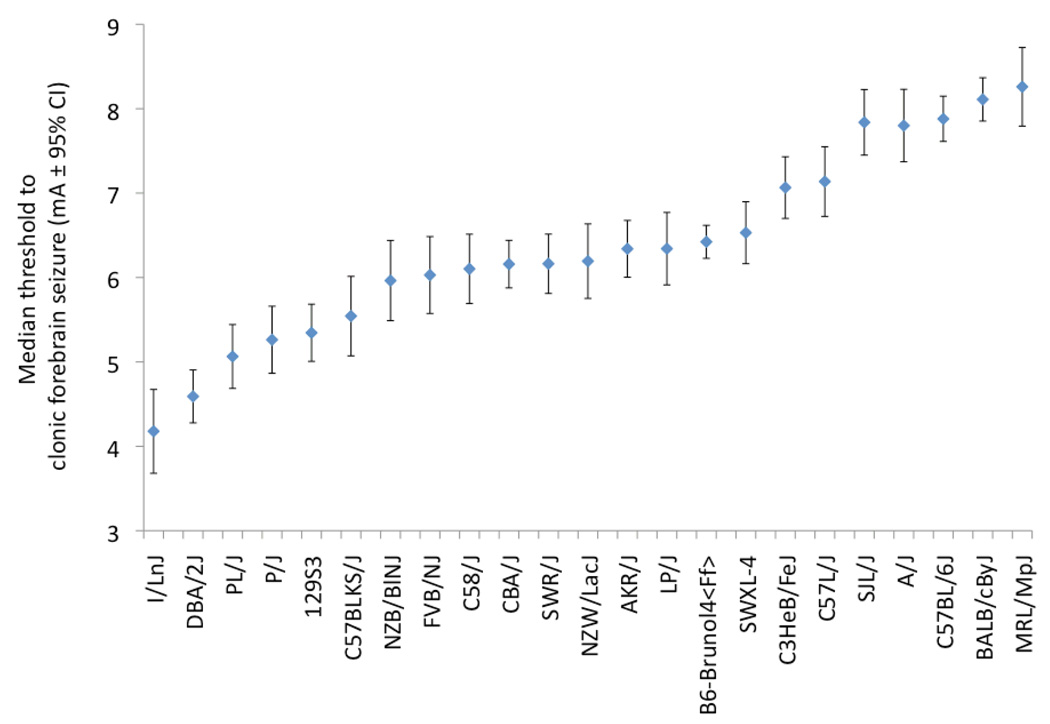
Figure 2. Electroconvulsive threshold variation in 23 mouse strains
The median thresholds (mA ± 95% CI) to clonic forebrain seizures are shown. Thresholds for I/LnJ, P/J, and MRL/MpJ have not been previously published. The remaining values were recalculated and re-plotted from previous studies , , ; the new data were collected and analyzed as described in those studies. For simplicity of presentation, only female data are shown, but the relative strain thresholds are similar for male. A four mA range of median seizure threshold amongst the different inbred strains is suggestive of a very appreciable amount of genetic variation.

References

    1. Kwan P, Brodie MJ. Early identification of refractory epilepsy. N Engl J Med. 2000;342:314–319. - PubMed
    1. Nei M, Bagla R. Seizure-related injury and death. Curr Neurol Neurosci Rep. 2007;7:335–341. - PubMed
    1. Ottman R. Analysis of genetically complex epilepsies. Epilepsia. 2005;46 Suppl 10:7–14. - PMC - PubMed
    1. Lucarini N, et al. Genetic polymorphisms and idiopathic generalized epilepsies. Pediatr Neurol. 2007;37:157–164. - PubMed

    1. Need AC, et al. A genome-wide investigation of SNPs and CNVs in schizophrenia. PLoS Genet. 2009;5 e1000373. - PMC - PubMed

Publication types