


Inflammation and cancer: how friendly is the relationship for cancer patients?
- PMID: 19665429
- PMCID: PMC2730981
- DOI: 10.1016/j.coph.2009.06.020
Inflammation and cancer: how friendly is the relationship for cancer patients?
Abstract
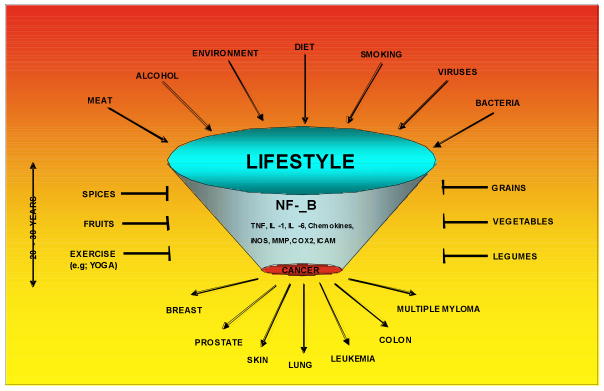
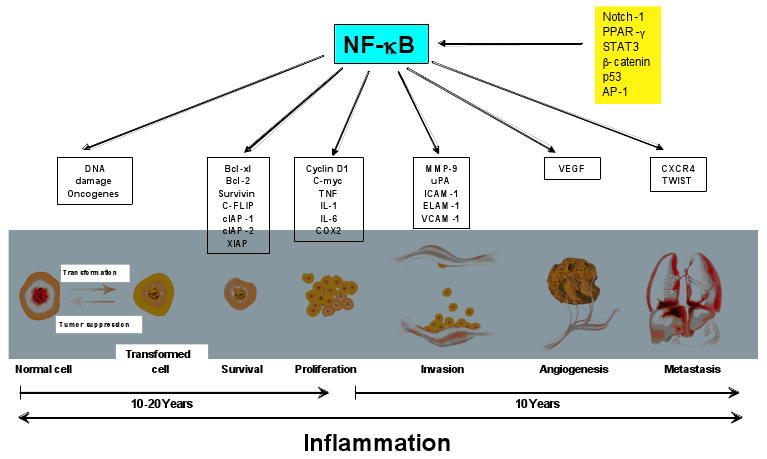
Evidence has emerged in the last two decades that at the molecular level most chronic diseases, including cancer, are caused by a dysregulated inflammatory response. The identification of transcription factors such as NF-kappaB, AP-1 and STAT3 and their gene products such as tumor necrosis factor, interleukin-1, interleukin-6, chemokines, cyclooxygenase-2, 5 lipooxygenase, matrix metalloproteases, and vascular endothelial growth factor, adhesion molecules and others have provided the molecular basis for the role of inflammation in cancer. These inflammatory pathways are activated by tobacco, stress, dietary agents, obesity, alcohol, infectious agents, irradiation, and environmental stimuli, which together account for as much as 95% of all cancers. These pathways have been implicated in transformation, survival, proliferation, invasion, angiogenesis, metastasis, chemoresistance, and radioresistance of cancer, so much so that survival and proliferation of most types of cancer stem cells themselves appear to be dependent on the activation of these inflammatory pathways. Most of this evidence, however, is from preclinical studies. Whether these pathways have any role in prevention, progression, diagnosis, prognosis, recurrence or treatment of cancer in patients, is the topic of discussion of this review. We present evidence that inhibitors of inflammatory biomarkers may have a role in both prevention and treatment of cancer.
Figures
References
-
- Heidland A, Klassen A, Rutkowski P, Bahner U. The contribution of Rudolf Virchow to the concept of inflammation: what is still of importance? J Nephrol. 2006;19 10:S102–9. - PubMed
-
- Vilimas T, Mascarenhas J, Palomero T, et al. Targeting the NF-kappaB signaling pathway in Notch1-induced T-cell leukemia. Nat Med. 2007;13:70–7. - PubMed
-
**An important evidence for the role of NF-kB in leukemia.
-
- Lee KJ, Kim HA, Kim PH, et al. Ox-LDL suppresses PMA-induced MMP-9 expression and activity through CD36-mediated activation of PPAR-g. Exp Mol Med. 2004;36:534–44. - PubMed
Publication types
MeSH terms
Substances
Grants and funding
LinkOut - more resources
Full Text Sources
Other Literature Sources
Medical
Research Materials
Miscellaneous
