. 2010 Jan;44(2):112-20.
doi: 10.1016/j.jpsychires.2009.06.011. Epub 2009 Aug 8.

Reduced overnight consolidation of procedural learning in chronic medicated schizophrenia is related to specific sleep stages

Affiliations

Reduced overnight consolidation of procedural learning in chronic medicated schizophrenia is related to specific sleep stages

Dara S Manoach et al. J Psychiatr Res. 2010 Jan.

Abstract

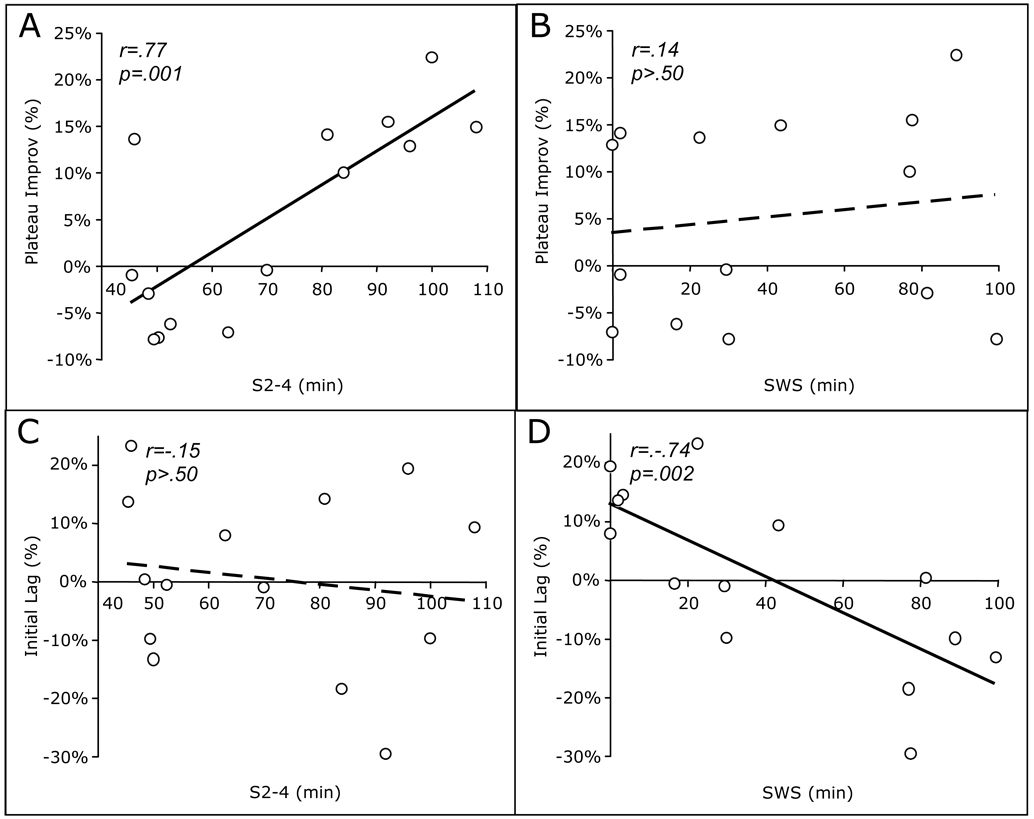
We previously reported that patients with schizophrenia failed to demonstrate normal sleep-dependent improvement in motor procedural learning. Here, we tested whether this failure was associated with the duration of Stage 2 sleep in the last quartile of the night (S2q4) and with spindle activity during this epoch. Fourteen patients with schizophrenia and 15 demographically matched controls performed a motor sequence task (MST) before and after a night of polysomnographically monitored sleep. Patients showed no significant overnight task improvement and significantly less than controls, who did show significant improvement. While there were no group differences in overall sleep architecture, patients showed significant reductions in fast sigma frequency power (45%) and in spindle density (43%) during S2q4 sleep at the electrode proximal to the motor cortex controlling the hand that performed the MST. Although spindle activity did not correlate with overnight improvement in either group, S2q4 sleep duration in patients significantly correlated with the plateau level of overnight improvement seen at the end of the morning testing session, and slow wave sleep (SWS) duration correlated with the delay in reaching this plateau. SWS and S2q4 sleep each predicted the initial level of overnight improvement in schizophrenia, and their product explained 77% of the variance, suggesting that both sleep stages are necessary for consolidation. These findings replicate our prior observation of reduced sleep-dependent consolidation of motor procedural learning in schizophrenia and link this deficit to specific sleep stages. They provide further evidence that sleep is an important contributor to cognitive deficits in schizophrenia.


Conflict of interest statement

Disclosures: This was not an industry-supported study. Dr. Manoach has received research funding and consulting fees from Sepracor Inc. Dr. Stickgold has received research funding from Merck & Co., Actelion Pharmaceuticals Ltd., and Sepracor Inc., as well as consulting fees from Actelion Pharmaceuticals Ltd. and Sepracor Inc, speaking fees from Epix Pharmaceuticals, and an educational grant from Takeda Inc. Ms. Stroynowski is presently employed by Alkermes. Dr. Goff has received honoraria or research support over the past year from Organon, Xytis, Wyeth, Forest Labs, Eli Lilly, Pfizer, and Ortho-McNeil-Janssen. None of the other authors have any conflicts of interest to disclose.

Figures

Figure 1
Figure 1
Experimental protocols. Participants were pseudorandomly assigned to (A) “Wake First” or (B) “Sleep First” protocols. MST sequence order was also counterbalanced within protocol order. Arrows indicate times of admission and discharge from the GCRC. (A) Wake first: Participants arrived at the GCRC at approximately 10am. Ten hours prior to their habitual bedtime (approximately 1 PM), they Trained on the first MST Sequence (MST Seq 1). Nine hours later, they were Tested on this sequence, and 10 minutes later, they trained on MST Seq 2. They were subsequently wired for polysomnography and allowed to go to sleep. Seq 2 Test occurred in the morning, approximately nine hours after Training, and after electrodes had been removed and breakfast eaten. Ten minutes later, they were retested on MST Seq 1. (B) Sleep first: Participants arrived at the GCRC 2.5 hours prior to their habitual bedtime (approximately 8:30 PM), and were Trained on MST Seq 1 90 minutes later. Prior to going to sleep, they were wired for polysomnography. Testing of MST Seq 1 occurred the next morning after electrodes had been removed and breakfast eaten, approximately nine hours after Training. Ten minutes later, they trained on MST Seq 2. Testing of MST Seq 2 occurred nine hours later, during the afternoon, followed 10 minutes later by the retest of MST Seq 1. (C) Measurements of Overnight Change in Performance: Initial improvement = percent increase from the last three Training trials to the first three Test trials; Plateau improvement = percent increase from the last six Training trials to the last six Test trials; Initial lag = plateau improvement – initial improvement.
Figure 2
Figure 2
MST performance. Motor skill learning across Training and Test trials for healthy control (n=15, open circles) and schizophrenia (n=14, filled squares) groups. The data point for each trial represents the group average ± SE. The y-axis represents the number of correct sequences typed in each 30 s trial. The shaded bar represents a night of sleep in the GCRC in between Training and Test trials. The solid lines fit through the data points for Training and Test were derived using an exponential model of motor learning (see Manoach et al., 2004). While patients and controls did not differ in the absolute amount of learning during Training trials (Table 2), only controls showed significant overnight improvement, which was realized at the plateau of Test.
Figure 3
Figure 3
Correlation of initial overnight improvement with minutes spent in SWS and S2q4 in schizophrenia patients. (A) Correlation with S2-4; (B) Correlation with SWS; (C) Correlation with SWS × S2q4
Figure 4
Figure 4
Correlations of sleep stages with measures of overnight improvement in schizophrenia patients. A) Plateau Improvement vs. S2-4; B) Plateau Improvement vs. SWS; C) Initial Lag vs. S2-4; D) Initial Lag vs. SWS.

References

    1. Andreasen NC. Scale for the assessment of negative symptoms (SANS) Iowa City: University of Iowa; 1983.
    1. Atienza M, Cantero JL, Stickgold R. Posttraining sleep enhances automaticity in perceptual discrimination. J Cogn Neurosci. 2004;16:53–64. - PubMed
    1. Benson KL. Sleep in schizophrenia: impairments, correlates, and treatment. Psychiatr Clin North Am. 2006;29:1033–1045. abstract ix-x. - PubMed
    1. Benson KL. Sleep in schizophrenia. Sleep Med Clinics. 2008;3:251–260.
    1. Brown R, Robertson E, Press DZ. Sequence skill acquisition and off-line learning in normal aging. PLoS One. (in press) - PMC - PubMed