


Review
doi: 10.1016/j.cell.2009.07.016.
Chromatin architecture and the generation of antigen receptor diversity
Affiliations
- PMID: 19665968
- PMCID: PMC2726833
- DOI: 10.1016/j.cell.2009.07.016
Item in Clipboard
Review
Chromatin architecture and the generation of antigen receptor diversity
Cell.
.
Abstract
The adaptive immune system generates a specific response to a vast spectrum of antigens. This remarkable property is achieved by lymphocytes that each express single and unique antigen receptors. During lymphocyte development, antigen receptor coding elements are assembled from widely dispersed gene segments. The assembly of antigen receptors is controlled at multiple levels, including epigenetic marking, nuclear location, and chromatin topology. Here, we review recently uncovered mechanisms that underpin long-range genomic interactions and the generation of antigen receptor diversity.
Figures
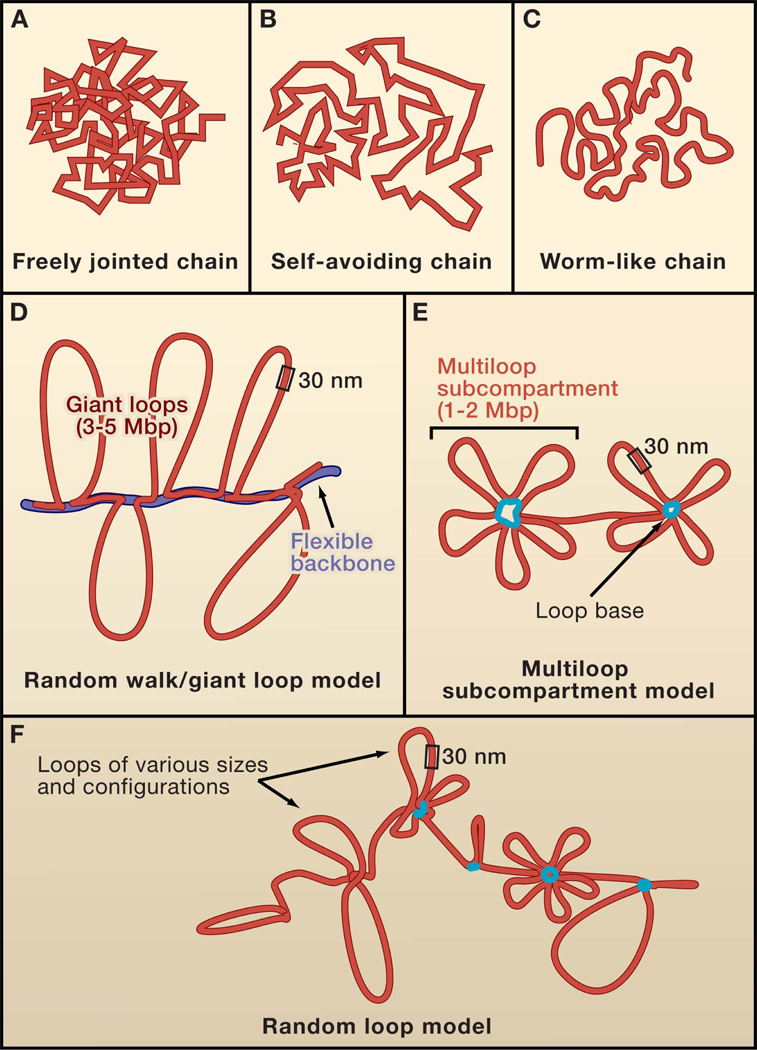
(A) Freely jointed chain. A freely jointed chain consists of a series of rigid segments connected by flexible hinges. (B) Self avoiding random walk. In a self-avoiding chain, a segment cannot intersect any other segment. (C) Worm-like chain. In contrast to the freely-jointed chain, which is flexible within the hinges that separate the segments, the worm-like polymer chain is continuously flexible. (D) Random walk/giant loop model. Giant loops of 3–5 Mbp are tethered to a backbone. The DNA within the loops and the backbone itself follow a random walk. (E) Multi-loop subcompartment model. Chromatin is organized into 1–2 Mbp subcompartments. Each subcompartment consists of a bundle of loops that are attached to a common loop base. Linkers connect the chromatin subcompartments. Both loops and linkers undergo random walk behavior. (F) Random loop model. Dynamic loops of large and small sizes are formed at random intervals on the chromosome. Both individual loops and bundles of loops are shown.

Genetic structures of antigen receptor loci are shown. Variable (V) gene segments are shown in blue; Diversity (D) gene segments, if present in purple; Joining (J) gene segments in red; Constant © regions a in black; Enhancers in green. Note that the TCRδ locus is interspersed within the TCRα locus. Genomic distances (Mbp or Kbp) are indicated for each of the loci.

Nuclear locations of antigen receptor loci during developmental progression are indicated. (A) Indicated are the nuclear positions of the Igh and Igκ alleles at various stages of early B cell development. Pre-pro-B and pro-B cell stage are shown in blue. Large pre-B and small pre-B are indicated in green. Immature-B cells are shown in red. Blue cluster of loops indicate V regions. Red clusters of loops represent D/J/C coding elements. Dark dots represent the pericentromeric heterochromatin. Relative degree of Igh and Igκ locus contraction and de-contraction is depicted. (B) Indicated are the nuclear positions of the TCRβ and TCRα alleles during thymopoieisis. The double negative cell stage is shown in blue. Double positive cells are in green; single positive cells in red. Blue clusters of loops indicate V regions. Red clusters of loops represent D/J/C coding elements. Dark dots represent the pericentromeric heterochromatin. Relative degree of TCRα and TCRβ contraction and de-contraction are depicted.
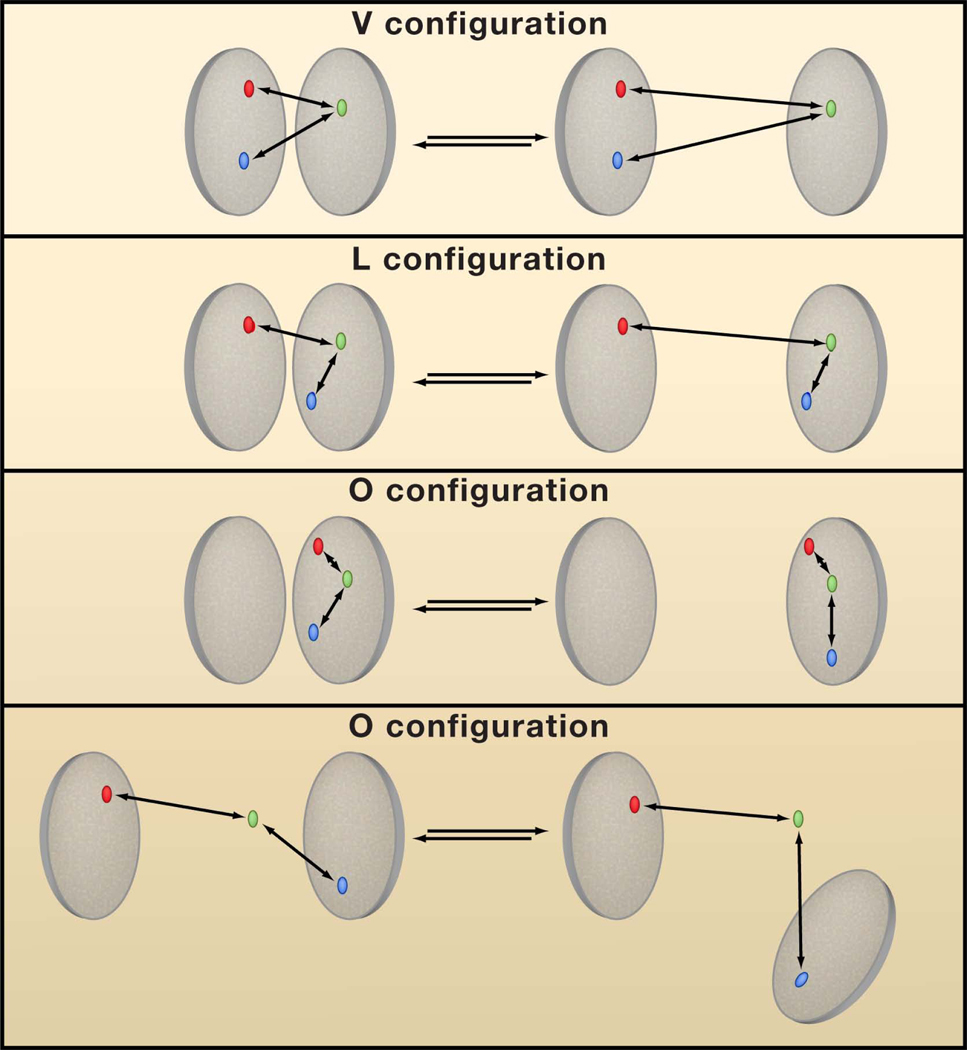
Positioning of genomic markers in distinct compartments using triple point spatial distance measurements in individual cells. Two genomic markers are located in one compartment if they move coordinately to or away from an anchor. Nuclear subcompartments are depicted as grey discs. Genomic markers within different subcompartments are shown in red, green, or blue. Spatial distances from the anchor (green) are shown as red or blue, respectively. Various configurations are indicated. V-configuration; Red and blue markers are in the same subcompartment whereas anchor (green) is positioned in a separate subcompartment. The red and blue markers move coordinately away from the anchor. L-configuration; One of the markers (blue) is in the same subcompartment as the anchor (green). The distance separating the blue marker from the anchor is independent of the distance separating the red marker from the anchor. O-configuration; All three genomic markers are in localized in one compartment or alternatively in three distinct compartments. The markers move independently from each other.
References
-
- Abarrategui I, Krangel MS. Regulation of T cell receptor-alpha gene recombination by transcription. Nat. Immunol. 2006;7:1109–1115. - PubMed
-
- Agata Y, Tamaki N, Sakamoto S, Ikawa T, Masuda K, Kawamoto H, Murre C. Regulation of T cell receptor beta gene rearrangements and allelic exclusion. Immunity. 2007;27:871–884. - PubMed
-
- Akhtar A, Gasser SM. The nuclear envelope and transcriptional control. Nat. Rev. Genet. 2007;8:507–517. - PubMed
Publication types
MeSH terms
Substances
Grants and funding
LinkOut - more resources
Full Text Sources
