


Insertion shuttle with carboxyl terminated self-assembled monolayer coatings for implanting flexible polymer neural probes in the brain
- PMID: 19666051
- PMCID: PMC3165009
- DOI: 10.1016/j.jneumeth.2009.08.002
Insertion shuttle with carboxyl terminated self-assembled monolayer coatings for implanting flexible polymer neural probes in the brain
Abstract
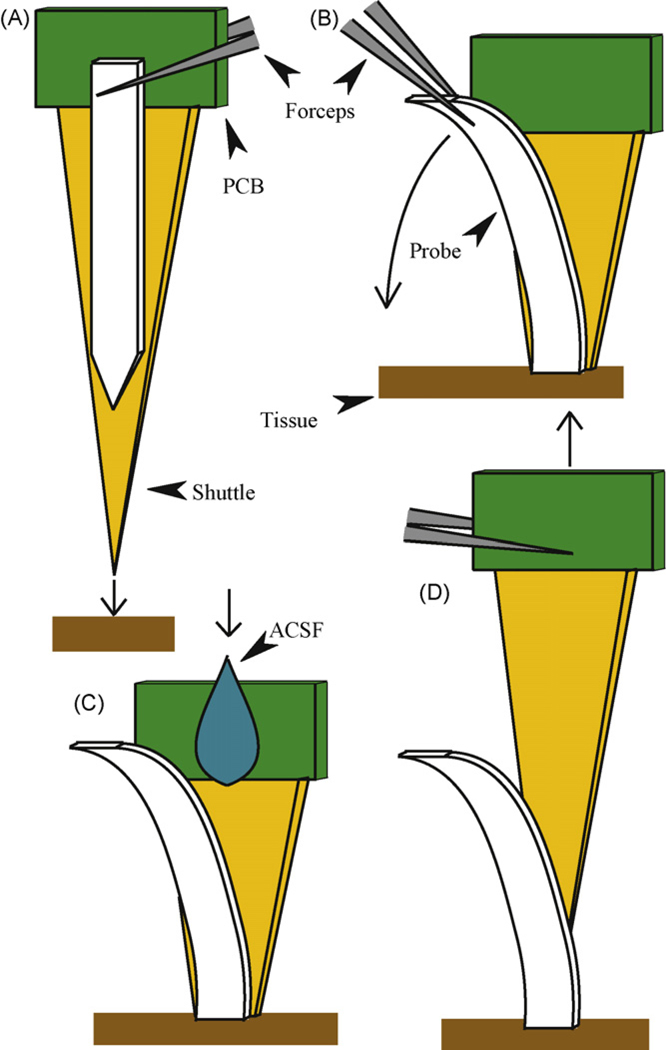
Penetrating microscale microelectrodes made from flexible polymers tend to bend or deflect and may fail to reach their target location. The development of flexible neural probes requires methods for reliable and controlled insertion into the brain. Previous approaches for implanting flexible probes into the cortex required modifications that negate the flexibility, limit the functionality, or restrict the design of the probe. This study investigated the use of an electronegative self-assembled monolayer (SAM) as a coating on a stiff insertion shuttle to carry a polymer probe into the cerebral cortex, and then the detachment of the shuttle from the probe by altering the shuttle's hydrophobicity. Polydimethylsiloxane (PDMS) and polyimide probes were inserted into an agarose in vitro brain model using silicon insertion shuttles. The silicon shuttles were coated with a carboxyl terminal SAM. The precision of insertion using the shuttle was measured by the percentage displacement of the probe upon shuttle removal after the probe was fully inserted. The average relative displacement of polyimide probes inserted with SAM-coated shuttles was (1.0+/-0.66)% of the total insertion depth compared to (26.5+/-3.7)% for uncoated silicon shuttles. The average relative displacement of PDMS probes was (2.1+/-1.1)% of the insertion depth compared to 100% (complete removal) for uncoated silicon shuttles. SAM-coated shuttles were further validated through their use to reliably insert PDMS probes in the cerebral cortex of rodents. This study found that SAM-coated silicon shuttles are a viable method for accurately and precisely inserting flexible neural probes in the brain.
Conflict of interest statement
D. Kipke has a significant financial and leadership interest in NeuroNexus Technologies.
Figures



References
-
- Barrangou LM, Drake M, Daubert CR, Foegeding EA. Textural properties of agarose gels. II. Relationships between rheological properties and sensory texture. Food Hydrocolloids. 2006;20:196–203.
-
- Biran R, Martin DC, Tresco PA. Neuronal cell loss accompanies the brain tissue response to chronically implanted silicon microelectrode arrays. Exp Neurol. 2005;195:115–126. - PubMed
-
- Bjornsson CS, Oh SJ, Al-Kofahi YA, Lim YJ, Smith KL, Turner JN, et al. Effects of insertion conditions on tissue strain and vascular damage during neuroprosthetic device insertion. J Neural Eng. 2006;3:196–207. - PubMed
Publication types
MeSH terms
Substances
Grants and funding
LinkOut - more resources
Full Text Sources
Other Literature Sources
