


Depression relapse prophylaxis with Mindfulness-Based Cognitive Therapy: replication and extension in the Swiss health care system
- PMID: 19666195
- PMCID: PMC2866251
- DOI: 10.1016/j.jad.2009.07.007
Depression relapse prophylaxis with Mindfulness-Based Cognitive Therapy: replication and extension in the Swiss health care system
Abstract
Background: Mindfulness-Based Cognitive Therapy (MBCT) is a group intervention that integrates elements of Cognitive Behavioural Therapy (CBT) with components of mindfulness training to prevent depressive relapse. The efficacy of MBCT compared to Treatment As Usual (TAU), shown in two randomized controlled trials indicates a significant decrease in 1-year relapse rates for patients with at least three past depressive episodes. The present study is the first independent replication trial comparing MBCT+TAU to TAU alone across both language and culture (Swiss health care system).
Methods: Sixty unmedicated patients in remission from recurrent depression (>or=3 episodes) were randomly assigned to MBCT+TAU or TAU. Relapse rate and time to relapse were measured over a 60 week observation period. The frequency of mindfulness practices during the study was also evaluated.
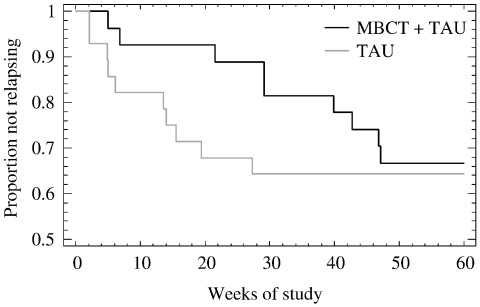
Results: Over a 14-month prospective follow-up period, time to relapse was significantly longer with MBCT+TAU than TAU alone (median 204 and 69 days, respectively), although both groups relapsed at similar rates. Analyses of homework adherence revealed that following treatment termination, the frequency of brief and informal mindfulness practice remained unchanged over 14 months, whereas the use of longer formal meditation decreased over time.
Limitations: Relapse monitoring was 14months in duration and prospective reporting of mindfulness practice would have yielded more precise frequency estimates compared to the retrospective methods we utilized.
Conclusions: Further studies are required to determine which patient characteristics, beyond the number of past depressive episodes, may predict differential benefits from this therapeutic approach.
Copyright (c) 2009 Elsevier B.V. All rights reserved.
Figures
References
-
- American Psychiatric Association . American Psychiatric Association; Washington, DC: 1994. Diagnostic and Statistical Manual of Mental Disorders: DSM-IV.
-
- Aubry J.M., Gervasoni N., Osiek C., Perret G., Rossier M.F., Bertschy G., Bondolfi G. The DEX/CRH neuroendocrine test and the prediction of depressive relapse in remitted depressed outpatients. J. Psychiatr. Res. 2007;41:290–294. - PubMed
-
- Beck A.T., Rush A.J., Shaw B.F., Emery G. Guilford Press; New York: 1979. Cognitive Therapy of Depression.
-
- Beck A.T., Steer R.A., Brown G.K. The Psychological Corporation; San Antonio, TX: 1996. Beck Depression Inventory-II.
-
- Bockting C.L., Schene A.H., Spinhoven P., Koeter M.W., Wouters L.F., Huyser J., Kamphuis J.H. Preventing relapse/recurrence in recurrent depression with cognitive therapy: a randomized controlled trial. J. Consult. Clin. Psychol. 2005;73:647–657. - PubMed
Publication types
MeSH terms
LinkOut - more resources
Full Text Sources
Medical
Research Materials
Miscellaneous
