


Restoring a maize root signal that attracts insect-killing nematodes to control a major pest
- PMID: 19666594
- PMCID: PMC2726344
- DOI: 10.1073/pnas.0906365106
Restoring a maize root signal that attracts insect-killing nematodes to control a major pest
Erratum in
- Proc Natl Acad Sci U S A. 2009 Oct 13;106(41):17606
Abstract
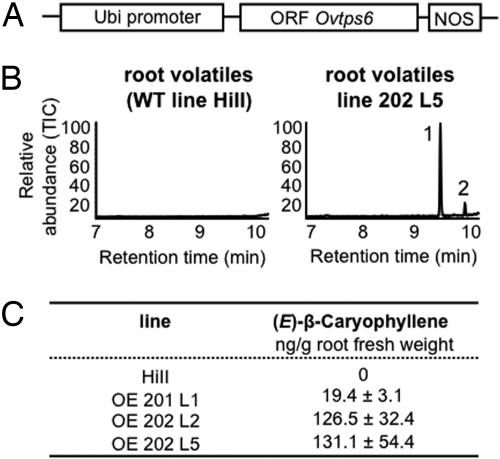
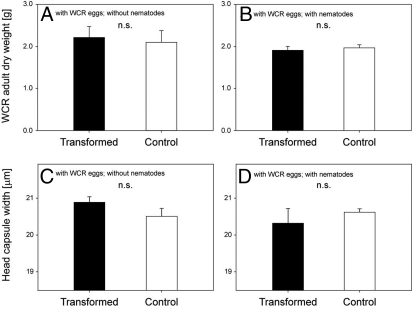
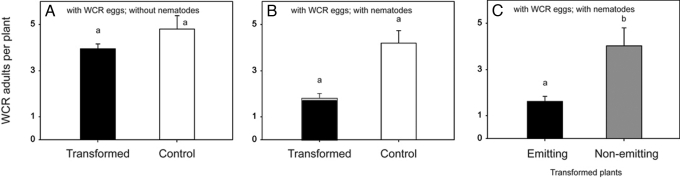
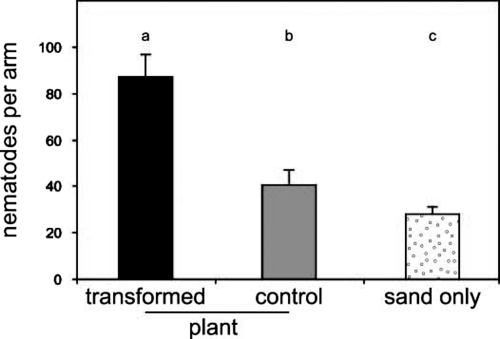
When attacked by herbivorous insects, plants emit volatile compounds that attract natural enemies of the insects. It has been proposed that these volatile signals can be manipulated to improve crop protection. Here, we demonstrate the full potential of this strategy by restoring the emission of a specific belowground signal emitted by insect-damaged maize roots. The western corn rootworm induces the roots of many maize varieties to emit (E)-beta-caryophyllene, which attracts entomopathogenic nematodes that infect and kill the voracious root pest. However, most North American maize varieties have lost the ability to emit (E)-beta-caryophyllene and may therefore receive little protection from the nematodes. To restore the signal, a nonemitting maize line was transformed with a (E)-beta-caryophyllene synthase gene from oregano, resulting in constitutive emissions of this sesquiterpene. In rootworm-infested field plots in which nematodes were released, the (E)-beta-caryophyllene-emitting plants suffered significantly less root damage and had 60% fewer adult beetles emerge than untransformed, nonemitting lines. This demonstration that plant volatile emissions can be manipulated to enhance the effectiveness of biological control agents opens the way for novel and ecologically sound strategies to fight a variety of insect pests.
Conflict of interest statement
Conflict of interest statement: A patent for the transformation with the oregano (
Figures
References
-
- Dudareva N, Negre F, Nagegowda DA, Orlova I. Plant volatiles: Recent advances and future perspectives. CRC Crit Rev Plant Sci. 2006;25:417–440.
-
- De Moraes CM, Lewis WJ, Pare PW, Alborn HT, Tumlinson JH. Herbivore-infested plants selectively attract parasitoids. Nature. 1998;393:570–573.
-
- Dicke M, Sabelis MW. How plants obtain predatory mites as bodyguards. Neth J Zool. 1988;38:148–165.
-
- Hilker M, Meiners T. Induction of plant responses to oviposition and feeding by herbivorous arthropods: A comparison. Entomol Exp Appl. 2002;104:181–192.
Publication types
MeSH terms
Substances
LinkOut - more resources
Full Text Sources
Other Literature Sources
