. 2009 Oct;75(19):6124-31.
doi: 10.1128/AEM.00809-09. Epub 2009 Aug 7.

New plasmid tools for genetic analysis of Actinobacillus pleuropneumoniae and other pasteurellaceae

Affiliations

New plasmid tools for genetic analysis of Actinobacillus pleuropneumoniae and other pasteurellaceae

Janine T Bossé et al. Appl Environ Microbiol. 2009 Oct.

Abstract

We have generated a set of plasmids, based on the mobilizable shuttle vector pMIDG100, which can be used as tools for genetic manipulation of Actinobacillus pleuropneumoniae and other members of the Pasteurellaceae. A tandem reporter plasmid, pMC-Tandem, carrying promoterless xylE and gfpmut3 genes downstream of a multiple-cloning site (MCS), can be used for identification of transcriptional regulators and conditions which favor gene expression from different cloned promoters. The ability to detect transcriptional regulators using the tandem reporter system was validated in A. pleuropneumoniae using the cloned rpoE (sigma(E)) promoter (P). The resulting plasmid, pMCrpoEP, was used to identify a mutant defective in production of RseA, the negative regulator of sigma(E), among a bank of random transposon mutants, as well as to detect induction of sigma(E) following exposure of A. pleuropneumoniae to ethanol or heat shock. pMCsodCP, carrying the cloned sodC promoter of A. pleuropneumoniae, was functional in A. pleuropneumoniae, Haemophilus influenzae, Haemophilus parasuis, Mannheimia haemolytica, and Pasteurella multocida. Two general expression vectors, pMK-Express and pMC-Express, which differ in their antibiotic resistance markers (kanamycin and chloramphenicol, respectively), were constructed for the Pasteurellaceae. Both plasmids have the A. pleuropneumoniae sodC promoter upstream of the gfpmut3 gene and an extended MCS. Replacement of gfpmut3 with a gene of interest allows complementation and heterologous gene expression, as evidenced by expression of the Haemophilus ducreyi nadV gene in A. pleuropneumoniae, rendering the latter NAD independent.


Figures
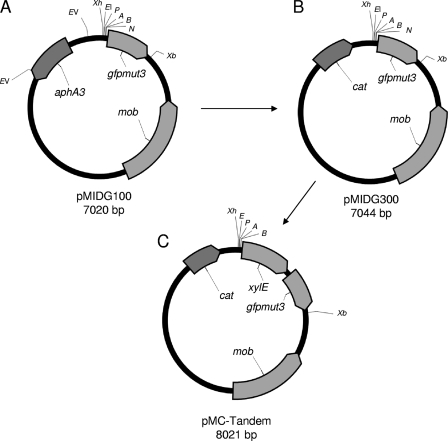
FIG. 1.
FIG. 1.
Construction of the reporter vector, pMC-Tandem. (A) pMIDG100 (49) containing aphA3 (kanamycin resistance), gfpmut3 (GFP), and mob (mobilization protein). (B) pMIDG300 was derived from pMIDG100 by cloning the cat gene (chloramphenicol resistance) from S. aureus pC194 (30) into the two EcoRV sites, replacing the aphA3 gene. (C) pMC-Tandem was derived from pMIDG300 by insertion of the xylE gene (catechol 2,3-dioxygenase) from pJFF224-NX:xylE (18) into the unique BamHI and NheI sites upstream of gfpmut3. Relevant restriction sites are labeled as follows: A, ApaI; B, BamHI; EI, EcoRI; EV, EcoRV; K, KpnI; N, NheI; P, PstI; Xb, XbaI; Xh, XhoI. All labeled restriction sites are unique except for EcoRV, which cuts twice in pMIDG100.
FIG. 2.
FIG. 2.
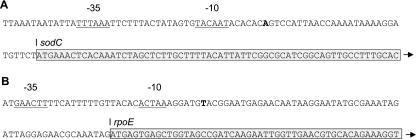
Identification of transcriptional start sites for sodC and rpoE in A. pleuropneumoniae by 5′ rapid amplification of cDNA ends. (A) Sequence showing the transcriptional start site for sodC (bold) and the predicted −10 and −35 promoter regions (underlined). The −10 sequence agrees with that previously predicted by Langford et al. (28) using primer extension. In that study, the −35 region was predicted to be TTATT, although an alternative (TTTAAA), which shows closer homology to the consensus for the −35 region of E. coli σ70 promoters (TTGACA), is present. (B) Sequence showing the transcriptional start site for rpoE (bold) and the predicted −10 and −35 promoter regions (underlined). The predicted −35 region is a perfect match for the −35 region of the E. coli σE promoter (GAACTT), whereas the −10 region (ACTAA) differs slightly from that in E. coli (TCAAA). For both sodC and rpoE, the boxed regions show the beginning of the translated genes.
FIG. 3.
FIG. 3.
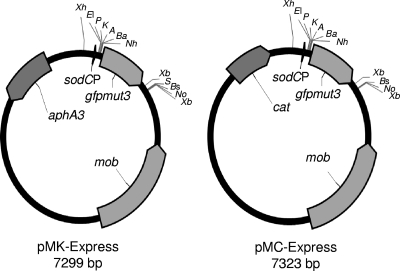
Maps of the expression vectors pMK-Express and pMC-Express. Genes aphA3 (kanamycin resistance), cat (chloramphenicol resistance), gfpmut3 (GFP), and mob (mobilization protein) are indicated by solid arrows. The A. pleuropneumoniae sodC promoter (sodCP) is indicated by the arrowhead upstream of gfpmut3. Relevant restriction sites are labeled as follows: A, ApaI; Ba, BamHI; Bs, BstXI; EI, EcoRI; EV, EcoRV; K, KpnI; Nh, NheI; No, NotI; P, PstI; S, SacI; Xb, XbaI; Xh, XhoI. All labeled restriction sites are unique except for XbaI, which cuts twice in both pMK-Express and pMC-Express.
FIG. 4.
FIG. 4.
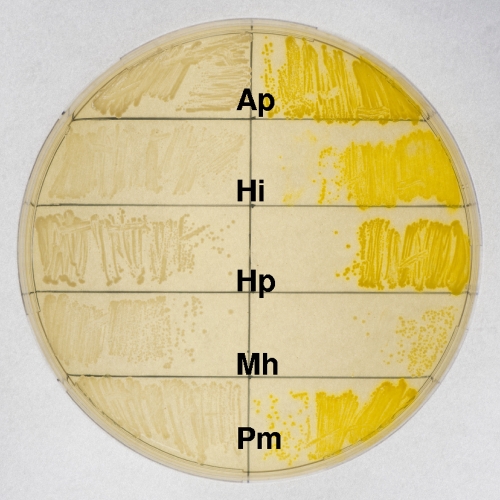
Assay for catechol 2,3-dioxygenase activity. Each of the Pasteurellaceae strains containing pMCsodCP (with the cloned A. pleuropneumoniae sodC promoter; right side of plate) produced bright yellow colonies (including those that are single and isolated) when sprayed with catechol, whereas there was no detectable color change for any of the strains containing pMC-Tandem (promoterless; left side of plate). Bacteria: Ap, A. pleuropneumoniae; Hi, H. influenzae; Hp, H. parasuis; Mh, M. haemolytica; Pm, P. multocida.
FIG. 5.
FIG. 5.
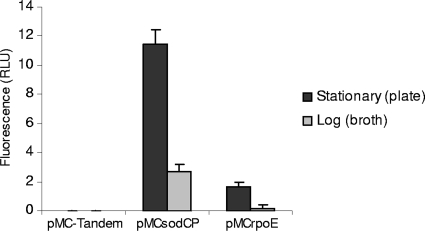
Expression of GFP in A. pleuropneumoniae S4074 bacteria containing different reporter plasmids. The relative fluorescence of the bacteria, grown either to stationary phase on BHI-Lev plates or to mid-log phase in BHI broth, was measured on gated populations of bacterial cells by flow cytometry, producing data in relative light units (RLU) per cell. In each case, the background fluorescence from A. pleuropneumoniae S4074 containing the pMC-Tandem (promoterless) has been subtracted. Experiments were performed in triplicate, and the error bars indicate the standard deviations of the means.
FIG. 6.
FIG. 6.
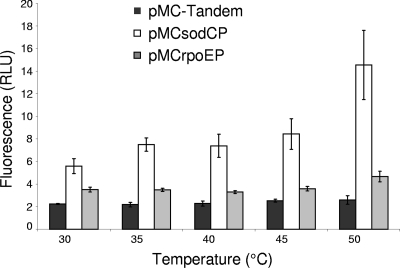
Induction of the A. pleuropneumoniae sodC and rpoE promoters following heat shock. The level of fluorescence per cell containing pMC-Tandem (promoterless) did not change following a shift from growth at 30°C to temperatures ranging from 35°C to 50°C. In contrast, the level of fluorescence per cell containing pMCsodCP or containing pMCrpoEP increased significantly after a temperature increase from 30°C to 50°C (P = <0.01 and P = 0.03, respectively), as determined by Student's t test. Experiments were performed in triplicate, and the error bars indicate the standard deviations of the means.
FIG. 7.
FIG. 7.
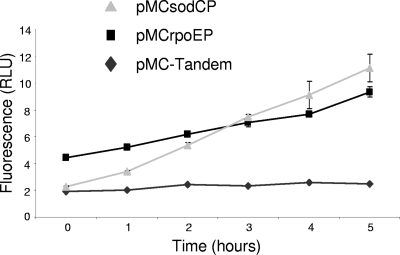
Induction of the A. pleuropneumoniae sodC and rpoE promoters following exposure to ethanol. The level of fluorescence per cell was measured following addition of 3% (vol/vol) ethanol to mid-log phase cultures (at 0 h). In A. pleuropneumoniae S4074 containing pMC-Tandem (promoterless), the levels of fluorescence remained constant throughout the time course, while the levels of fluorescence in cells containing pMCsodCP or pMCrpoE increased over time. Following addition of ethanol, viable cell counts did not increase, and by 5 h there was a 10-fold reduction in viable cell counts. Experiments were performed in triplicate, and the error bars indicate the standard deviations of the means.
FIG. 8.
FIG. 8.
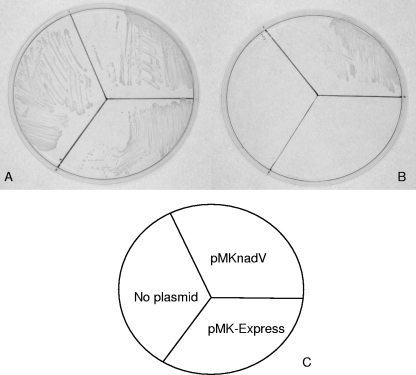
Complementation of the requirement for NAD in A. pleuropneumoniae S4074 by H. ducreyi nadV. Bacterial strains were plated on BHI plus NAD (A) or BHI with no supplement (B). (C) Cartoon showing the relative positions of A. pleuropneumoniae containing no plasmid, empty vector (pMK-Express), or pMKnadV (expressing the cloned H. ducreyi nadV gene). Only the strain containing pMKnadV was able to grow on BHI media in the absence of added NAD.

References

    1. Anderson, T. J., and J. I. MacInnes. 1997. Expression and phylogenetic relationships of a novel lacZ homologue from Actinobacillus pleuropneumoniae. FEMS Microbiol. Lett. 152:117-123. - PubMed
    1. Auger, E., V. Deslandes, M. Ramjeet, I. Contreras, J. H. Nash, J. Harel, M. Gottschalk, M. Olivier, and M. Jacques. 2009. Host-pathogen interactions of Actinobacillus pleuropneumoniae with porcine lung and tracheal epithelial cells. Infect. Immun. 77:1426-1441. - PMC - PubMed
    1. Baltes, N., I. Hennig-Pauka, I. Jacobsen, A. D. Gruber, and G. F. Gerlach. 2003. Identification of dimethyl sulfoxide reductase in Actinobacillus pleuropneumoniae and its role in infection. Infect. Immun. 71:6784-6792. - PMC - PubMed
    1. Baltes, N., M. N′Diaye, I. D. Jacobsen, A. Maas, F. F. Buettner, and G. F. Gerlach. 2005. Deletion of the anaerobic regulator HlyX causes reduced colonization and persistence of Actinobacillus pleuropneumoniae in the porcine respiratory tract. Infect. Immun. 73:4614-4619. - PMC - PubMed
    1. Bandara, A. B., M. L. Lawrence, H. P. Veit, and T. J. Inzana. 2003. Association of Actinobacillus pleuropneumoniae capsular polysaccharide with virulence in pigs. Infect. Immun. 71:3320-3328. - PMC - PubMed

Publication types

Associated data

LinkOut - more resources