. 2009 Oct;297(4):H1453-61.
doi: 10.1152/ajpheart.00315.2009. Epub 2009 Aug 7.

Heme oxygenase-1 induction modulates hypoxic pulmonary vasoconstriction through upregulation of ecSOD

Affiliations

Heme oxygenase-1 induction modulates hypoxic pulmonary vasoconstriction through upregulation of ecSOD

Mansoor Ahmad et al. Am J Physiol Heart Circ Physiol. 2009 Oct.

Abstract

Endothelium-denuded bovine pulmonary arteries (BPA) contract to hypoxia through a mechanism potentially involving removing a superoxide-derived hydrogen peroxide-mediated relaxation. BPA organ cultured for 24 h with 0.1 mM cobalt chloride (CoCl(2)) to increase the expression and activity of heme oxygenase-1 (HO-1) is accompanied by a decrease in 5 microM lucigenin-detectable superoxide and an increase in horseradish peroxidase-luminol detectable peroxide levels. Force development to KCl in BPA was not affected by increases in HO-1, but the hypoxic pulmonary vasoconstriction (HPV) response was decreased. Organ culture with a HO-1 inhibitor (10 microM chromium mesoporphyrin) reversed the effects of HO-1 on HPV and peroxide. Treatment of HO-1-induced BPA with extracellular catalase resulted in reversal of the attenuation of HPV without affecting the force development to KCl. Increasing intracellular peroxide scavenging with 0.1 mM ebselen increased force development to KCl and partially reversed the decrease in HPV seen on induction of HO-1. HO-1 induction increases extracellular (ec) superoxide dismutase (SOD) expression without changing Cu,Zn-SOD and Mn-SOD levels. HO-1-induced BPA rings treated with the copper chelator 10 mM diethyldithiocarbamate to inactivate ecSOD and Cu,Zn-SOD showed increased superoxide and decreased peroxide to levels equal to non-HO-1-induced rings, whereas the addition of SOD to freshly isolated BPA rings attenuated HPV similar to HO-1 induction with CoCl(2). Therefore, HO-1 induction in BPA increases ecSOD expression associated with enhanced generation of peroxide in amounts that may not be adequately removed during hypoxia, leading to an attenuation of HPV.


Figures
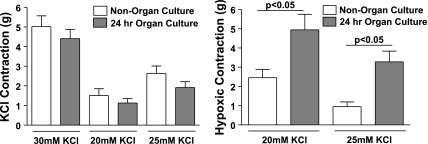
Fig. 1.
Fig. 1.
Effects of a 24 h organ culture on the contraction of isolated endothelium-rubbed bovine calf pulmonary arteries to the various doses of KCl examined in the protocols used in this study, and on the increase in force elicited by an acute exposure to hypoxia. The pooled data are a summary of the actual increases in force measured in freshly isolated (nonorgan cultured, n = 9–37) and organ cultured (n = 18–46) arteries in the absence of additional treatments for the initial contractions to 30 mM KCl (n = 37–46) and subsequent contractions to 20 (n = 9–18) or 25 (n = 24–33) mM KCl, which were exposed to hypoxia for the experiments reported in this study.
Fig. 2.
Fig. 2.
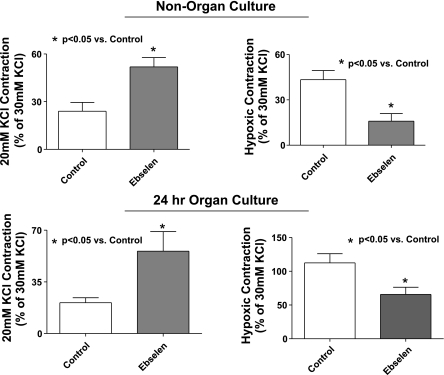
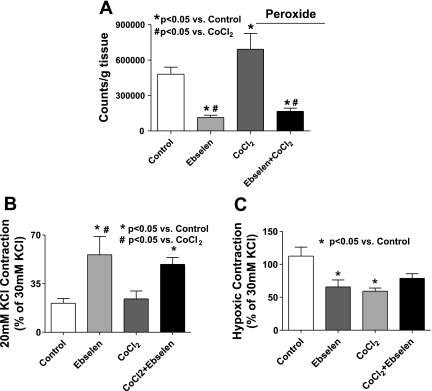
Effects of increasing peroxide consumption by the presence of 100 μM ebselen on the contractile response of non-organ-cultured and 24-h organ-cultured bovine pulmonary arteries (BPA) to 20 mM KCl, and on the increase in force elicited by an acute exposure to hypoxia. Force generation in BPA to 20 mM KCl is increased while force development to hypoxia is decreased in the presence of 0.1 mM ebselen in both fresh and organ-cultured arteries (n = 9).
Fig. 3.
Fig. 3.
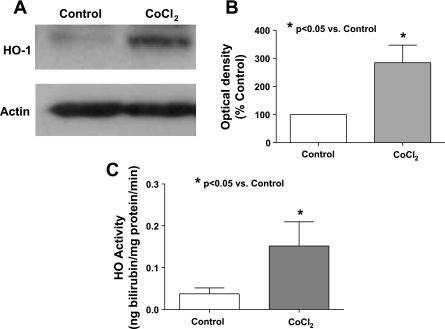
Western blot (A) and summary data (n = 7) (B) documenting that heme oxygenase (HO)-1 expression is increased on exposure to 24 h of CoCl2 (0.1 mM) in organ culture. C: HO activity is also significantly (n = 12) increased by organ culture with CoCl2.
Fig. 4.
Fig. 4.
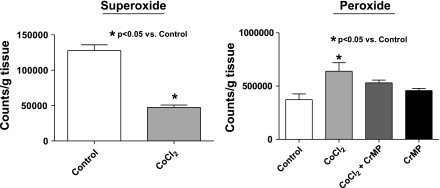
Lucigenin-detected superoxide levels are decreased (n = 12) while luminol-detected peroxide levels are increased (n = 4) by organ culture of BPA with CoCl2 (0.1 mM) for 24 h. When the HO inhibitor chromium mesoporphyrin (CrMP, 10 μM) is present during organ culture, it prevents detection of the increase in peroxide seen on induction of HO-1 with CoCl2.
Fig. 5.
Fig. 5.
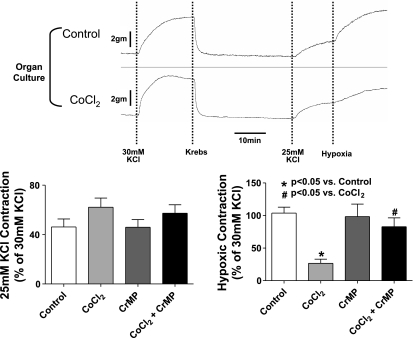
Effects of HO-1 induction by CoCl2 on the contraction of BPA to 25 mM KCl and the contraction elicited by hypoxia. The effects of 24 h organ culture in the absence and presence of CoCl2 (0.1 mM) on responses of BPA to 30 mM KCl, 25 mM KCl, and subsequent exposure of arteries contracted with 25 mM KCl to hypoxia are shown. Summary data for the increase in force elicited by 25 mM KCl and the additional increase in force elicited by hypoxia are reported for BPA organ cultured in the absence and presence of combinations of CoCl2 and the inhibitor of HO activity CrMP. The data indicate that force development to 25 mM KCl is not changed on treatment with CoCl2 and CrMP (n = 10); however, force development to hypoxia is decreased on treatment with CoCl2, and CrMP prevents this attenuation in force.
Fig. 6.
Fig. 6.
A: peroxide levels are increased in BPA organ cultured with CoCl2 (0.1 mM) and decreased when measured in the presence of ebselen (n = 6). B: 20 mM KCl contraction is increased (n = 7–9) (B) and attenuation of hypoxic force seen on induction of HO-1 through CoCl2 (0.1 mM) is removed in the presence of ebselen (n = 7–9) (C).
Fig. 7.
Fig. 7.
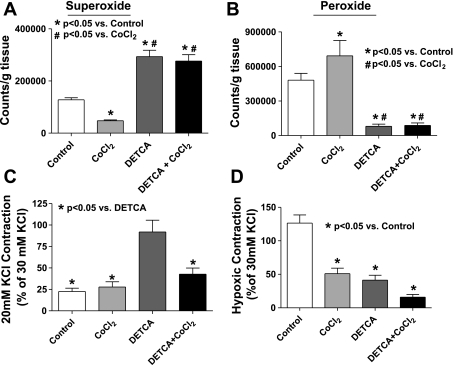
Superoxide levels are increased (n = 12) (A) while peroxide levels are decreased (B) to similar levels in pulmonary arteries organ cultured either in the absence or presence of CoCl2, that were subsequently treated with the Cu-binding agent 10 mM diethyldithiocarbamate (DETCA, n = 6). C: 20 mM KCl force is significantly increased in the presence of DETCA in organ-cultured vessels (n = 9–13). D: hypoxic force development is decreased in the organ-cultured arteries subsequently treated with DETCA (n = 9–13).
Fig. 8.
Fig. 8.
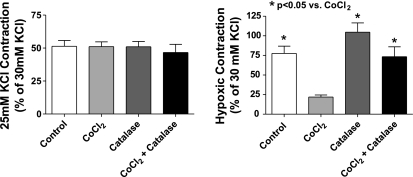
Force development to 25 mM KCl is not affected by a 30-min treatment of pulmonary arteries previously organ cultured in the absence or presence of CoCl2 by catalase (1 μM) (22–23), but the attenuation in hypoxic force development by HO-1 induction with CoCl2 is reversed in the presence of catalase (n = 23–29).
Fig. 9.
Fig. 9.
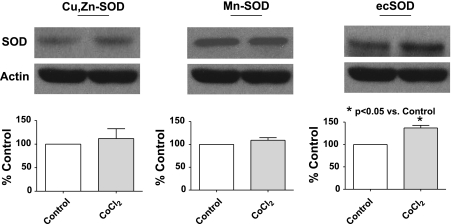
HO-1 induction with CoCl2 causes an increase in the expression of extracellular (ec) superoxide dismutase (SOD) (n = 6) while the expression of Cu,Zn-SOD (n = 14) and Mn-SOD, (n = 6) is not affected.
Fig. 10.
Fig. 10.
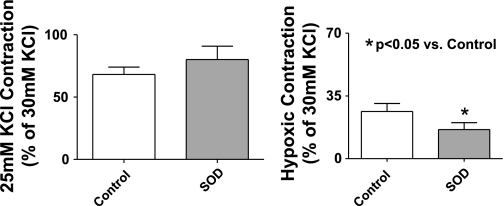
Freshly isolated BPA rings treated for 30 min with SOD (1 μM) do not show a change in force development to 25 mM KCl, but hypoxic force development is attenuated significantly in these rings (n = 24).
Fig. 11.
Fig. 11.
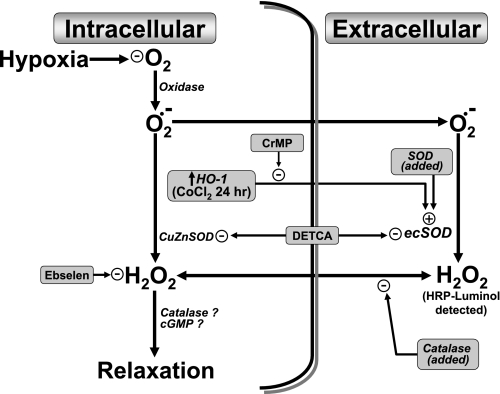
Model showing how an increase in ecSOD expression as a result of HO-1 induction by organ culture with CoCl2 potentially inhibits the contraction of BPA to hypoxia by enhancing the conversion of extracellular superoxide normally present in BPA to peroxide. The model shows how the interventions used in this study modulate a hypoxia-elicited contractile mechanism hypothesized to be mediated by removal of the oxygen-dependent relaxing effects of peroxide that are normally derived from intracellular superoxide.

References

    1. Abraham NG, Kappas A. Pharmacological and clinical aspects of heme oxygenase. Pharmacol Rev 60: 79–127, 2008 - PubMed
    1. Abraham NG, Lin JH, Dunn MW, Schwartzman ML. Presence of heme oxygenase and NADPH cytochrome P-450 (c) reductase in human corneal epithelium. Invest Ophthalmol Vis Sci 28: 1464–1472, 1987 - PubMed
    1. Archer SL, Will JA, Weir EK. Redox status in the control of pulmonary vascular tone. Herz 11: 127–141, 1986 - PubMed
    1. Bradford MM. A rapid and sensitive method for the quantitation of microgram quantities of protein utilizing the principle of protein-dye binding. Anal Biochem 72: 248–254, 1976 - PubMed
    1. Burke TM, Wolin MS. Hydrogen peroxide elicits pulmonary arterial relaxation and guanylate cyclase activation. Am J Physiol Heart Circ Physiol 252: H721–H732, 1987 - PubMed

Publication types

MeSH terms

LinkOut - more resources