


Extracellular acidification exerts opposite actions on TREK1 and TREK2 potassium channels via a single conserved histidine residue
- PMID: 19667202
- PMCID: PMC2732798
- DOI: 10.1073/pnas.0906267106
Extracellular acidification exerts opposite actions on TREK1 and TREK2 potassium channels via a single conserved histidine residue
Abstract
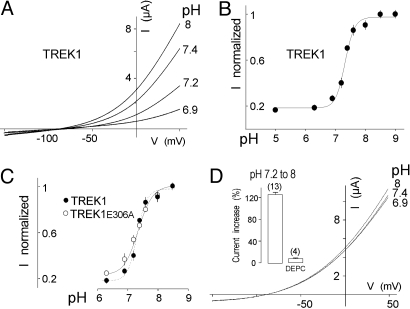
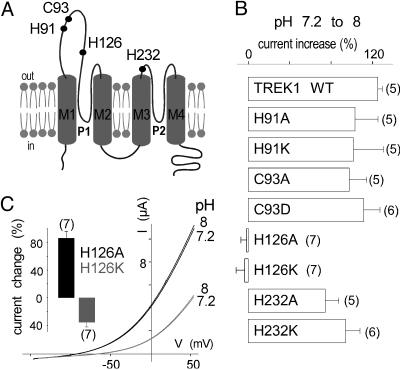
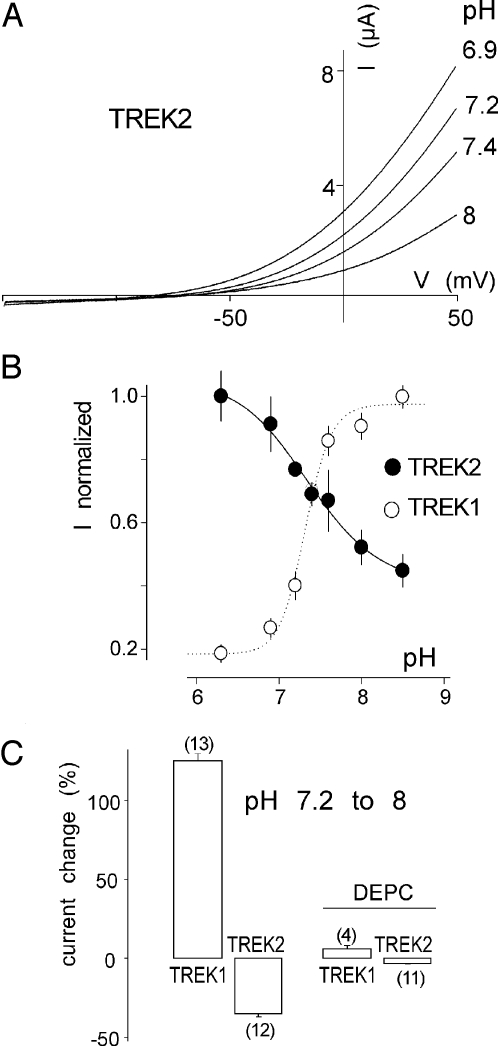
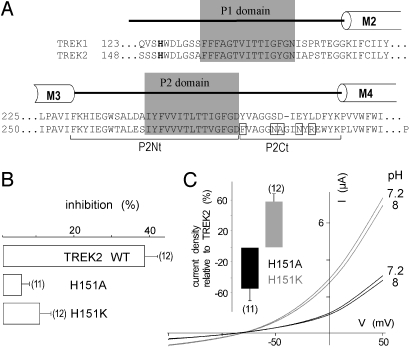
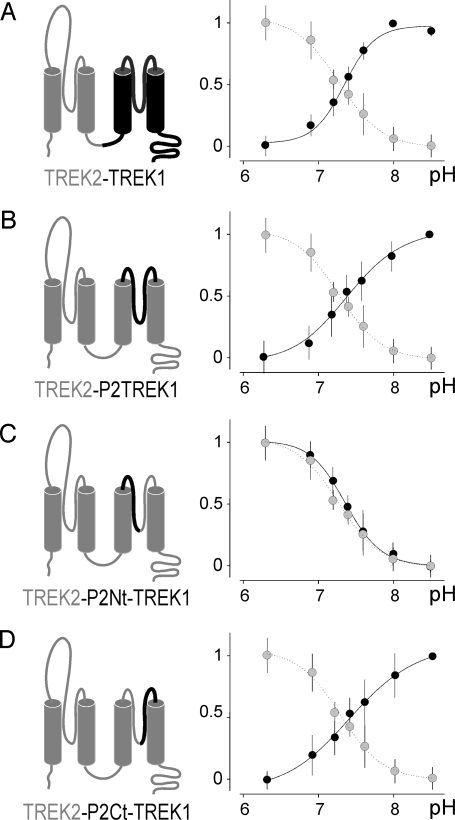
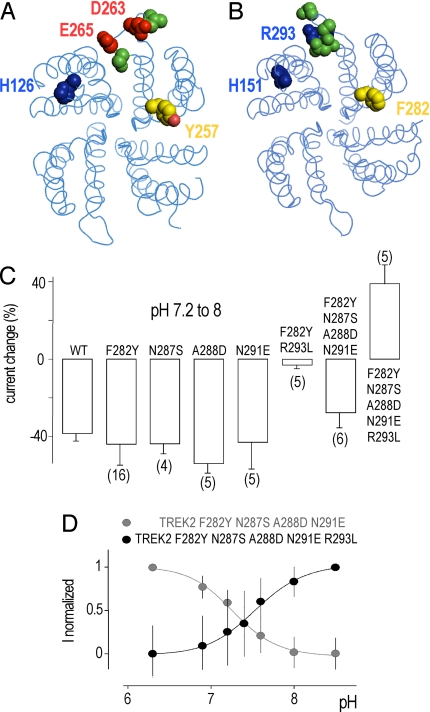
Mechanosensitive K(+) channels TREK1 and TREK2 form a subclass of two P-domain K(+) channels. They are potently activated by polyunsaturated fatty acids and are involved in neuroprotection, anesthesia, and pain perception. Here, we show that acidification of the extracellular medium strongly inhibits TREK1 with an apparent pK near to 7.4 corresponding to the physiological pH. The all-or-none effect of pH variation is steep and is observed within one pH unit. TREK2 is not inhibited but activated by acidification within the same range of pH, despite its close homology with TREK1. A single conserved residue, H126 in TREK1 and H151 in TREK2, is involved in proton sensing. This histidine is located in the M1P1 extracellular loop preceding the first P domain. The differential effect of acidification, that is, activation for TREK2 and inhibition for TREK1, involves other residues located in the P2M4 loop, linking the second P domain and the fourth membrane-spanning segment. Structural modeling of TREK1 and TREK2 and site-directed mutagenesis strongly suggest that attraction or repulsion between the protonated side chain of histidine and closely located negatively or positively charged residues in P2M4 control outer gating of these channels. The differential sensitivity of TREK1 and TREK2 to external pH variations discriminates between these two K(+) channels that otherwise share the same regulations by physical and chemical stimuli, and by hormones and neurotransmitters.
Conflict of interest statement
The authors declare no conflict of interest.
Figures
References
-
- Lesage F, Terrenoire C, Romey G, Lazdunski M. Human TREK2, a 2P domain mechano-sensitive K+ channel with multiple regulations by polyunsaturated fatty acids, lysophospholipids, and Gs, Gi, and Gq protein-coupled receptors. J Biol Chem. 2000;275:28398–28405. - PubMed
-
- Bang H, Kim Y, Kim D. TREK-2, a new member of the mechanosensitive tandem-pore K+ channel family. J Biol Chem. 2000;275:17412–17419. - PubMed
Publication types
MeSH terms
Substances
LinkOut - more resources
Full Text Sources
Molecular Biology Databases
