


Polyomavirus infection and its impact on renal function and long-term outcomes after lung transplantation
- PMID: 19667938
- PMCID: PMC2752200
- DOI: 10.1097/TP.0b013e3181ae5ff9
Polyomavirus infection and its impact on renal function and long-term outcomes after lung transplantation
Abstract
Background: Polyomavirus infection causes nephropathy after kidney transplantation but has not been thoroughly investigated in nonrenal organ transplantation.
Methods: Ninety lung transplant recipients were enrolled, and they provided urine samples for over 4.5 years. Samples were analyzed for BK virus (BKV), JC virus (JCV), and simian virus 40 (SV40) by conventional and quantitative real-time polymerase chain reaction.
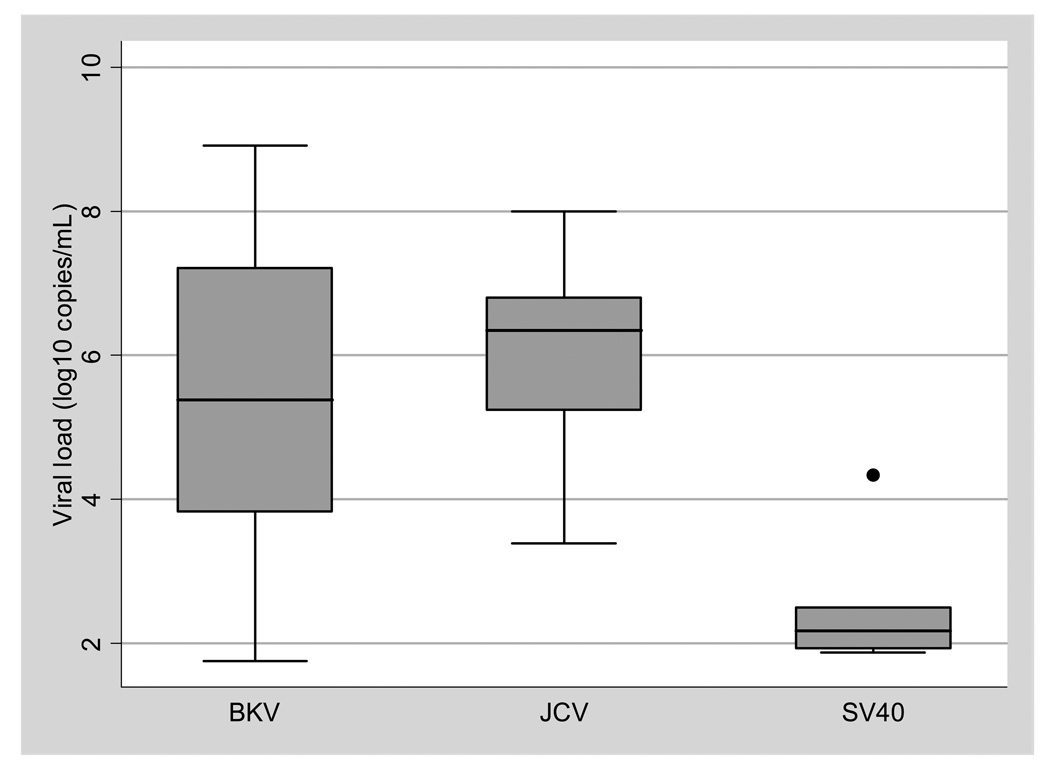
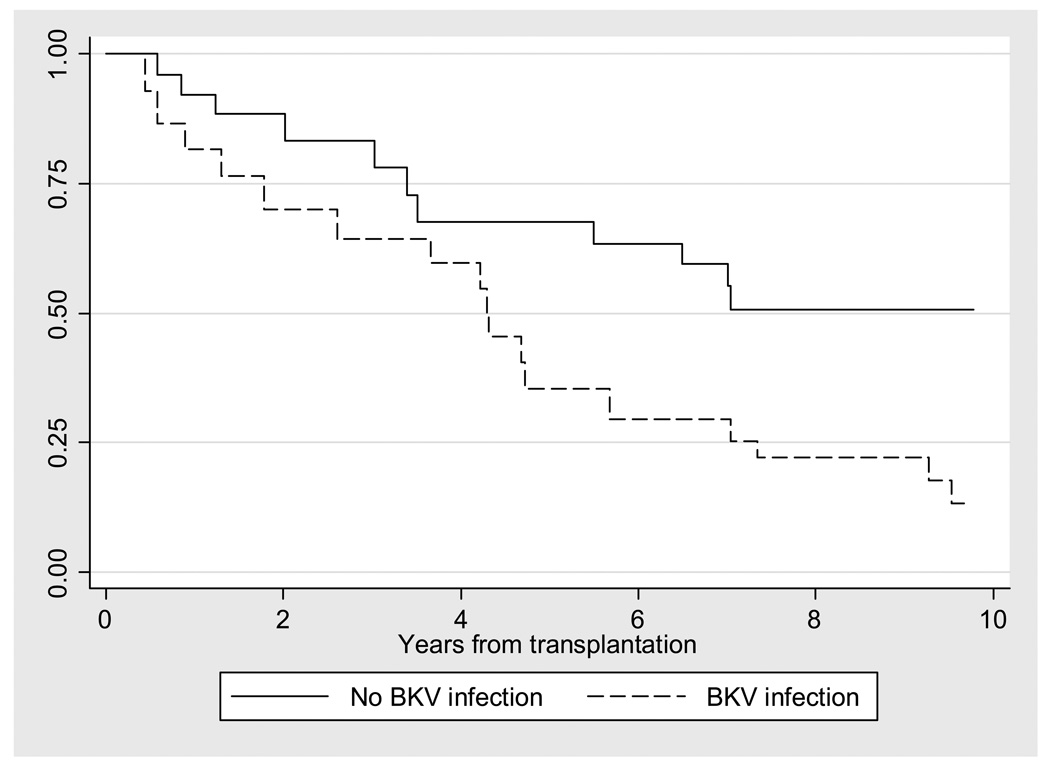
Results: Fifty-nine (66%) patients had polyomavirus detected at least once, including 38 patients (42%) for BKV, 25 patients (28%) for JCV, and six patients (7%) for SV40. Frequency of virus shedding in serial urine samples by patients positive at least once varied significantly among viruses: JCV, 64%; BKV, 48%; and SV40, 14%. Urinary viral loads for BKV (10 copies/mL) and JCV (10 copies/mL) were higher than for SV40 (10 copies/mL; P=0.001 and 0.0003, respectively). Polyomavirus infection was associated with a pretransplant diagnosis of chronic obstructive pulmonary disease (odds ratio 6.0; P=0.016) but was less common in patients with a history of acute rejection (odds ratio 0.28; P=0.016). SV40 infection was associated with sirolimus-based immunosuppression (P=0.037). Reduced survival was noted for patients with BKV infection (P=0.03). Patients with polyomavirus infection did not have worse renal function than those without infection, but in patients with BKV infection, creatinine clearances were lower at times when viral shedding was detected (P=0.038).
Conclusions: BKV and JCV were commonly detected in the urine of lung transplant recipients; SV40 was found at low frequency. No definite impact of polyomavirus infection on renal function was documented. BKV infection was associated with poorer survival.
Figures
Comment in
-
Respiratory epithelium: an unlikely reservoir for latent human polyomavirus infection but a likely portal of entry.Transplantation. 2010 Mar 15;89(5):634-5. doi: 10.1097/TP.0b013e3181c7f255. Transplantation. 2010. PMID: 20216372 No abstract available.
References
-
- Ojo AO, Held PJ, Port FK, et al. Chronic renal failure after transplantation of a nonrenal organ. New Engl J Med. 2003;349:931. - PubMed
-
- Wilkinson AH, Cohen DJ. Renal failure in the recipients of nonrenal solid organ transplants. J Am Soc Nephrol. 1999;10:1136. - PubMed
-
- Pattison JM, Petersen J, Kuo P, Valantine V, Robbins RC, Theodore J. The incidence of renal failure in one hundred consecutive heart-lung transplant recipients. Am J Kidney Dis. 1995;26:643. - PubMed
-
- Wyatt CM, Arons RR. The burden of acute renal failure in non-renal solid organ transplantation. Transplantation. 2004;78:1351. - PubMed
-
- Ishani A, Erturk S, Hertz MI, Matas AJ, Savik K, Rosenburg ME. Predictors of renal function following lung or heart-lung transplantation. Kidney Int. 2002;61:2228. - PubMed
Publication types
MeSH terms
Substances
Grants and funding
LinkOut - more resources
Full Text Sources
Medical
