


False negative results in glaucoma detection with Heidelberg Retina Tomograph II
- PMID: 19668399
- PMCID: PMC2698681
- DOI: 10.2147/opth.s2281
False negative results in glaucoma detection with Heidelberg Retina Tomograph II
Abstract
Purpose: To evaluate the rate of false negative results with the Heidelberg Retina Tomograph (HRT II) in a glaucoma practice.
Design: Cross-sectional study.
Methods: We analyzed the HRTs taken between October 2002 and October 2003 in our glaucoma clinic, and selected the patients who had a good quality image (SD < 40 mu) with a normal Moorfield's Regression Analysis (MRA). A masked independent observer classified those patients as normal, glaucoma suspect, or glaucomatous on the basis of optic disc stereo photos (ODP) and at least 2 consecutive reliable automated perimetries. The diagnosis of glaucoma was based on a glaucomatous optic disc with a congruent, reproducible visual field defect.
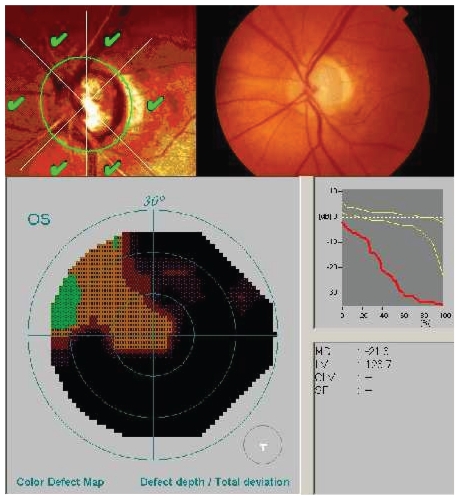
Results: Four hundred and fifty patients who had undergone an HRT examination were analyzed. One hundred and nine patients had an HRT classified as normal on the MRA, and a good quality image. Fifteen of those 109 patients (13.7%) were classified as glaucomatous on the basis of an abnormal ODP with corresponding visual field defect. Seven (6.4%) patients were classified as glaucoma suspect.
Conclusion: Fourteen percent of glaucoma patients with glaucoma remained undetected with the HRT II Moorfield's regression analysis as a sole means to detect glaucoma.
Keywords: Heidelberg Retina Tomograph II; false negative results; glaucoma detection.
Figures

Similar articles
-
Detection of glaucomatous visual field changes using the Moorfields regression analysis of the Heidelberg retina tomograph.Am J Ophthalmol. 2003 Jul;136(1):26-33. doi: 10.1016/s0002-9394(03)00084-9. Am J Ophthalmol. 2003. PMID: 12834666
-
Clinical ability of Heidelberg retinal tomograph examination to detect glaucomatous visual field changes.Ophthalmology. 2001 Sep;108(9):1621-7. doi: 10.1016/s0161-6420(01)00676-5. Ophthalmology. 2001. PMID: 11535460
-
Diagnostic accuracy of the Moorfields Regression Analysis using the Heidelberg Retina Tomograph in glaucoma patients with visual field defects.Eur J Ophthalmol. 2007 Mar-Apr;17(2):216-22. doi: 10.1177/112067210701700211. Eur J Ophthalmol. 2007. PMID: 17415695
-
Validity of screening for glaucomatous optic nerve damage using confocal scanning laser ophthalmoscopy (Heidelberg Retina Tomograph II) in high-risk populations: a pilot study.Ophthalmology. 2005 Dec;112(12):2164-71. doi: 10.1016/j.ophtha.2005.09.009. Ophthalmology. 2005. PMID: 16325710
-
Comparison of disc damage likelihood scale, cup to disc ratio, and Heidelberg retina tomograph in the diagnosis of glaucoma.Br J Ophthalmol. 2006 Apr;90(4):437-41. doi: 10.1136/bjo.2005.077131. Br J Ophthalmol. 2006. PMID: 16547323 Free PMC article.
References
-
- Asmann P, Heijl A. Glaucoma hemifield test: Automated visual field evaluation. Arch Ophthalmol. 1992;110:812–19. - PubMed
-
- Brusini P, Salvetat ML, Zeppieri M, et al. Frequency doubling technology perimetry with the Humphrey Matrix 30–2 test. J Glaucoma. 2006;15:77–83. - PubMed
-
- [EGS] European Glaucoma Society. Terminology and Guidelines for Glaucoma. (2nd ed) 2004 [online]. Accessed on 9 January, 2007. URL: http://www.eugs.org/fullbook.asp.
-
- [EGP] European Glaucoma Prevention Study Group. Reproducibility of evaluation of optic disc change for glaucoma with the stereo optic disc photographs. Ophthalmology. 2003;110:340–4. - PubMed
-
- [EGP] European Glaucoma Prevention Study Group. Results of the European Glaucoma Prevention Study. Ophthalmology. 2005;112:366–375. - PubMed
LinkOut - more resources
Full Text Sources
Research Materials
