


doi: 10.1007/s12072-008-9071-4.
Epub 2008 Apr 10.
Hepatitis E vaccine
Affiliations
- PMID: 19669259
- PMCID: PMC2716888
- DOI: 10.1007/s12072-008-9071-4
Item in Clipboard
Hepatitis E vaccine
Hepatol Int.
2008 Sep.
Abstract
Hepatitis E is an emerging disease in resource-poor regions of the world. It is estimated that about 2 billion people live in areas endemic for this disease. The inability to reproducibly culture hepatitis E virus makes it impossible to develop traditional live or inactivated vaccines. However, significant progress has been made in developing and testing recombinant subunit vaccines based on the viral capsid protein. This review summarizes these efforts.
Figures
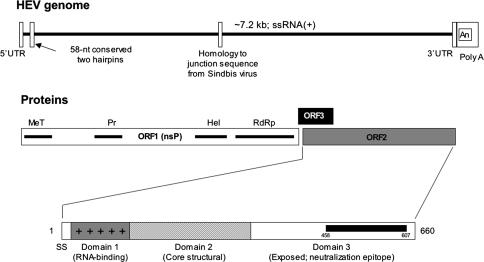
The genome organization of HEV. The HEV genome is an ∼7.2-kilobase (kb) single-stranded (+) sense RNA that encodes three open-reading frames: ORF1, ORF2, and ORF3. The ORF1 encodes the nonstructural polyprotein that contains various functional domains (methyltransferase, MeT; protease, Pr; RNA helicase, Hel; RNA-dependent RNA polymerase, RdRp). The ORF2 encodes the viral capsid protein and ORF3, a protein with regulatory properties. The 660-amino acid ORF2 protein has an N-terminal signal sequence (SS) and three putative domains (S. Jameel, 2008). Of these, domain 1 (∼100 residues) with a high density of arginine residues is likely to be involved in RNA encapsidation. Domain 2 (∼240 residues) is predicted to form the core of the viral capsid and domain 3 (∼300 residues) is predicted to be exposed on the virus particle. A neutralization epitope (amino acids 458–607) was localized to domain 3 and is likely to be involved in the binding of HEV to its cellular receptor
References
-
- Krawczynski K. Hepatitis E. Hepatology 1993;17:932–41. - PubMed
-
- Arankalle VA, Tsarev SA, Chadha MS, Alling DW, Emerson SU, Banerjee K, et al. Age-specific prevalence of antibodies to hepatitis A and E viruses in Pune, India, 1982 and 1992. J Infect Dis 1995;171:447–50. - PubMed
-
- Fix AD, Abdel-Hamid M, Purcell RH, Shehata MH, Abdel-Aziz F, Mikhail N, et al. Prevalence of antibodies to hepatitis E in two rural Egyptian communities. Am J Trop Med Hyg 2000;62:519–23. - PubMed
LinkOut - more resources
Full Text Sources
Other Literature Sources
