Acute fatal presentation of ornithine transcarbamylase deficiency in a previously healthy male
- PMID: 19669271
- PMCID: PMC2716892
- DOI: 10.1007/s12072-008-9078-x
Acute fatal presentation of ornithine transcarbamylase deficiency in a previously healthy male
Erratum in
-
Errata.Hepatol Int. 2008 Sep;2(3):395-6. doi: 10.1007/s12072-008-9089-7. Hepatol Int. 2008. PMID: 19669272 Free PMC article. No abstract available.
Abstract
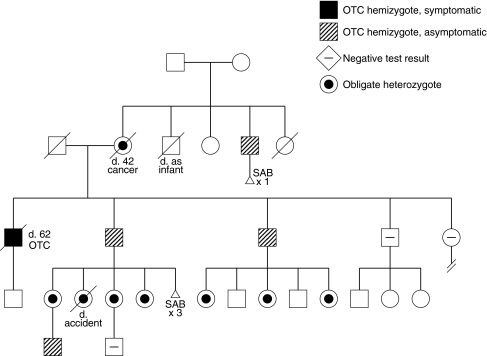
Ornithine transcarbamylase (OTC) deficiency is an X-linked urea cycle defect. While hemizygous males typically present with hyperammonemic coma in infancy, reports of rare late-onset presentations exist, with poor outcomes in males up to 58 years old. Relatives with mutations identical to affected patients often remain asymptomatic, and it is likely that environmental and genetic factors influence disease penetrance and expression. Here, we present our investigation of a patient with late-onset presentation, and we emphasize the potential role of environmental and genetic factors on disease expression. The patient was a previously healthy 62-year-old man who developed mental slowing, refractory seizures, and coma over an 8-day period. Interestingly, the patient had recently used home gardening fertilizers and pesticides. Evaluations for drug and alcohol use, infections, and liver disease were negative. Despite aggressive therapy, blood NH(3) concentration peaked at 2,050 muM and the patient died from cerebral edema and cerebellar herniation. Analysis of the OTC gene showed a Pro-225-Thr (P225T) change in exon 7, a mutation that has been previously implicated in OTC deficiency. This case illustrates that OTC deficiency can cause acute, severe hyperammonemia in a previously healthy adult and that the P225T mutation can be associated with late-onset OTC deficiency. We speculate that exposure to organic chemicals might have contributed to the onset of symptoms in this patient. This case also emphasizes that persistent hyperammonemia may cause irreversible neurologic damage and that after the diagnosis of hyperammonemia is established in an acutely ill patient, certain diagnostic tests should be performed to differentiate between urea cycle disorders and other causes of hyperammonemic encephalopathy.
Figures
References
-
- {'text': '', 'ref_index': 1, 'ids': [{'type': 'DOI', 'value': '10.1023/A:1005353407220', 'is_inner': False, 'url': 'https://doi.org/10.1023/a:1005353407220'}, {'type': 'PubMed', 'value': '9686344', 'is_inner': True, 'url': 'https://pubmed.ncbi.nlm.nih.gov/9686344/'}]}
- Tuchman M, Morizono H, Rajagopal BS, Plante RJ, Allewell NM. The biochemical and molecular spectrum of ornithine transcarbamylase deficiency. J Inherit Metab Dis 1998;21(Suppl 1):40–58. - PubMed
-
- {'text': '', 'ref_index': 1, 'ids': [{'type': 'DOI', 'value': '10.1002/humu.10035', 'is_inner': False, 'url': 'https://doi.org/10.1002/humu.10035'}, {'type': 'PubMed', 'value': '11793468', 'is_inner': True, 'url': 'https://pubmed.ncbi.nlm.nih.gov/11793468/'}]}
- Tuchman M, Jaleel N, Morizono H, Sheehy L, Lynch MG. Mutations and polymorphisms in the human ornithine transcarbamylase gene. Hum Mutat 2002;19:93–107. - PubMed
-
- {'text': '', 'ref_index': 1, 'ids': [{'type': 'DOI', 'value': '10.1023/A:1005363600268', 'is_inner': False, 'url': 'https://doi.org/10.1023/a:1005363600268'}, {'type': 'PubMed', 'value': '9427144', 'is_inner': True, 'url': 'https://pubmed.ncbi.nlm.nih.gov/9427144/'}]}
- Garcia-Perez MA, Climent C, Briones P, Vilaseca MA, Rodes M, Rubio V. Missense mutations in codon 225 of ornithine transcarbamylase (OTC) result in decreased amounts of OTC protein: a hypothesis on the molecular mechanism of the OTC deficiency. J Inherit Metab Dis 1997;20:769–77. - PubMed
-
- {'text': '', 'ref_index': 1, 'ids': [{'type': 'DOI', 'value': '10.1007/BF00206063', 'is_inner': False, 'url': 'https://doi.org/10.1007/bf00206063'}, {'type': 'PubMed', 'value': '1721894', 'is_inner': True, 'url': 'https://pubmed.ncbi.nlm.nih.gov/1721894/'}]}
- Hentzen D, Pelet A, Feldman D, Rabier D, Berthelot J, Munnich A. Fatal hyperammonemia resulting from a C-to-T mutation at a MspI site of the ornithine transcarbamylase gene. Hum Genet 1991;88:153–6. - PubMed
-
- {'text': '', 'ref_index': 1, 'ids': [{'type': 'DOI', 'value': '10.1002/humu.1380040109', 'is_inner': False, 'url': 'https://doi.org/10.1002/humu.1380040109'}, {'type': 'PubMed', 'value': '7951259', 'is_inner': True, 'url': 'https://pubmed.ncbi.nlm.nih.gov/7951259/'}]}
- Tuchman M, Plante RJ, McCann MT, Qureshi AA. Seven new mutations in the human ornithine transcarbamylase gene. Hum Mutat 1994;4:57–60. - PubMed
