. 2008 Aug;34(3-4):279-99.
doi: 10.1007/s10867-008-9079-y. Epub 2008 Jun 17.

Oscillations and synchrony in large-scale cortical network models

Affiliations

Oscillations and synchrony in large-scale cortical network models

Nikolai F Rulkov et al. J Biol Phys. 2008 Aug.

Abstract

Intrinsic neuronal and circuit properties control the responses of large ensembles of neurons by creating spatiotemporal patterns of activity that are used for sensory processing, memory formation, and other cognitive tasks. The modeling of such systems requires computationally efficient single-neuron models capable of displaying realistic response properties. We developed a set of reduced models based on difference equations (map-based models) to simulate the intrinsic dynamics of biological neurons. These phenomenological models were designed to capture the main response properties of specific types of neurons while ensuring realistic model behavior across a sufficient dynamic range of inputs. This approach allows for fast simulations and efficient parameter space analysis of networks containing hundreds of thousands of neurons of different types using a conventional workstation. Drawing on results obtained using large-scale networks of map-based neurons, we discuss spatiotemporal cortical network dynamics as a function of parameters that affect synaptic interactions and intrinsic states of the neurons.


Figures
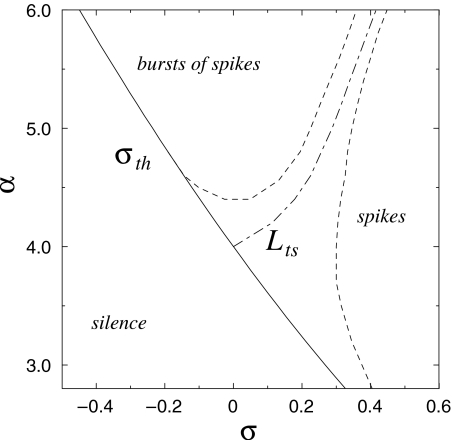
Fig. 1
Fig. 1
Diagram of dynamical regimes produced by map (4). Irregular (chaotic) spiking and spiking–bursting oscillations are typical within the intermediate region outlined by dashed lines and σth
Fig. 2
Fig. 2
Restructuring of oscillation in map (4) with aα=5.0, bα=4.5, and cα=4.0, as the value of σ increases with the constant slew rate Δσ = 0.00005 per iteration
Fig. 3
Fig. 3
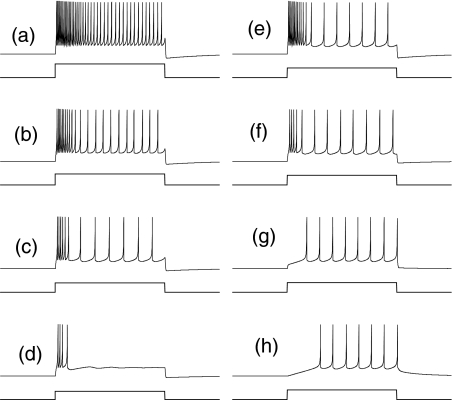
Waveforms of xn for the responses of map (4) to a rectangular pulse of amplitude Ia and duration 1,000 iterations computed for different pulse amplitudes (left) and the input balance parameter βe (right). The shapes of the pulse are shown below the traces of xn. The parameter values are α = 4.0, σ = − 0.4, σe = 1.0, and a - Ia = 0.630, βe = 0.224; b - Ia = 0.517, βe = 0.224; c - Ia = 0.439, βe = 0.224; d - Ia = 0.394, βe = 0.224; e - βe = 0.3, Ia = 0.45; f - βe = 0.2, Ia = 0.45; g - βe = 0.1, Ia = 0.45; h - βe = 0.0, Ia = 0.45
Fig. 4
Fig. 4
Phase portraits of the map (4) in the plane of variables un = yn + βn and xn explaining the dynamical mechanisms behind the main properties of waveforms for the responses shown in Fig. 3. The samples generated by the map-based model are shown with red dots. To follow the trajectory of the map, these dots are connected with straight yellow lines. a, b, and c Phase portraits for the trajectories shown in Fig. 3h, f, and d, respectively
Fig. 5
Fig. 5
The plots of fs vs n computed for the waveforms shown in Fig. 3a, b, c, and d.
Fig. 6
Fig. 6
The dependence of fS on time n plotted for different values of βe. The other parameters of the map are the same as in Fig. 3, right panels
Fig. 7
Fig. 7
The map responses to a depolarizing (a) and hyperpolarizing (b) rectangular pulse with a duration of 1,000 iterations in the case of a continuously spiking map. The parameters of the maps are α = 4.0, σ = 4.08e − 2, and βe = 0.3. aIa = 0.2 and bIa = − 0.2
Fig. 8
Fig. 8
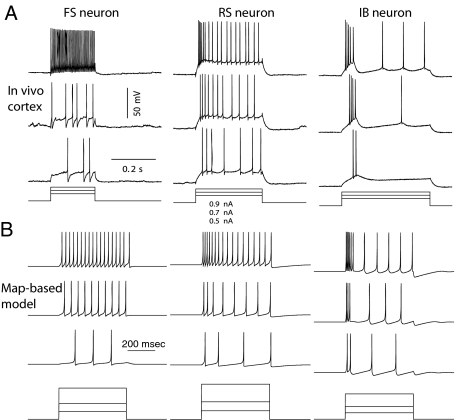
Intrinsic neuronal firing patterns in vivo and in the models. a In vivo data. b Map-based model. Left panels show a fast spiking (FS) neuron, middle panels show a regular spiking (RS) neuron, and right panel show an intrinsically bursting (IB) neuron. The map-based model of the FS cell is given by (9), (10) with α = 3.8, y rs = 2.9, βhp = 0.5, γhp = 0.6, g hp = 0.1, βe = 0.1, and amplitude of rectangular pulse A = 1.6E − 2 (100%). The map-based models of the RS and the IB cell are given by (4), where α = 3.65, σ = 0.06, μ = 0.0005, σe = 1.0, βe = 0.133, and A = 3.0E − 2 for the RS cell, and α = 4.1, σ = − 0.036, μ = 0.001, σe = 1.0, βe = 0.1, and A = 1.0E − 2 for the IB cell. The duration of the depolarizing pulse in the map-based simulation is 870 iterations, which is approximately 430 ms
Fig. 9
Fig. 9
Waveforms generated by negative rectangular current pulses of amplitude 0.3 and durations of 100, 200, and 400 iterations. The beginning and end of each pulse are shown by arrows. Parameters of the map are μ = 0.002, α = 3.8, σ − 0.15, βe = 0.6, and σe = 1.0.
Fig. 10
Fig. 10
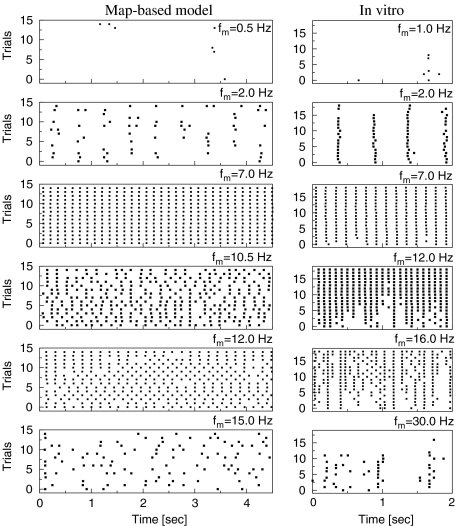
Spiking of RS neuron in response to 100 Poisson distributed independent input spike trains with sine-wave modulated mean rate: R = fc(1 − sin(2 fmt )), where fc = 200 Hz, fm is the frequency of periodic modulation. Sampling rate: one iteration = 0.5 ms. Six different modulation frequencies fm and 16 trials for each frequency (raster) are shown. Each dot represents a spike. Map-based model of RS cell (left) and experiment with a RS cell of rat prefrontal cortex (right)
Fig. 11
Fig. 11
Oscillations in the model of three PY neurons and one IN. Left, excitatory (RS-type) PY neurons are mutually connected with inhibitory (FS-type) IN. Right, increase of excitatory input from PY neurons to IN (from top to bottom) changed the type of oscillations. Different colors indicate three different PY neurons
Fig. 12
Fig. 12
Sketch of a two-layer network containing RS PY cells and FS INs. The radius of connection footprint was eight neurons (16 presynaptic neurons) for AMPA-type excitatory PY–IN synapses and two neurons (five presynaptic neurons) for GABAA-mediated IN–PY synapses
Fig. 13
Fig. 13
Resonance phase locking in one-dimensional network model of 256 PY neurons and 64 IN neurons. Frequency corresponding to the highest peak in the power spectrum of the mean field of PY cells’ activity is plotted as a function of synaptic coupling between PY cells and INs. Note several bands corresponding to different resonance-locking modes between FP and PY neurons. The ratio f PY/f FP changed from one (lowest band) to four (highest band)
Fig. 14
Fig. 14
Spectrograms of oscillation in one-dimensional IN–PY network. Increase of PY–IN coupling was followed by decrease of PY frequency (f PY) and increase of f FP and f IN. Inhibitory INs always fired at the frequency of the FP oscillations. agIN − PY = 0.0007. bgIN − PY = 0.0015
Fig. 15
Fig. 15
Oscillations in two-dimensional network model of 256×256 PY neurons and 128×128 INs. Snapshots of activity in inhibitory, IN, population (top) and cross correlation of local FPs (average activity of 100×100 PY neurons) between two remote spatial areas (bottom) are shown. a Nearly global synchronization–phase locking with zero phase shift, gPY − IN=0.002, gIN − PY=0.0007. b Local synchronization mediated by two rotation spiral waves, gPY − IN=0.0015, gIN − PY=0.0007. c Asynchronous state, gPY − IN=0.002, gIN − PY=0.0015. In top panels, red, depolarizing (spikes), and blue, hyperpolarizing potentials

References

    1. {'text': '', 'ref_index': 1, 'ids': [{'type': 'PMC', 'value': 'PMC1392413', 'is_inner': False, 'url': 'https://pmc.ncbi.nlm.nih.gov/articles/PMC1392413/'}, {'type': 'PubMed', 'value': '12991237', 'is_inner': True, 'url': 'https://pubmed.ncbi.nlm.nih.gov/12991237/'}]}
    2. Hodgkin, A.L, Huxley, A.F.: A quantitative description of membrane current and its application to conduction and excitation in nerve. J. Physiol. (Lond.) 117, 500–544 (1952) - PMC - PubMed
    1. {'text': '', 'ref_index': 1, 'ids': [{'type': 'PMC', 'value': 'PMC6757797', 'is_inner': False, 'url': 'https://pmc.ncbi.nlm.nih.gov/articles/PMC6757797/'}, {'type': 'PubMed', 'value': '12351744', 'is_inner': True, 'url': 'https://pubmed.ncbi.nlm.nih.gov/12351744/'}]}
    2. Bazhenov, M., Timofeev, I., Steriade, M., Sejnowski, T.J.: Model of thalamocortical slow-wave sleep oscillations and transitions to activated states. J. Neurosci. 22, 8691–8704 (2002) - PMC - PubMed
    1. {'text': '', 'ref_index': 1, 'ids': [{'type': 'PubMed', 'value': '9425171', 'is_inner': True, 'url': 'https://pubmed.ncbi.nlm.nih.gov/9425171/'}]}
    2. Golomb, D.: Models of neuronal transient synchrony during propagation of activity through neocortical circuitry. J. Neurophysiol. 79, 1–12 (1998) - PubMed
    1. {'text': '', 'ref_index': 1, 'ids': [{'type': 'PubMed', 'value': '9310412', 'is_inner': True, 'url': 'https://pubmed.ncbi.nlm.nih.gov/9310412/'}]}
    2. Golomb, D., Amitai, Y.: Propagating neuronal discharges in neocortical slices: computational and experimental study. J. Neurophysiol. 78, 1199–1211 (1997) - PubMed
    1. {'text': '', 'ref_index': 1, 'ids': [{'type': 'DOI', 'value': '10.1113/jphysiol.2001.012759', 'is_inner': False, 'url': 'https://doi.org/10.1113/jphysiol.2001.012759'}, {'type': 'PMC', 'value': 'PMC2316151', 'is_inner': False, 'url': 'https://pmc.ncbi.nlm.nih.gov/articles/PMC2316151/'}, {'type': 'PubMed', 'value': '12122156', 'is_inner': True, 'url': 'https://pubmed.ncbi.nlm.nih.gov/12122156/'}]}
    2. Houweling, A.R., Bazhenov, M., Timofeev, I., Grenier, F., Steriade, M., Sejnowski, T.J.: Frequency-selective augmenting responses by short-term synaptic depression in cat neocortex. J. Physiol. 542, 599–617 (2002) - PMC - PubMed