Review
. 2010 Mar;39(4):513-25.
doi: 10.1007/s00249-009-0512-3. Epub 2009 Aug 11.

Electron spin resonance in membrane research: protein-lipid interactions from challenging beginnings to state of the art

Affiliations
Review

Electron spin resonance in membrane research: protein-lipid interactions from challenging beginnings to state of the art

Derek Marsh. Eur Biophys J. 2010 Mar.

Abstract

Conventional electron paramagnetic resonance (EPR) spectra of lipids that are spin-labelled close to the terminal methyl end of the acyl chains are able to resolve the lipids directly contacting the protein from those in the fluid bilayer regions of the membrane. This allows determination of both the stoichiometry of lipid-protein interaction (i.e., number of lipid sites at the protein perimeter) and the selectivity of the protein for different lipid species (i.e., association constants relative to the background lipid). Spin-label EPR data are summarised for 20 or more different transmembrane peptides and proteins, and 7 distinct species of lipids. Lineshape simulations of the two-component conventional spin-label EPR spectra allow estimation of the rate at which protein-associated lipids exchange with those in the bulk fluid regions of the membrane. For lipids that do not display a selectivity for the protein, the intrinsic off-rates for exchange are in the region of 10 MHz: less than 10x slower than the rates of diffusive exchange in fluid lipid membranes. Lipids with an affinity for the protein, relative to the background lipid, have off-rates for leaving the protein that are correspondingly slower. Non-linear EPR, which depends on saturation of the spectrum at high radiation intensities, is optimally sensitive to dynamics on the timescale of spin-lattice relaxation, i.e., the microsecond regime. Both progressive saturation and saturation transfer EPR experiments provide definitive evidence that lipids at the protein interface are exchanging on this timescale. The sensitivity of non-linear EPR to low frequencies of spin exchange also allows the location of spin-labelled membrane protein residues relative to those of spin-labelled lipids, in double-labelling experiments.


Figures
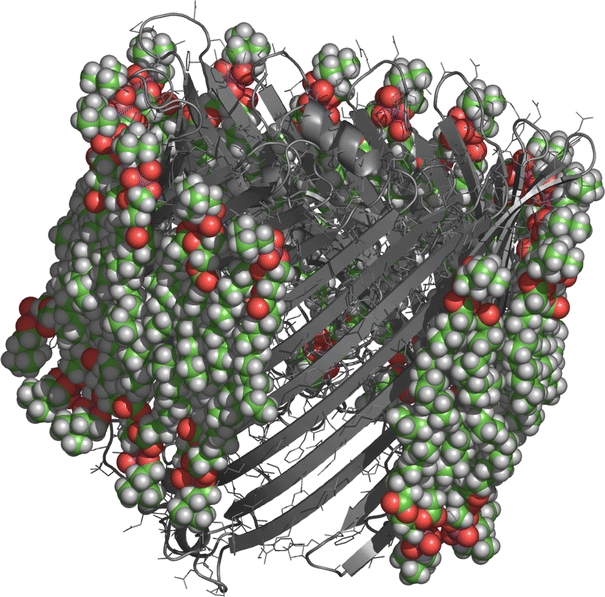
Fig. 1
Fig. 1
First shell of lipids surrounding the crystal structure of Escherichia coli outer membrane protein FhuA (PDB code 2FCP) (Ferguson et al. 1998). Part of the shell of energy-minimised diC14:0PtdCho lipids (space-filling representation) is cut away to show the protein in ribbon and wire-frame representation. In total, 34 lipids contact the intramembrane perimeter of the protein (Páli et al. 2006). The stoichiometry of motionally restricted lipids observed by EPR is N b = 32 (Ramakrishnan et al. 2004)
Fig. 2
Fig. 2
Spin-labelled lipids used for investigating lipid–protein interactions. The spin-label nitroxyl ring is rigidly attached to the C-n atom of the lipid hydrocarbon chain (n = 14 in the figure), or to the steroid nucleus. For transmembrane proteins, two-component spectra are detected with lipids spin-labelled at the C14-position of the hydrocarbon chain (14-PXSL and 14-SASL). Two-component spectra are also resolved with the spin-labelled steroids, cholestane and androstanol (CSL and ASL, respectively). n-SASL, stearic acid; n-PCSL, -PESL, -PGSL, -PSSL, -PISL, and -PASL: phosphatidylcholine, phosphatidylethanolamine, phosphatidylglycerol, phosphatidylserine, phosphatidylinositol and phosphatidic acid, respectively. n-CLSL, cardiolipin. n-SMSL, sphingomyelin; n-GM1SL, monosialoganglioside GM1; n-GM2SL, monosialoganglioside GM2; n-GM3SL, monosialoganglioside GM3; n-GD1bSL, disialoganglioside GD1b; n-MGDGSL, monogalactosyl diglyceride; CSL, cholestane; and ASL, androstanol
Fig. 3
Fig. 3
Clusters of basic amino-acids that give rise to the pronounced selectivity of FhuA for anionic lipids (phosphatidic acid, phosphatidylserine and stearic acid). Electrostatic surfaces are coloured with blue positive, red negative and white neutral (Ramakrishnan et al. 2004)
Fig. 4
Fig. 4
Energy levels, spin populations (N b±N f±), and transitions for two spin-label sites, ‘b’ and ‘f’. The spin population difference is given by: n b = N b − N b+. The transition rate for spin-lattice relaxation is: 2W e = 1/T 1o. The rate of exchange between the two sites is: N b τ b−1 = N f τ f−1, for both spin populations and population differences. The rate of Heisenberg exchange between spins ‘b’ and ‘f’ is: 2K x N b± N f (Marsh 1993)
Fig. 5
Fig. 5
Progressive saturation curves for the integrated intensity of the conventional EPR spectra of spin-labelled phosphatidylcholine 14-PCSL in: diC14:0PtdCho membranes (solid circles), delipidated myelin proteolipid protein PLP (open circles), and PLP/diC14:0PtdCho membranes of lipid/protein ratio 24:1 mol/mol (solid squares). Left in the lipid gel phase (4°C), right in the lipid fluid phase (30°C). Solid lines are fits of Eq. 12 for saturation of the single components (f b = 0 or 1), and dotted lines are predictions for saturation of the lipid–protein membranes assuming no exchange between the two components (f b = 0.40) (Horváth et al. 1993a)
Fig. 6
Fig. 6
Dependence of the integrated V2 saturation transfer EPR intensity, I ST, from different spin-labelled lipids on the fraction, f b, of each lipid species associated with the myelin proteolipid protein in diC14:0PtdCho membranes at fixed lipid/protein ratio (37:1 mol/mol). Measurements correspond to the gel-phase (T < T t) and the fluid phase (T > T t) at 4 and 30°C, respectively. Straight lines are predictions for zero exchange rate (τ b−1 = 0) at the two temperatures, and the curved line is a non-linear least-squares fit of Eq. 14 with Eq. 11 (and equivalent) giving a constant lipid on-rate of T 1,boτf−1 = 2.9 in the fluid phase at 30°C (Horváth et al. 1993a)

References

    1. Abramovitch DA, Marsh D, Powell GL. Activation of beef heart cytochrome oxidase by cardiolipin and analogues of cardiolipin. Biochim Biophys Acta. 1990;1020:34–42. - PubMed
    1. Anbazhagan V, Qu J, Kleinschmidt JH, Marsh D. Incorporation of outer membrane protein OmpG in lipid membranes. Protein–lipid interactions and β-barrel orientation. Biochemistry. 2008;47:6189–6198. - PubMed
    1. Anbazhagan V, Vijay N, Kleinschmidt JH, Marsh D. Protein–lipid interactions with Fusobacterium nucleatum major membrane protein FomA: spin-label EPR and polarised infrared spectroscopy. Biochemistry. 2008;47:8414–8423. - PubMed
    1. Arora A, Marsh D. Protein-induced vertical lipid dislocation in a model membrane system: spin-label relaxation studies on avidin–biotinylphosphatidylethanolamine interactions. Biophys J. 1998;75:2915–2922. - PMC - PubMed
    1. Arora A, Esmann M, Marsh D. Selectivity of lipid–protein interactions with trypsinized Na, K-ATPase studied by spin-label EPR. Biochim Biophys Acta. 1998;1371:163–167. - PubMed

MeSH terms

LinkOut - more resources
