. 2009 Nov 15;18(22):4296-303.
doi: 10.1093/hmg/ddp382. Epub 2009 Aug 11.

Expression quantitative trait loci detected in cell lines are often present in primary tissues

Affiliations

Expression quantitative trait loci detected in cell lines are often present in primary tissues

Kevin Bullaughey et al. Hum Mol Genet. .

Abstract

Expression quantitative trait loci (eQTL) mapping is a powerful tool for identifying genetic regulatory variation. However, at present, most eQTLs in humans were identified using gene expression data from cell lines, and it remains unknown whether these eQTLs also have a regulatory function in other expression contexts, such as human primary tissues. Here we investigate this question using a targeted strategy. Specifically, we selected a subset of large-effect eQTLs identified in the HapMap lymphoblastoid cell lines, and examined the association of these eQTLs with gene expression levels across individuals in five human primary tissues (heart, kidney, liver, lung and testes). We show that genotypes at the eQTLs we selected are often predictive of variation in gene expression levels in one or more of the five primary tissues. The genotype effects in the primary tissues are consistently in the same direction as the effects inferred in the cell lines. Additionally, a number of the eQTLs we tested are found in more than one of the tissues. Our results indicate that functional studies in cell lines may uncover a substantial amount of genetic variation that affects gene expression levels in human primary tissues.


Figures
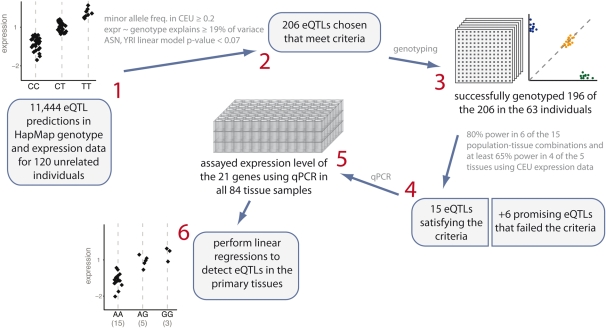
Figure 1.
Figure 1.
Illustration of candidate eQTL selection strategy. (1) In selecting SNPs to test for an association with expression in primary human tissues, we began with a set of predictions based on a Bayesian analysis of HapMap genotypes and expression data. (2) We narrowed these 11 444 eQTL predictions down to 206 based on several criteria, as detailed in the Materials and Methods section. (3) We successfully genotyped 196 of the 206 in the 63 individuals from which we have tissue samples. (4) For each eQTL in each of the five tissues, we conducted simulations to estimate power conditional on the actual genotypes of our samples, using expression data from one of the three HapMap populations. On the basis of these simulations, we chose 15 eQTLs that we estimated to have 80% power in at least six of the 15 population-tissue combinations and at least 65% power in four of the five tissues using data from CEU. To these 15, we added six more eQTLs that fell slightly below our cutoffs, but looked promising. (5) We then assayed expression level of the 21 genes using qPCR in all 84 samples. (6) We used linear regressions to determine significance of each of the eQTLs in each of the five human primary tissues.
Figure 2.
Figure 2.
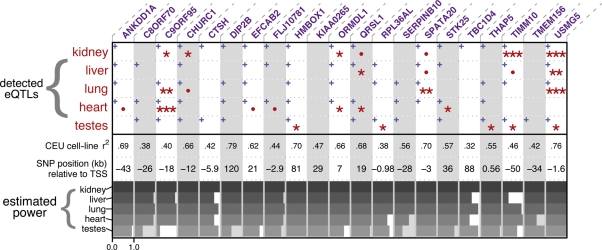
Summary of detected eQTLs and our predicted power. Columns correspond to the 21 genes we tested for eQTLs. One-sided P-values from linear models testing the eQTL are summarized by either one (0.05 > P > 0.01), two (0.01 > P > 0.001), or three (0.001 > p) red asterisks; marginally significant tests (0.1 > P > 0.05) are marked with a red dot (see Supplementary Material, Table S1 for all P-values). Blue plus signs indicate the effect is in the same direction as the effect observed in the LCLs. CEU cell-line r2 is the proportion of variance explained by genotype in a linear model fit to the original CEU cell-line data. Estimated power is illustrated with horizontal gray bars for each eQTL-tissue combination using microarray expression data sampled from CEU HapMap LCLs with matching genotypes (see Materials and Methods), with the axis (ranging from 0 to 1) shown below only for the first column.
Figure 3.
Figure 3.
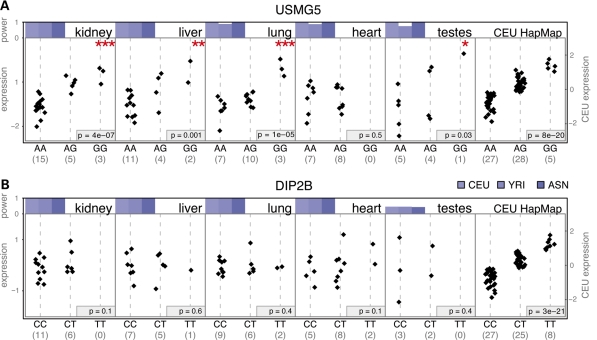
Results for two illustrative genes. (A) We detect the cis-eQTL for the gene USMG5 in four of five tissues while in (B) we do not confirm the eQTL for the gene DIP2B, despite estimating that we have good power to detect it. The first five panels in parts (A) and (B) correspond to qPCR expression data in the five primary tissues (vertical axis on left) while the last panel shows microarray expression data from the original CEU HapMap LCLs (vertical axis on right); note that we show the CEU cell-line data for comparison purposes—there is no overlap in individuals between cell lines and primary tissues. Black diamonds correspond to normalized expression levels for the genotypes indicated below (number of observations in parenthesis). P-values for the five tissues are one-sided (*0.01 < P < 0.05, **0.001 < P < 0.01, ***P < 0.001); P-values for the cell-line data are two-sided tests. Power is shown above each plot (vertical axis ranging between 0 and 1 as indicated) and was estimated by resampling cell-line expression values from each HapMap population in turn (color indicates HapMap population), conditioning on the genotypes observed for the tissue samples we assayed.

References

    1. Gilad Y., Rifkin S.A., Pritchard J.K. Revealing the architecture of gene regulation: the promise of eQTL studies. Trends Genet. 2008;24:408–415. - PMC - PubMed
    1. Deutsch S., Lyle R., Dermitzakis E.T., Attar H., Subrahmanyan L., Gehrig C., Parand L., Gagnebin M., Rougemont J., Jongeneel C.V., et al. Gene expression variation and expression quantitative trait mapping of human chromosome 21 genes. Hum. Mol. Genet. 2005;14:3741–3749. - PubMed
    1. Dixon A.L., Liang L., Moffatt M.F., Chen W., Heath S., Wong K.C.C., Taylor J., Burnett E., Gut I., Farrall M., et al. A genome-wide association study of global gene expression. Nat. Genet. 2007;39:1202–1207. - PubMed

    1. Duan S., Huang R.S., Zhang W., Bleibel W.K., Roe C.A., Clark T.A., Chen T.X., Schweitzer A.C., Blume J.E., Cox N.J., et al. Genetic architecture of transcript-level variation in humans. Am. J. Hum. Genet. 2008;82:1101–1113. - PMC - PubMed
    1. Huang R.S., Duan S., Kistner E.O., Zhang W., Bleibel W.K., Cox N.J., Dolan M.E. Identification of genetic variants and gene expression relationships associated with pharmacogenes in humans. Pharmacogenet. Genomics. 2008;18:545–549. - PMC - PubMed

Publication types