Limnohabitans curvus gen. nov., sp. nov., a planktonic bacterium isolated from a freshwater lake
- PMID: 19671731
- PMCID: PMC3091418
- DOI: 10.1099/ijs.0.013292-0
Limnohabitans curvus gen. nov., sp. nov., a planktonic bacterium isolated from a freshwater lake
Abstract
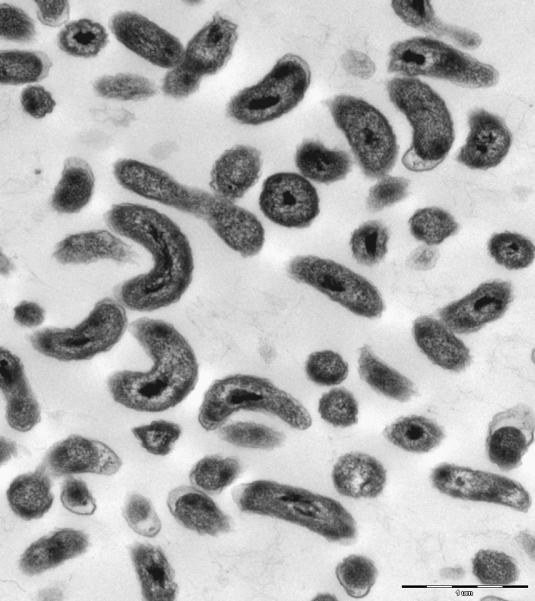
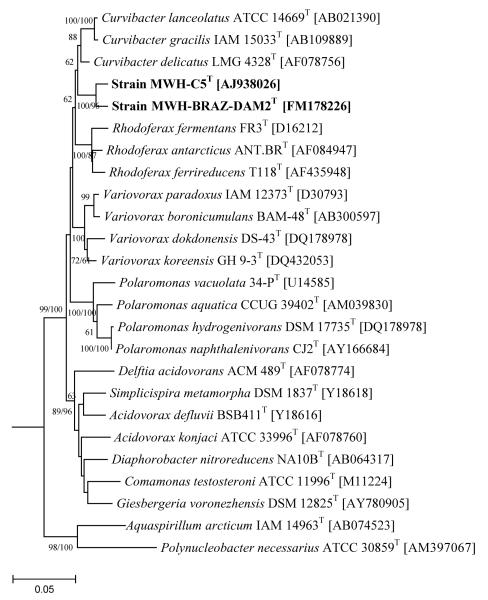
A chemo-organotrophic, aerobic, facultatively anaerobic, non-motile strain, MWH-C5(T), isolated from the water column of the oligomesotrophic Lake Mondsee (Austria), was characterized phenotypically, phylogenetically and chemotaxonomically. The predominant fatty acids of the strain were C(16 : 1)omega7c/omega6c, C(16 : 0), C(12 : 1) and C(8 : 0)-3OH, the major quinone was ubiquinone Q-8 and the G+C content of the DNA of the strain was 55.5 mol%. 16S rRNA gene similarity to the closest related type strains was 96.6 % (Curvibacter delicatus LMG 4328(T)) and 95.7 % (Rhodoferax fermentans FR3(T)). Phylogenetic analysis of 16S rRNA gene sequences revealed the affiliation of the strain with the family Comamonadaceae (Betaproteobacteria); however, the phylogenetic position of the strain did not support an affiliation to any previously described genus within this family. A family-wide comparison of traits revealed that the strain possesses a unique combination of DNA G+C content, major fatty acids and major 3-hydroxy fatty acid. Furthermore, the strain differs in several traits from the closest related genera. Based on the phylogeny of the strain and differences from closely related genera, we propose to establish the new genus and species Limnohabitans curvus gen. nov., sp. nov. to accommodate this strain. The type strain of Limnohabitans curvus is MWH-C5(T) (=DSM 21645(T) =CCUG 56720(T)). The type strain is closely related to a large number of uncultured bacteria detected by cultivation-independent methods in various freshwater systems.
Figures
References
-
- Bruland N, Bathe S, Willems A, Steinbüchel A. Pseudorhodoferax soli gen. nov., sp. nov., and Pseudorhodoferax caeni sp. nov., two novel Betaproteobacteria belonging to the Comamonadaceae family. Int J Syst Evol Microbiol. (in press) - PubMed
-
- Crump BC, Hobbie JE. Synchrony and seasonality in bacterioplankton communities of two temperate rivers. Limnol Oceanogr. 2005;50:1718–1729.
-
- Cummings MP, Huskamp JC. Grid computing. Educause Review. 2005;40:116–117.
-
- Ding L, Yokota A. Proposals of Curvibacter gracilis gen. nov., sp. nov. and Herbaspirillum putei sp. nov. for bacterial strains isolated from well water and reclassification of [Pseudomonas] huttiensis, [Pseudomonas] lanceolata, [Aquaspirillum] delicatum and [Aquaspirillum] autotrophicum as Herbaspirillum huttiense comb. nov., Curvibacter lanceolatus comb. nov., Curvibacter delicatus comb. nov. and Herbaspirillum autotrophicum comb. nov. Int J Syst Evol Microbiol. 2004;54:2223–2230. - PubMed
Publication types
MeSH terms
Substances
Associated data
- Actions
Grants and funding
LinkOut - more resources
Full Text Sources
Molecular Biology Databases
Miscellaneous