Enhanced targeting with heterobivalent ligands
- PMID: 19671749
- PMCID: PMC3662534
- DOI: 10.1158/1535-7163.MCT-08-1183
Enhanced targeting with heterobivalent ligands
Abstract
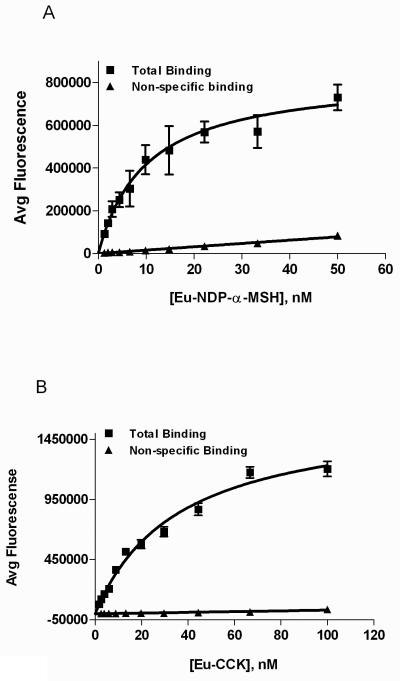
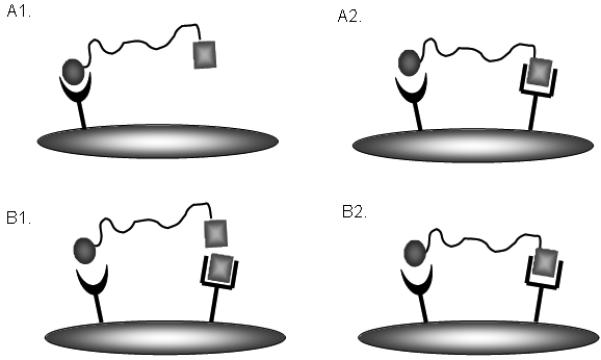
A novel approach to specifically target tumor cells for detection and treatment is the proposed use of heteromultivalent ligands, which are designed to interact with, and noncovalently crosslink, multiple different cell surface receptors. Although enhanced binding has been shown for synthetic homomultivalent ligands, proof of cross-linking requires the use of ligands with two or more different binding moieties. As proof-of-concept, we have examined the binding of synthetic heterobivalent ligands to cell lines that were engineered to coexpress two different G-protein-coupled human receptors, i.e., the human melanocortin 4 receptor (MC4R) expressed in combination with either the human delta-opioid receptor (deltaOR) or the human cholecystokinin-2 receptor (CCK2R). Expression levels of these receptors were characterized by time-resolved fluorescence saturation binding assays using Europium-labeled ligands; Eu-DPLCE, Eu-NDP-alpha-MSH, and Eu-CCK8 for the deltaOR, MC4R, and CCK2R, respectively. Heterobivalent ligands were synthesized to contain a MC4R agonist connected via chemical linkers to either a deltaOR or a CCK2R agonist. In both cell systems, the heterobivalent constructs bound with much higher affinity to cells expressing both receptors, compared with cells with single receptors or to cells where one of the receptors was competitively blocked. These results indicate that synthetic heterobivalent ligands can noncovalently crosslink two unrelated cell surface receptors, making feasible the targeting of receptor combinations. The in vitro cell models described herein will lead to the development of multivalent ligands for target combinations identified in human cancers.
Figures



References
-
- Finley RS. Overview of targeted therapies for cancer. Am J Health Syst Pharm. 2003;60:S4–10. - PubMed
-
- Lindsay MA. Target discovery. Nat Rev Drug Discov. 2003;2:831–8. - PubMed
-
- Ross JS, Schenkein DP, Pietrusko R, et al. Targeted therapies for cancer 2004. Am J Clin Pathol. 2004;122:598–609. - PubMed
-
- Kaptain S, Tan LK, Chen B. Her-2/neu and breast cancer. Diagn Mol Pathol. 2001;10:139–52. - PubMed
-
- Gillies RJ, Hruby VJ. Expression-driven reverse engineering of targeted imaging and therapeutic agents. Expert Opin Ther Targets. 2003;7:137–9. - PubMed
Publication types
MeSH terms
Substances
Grants and funding
LinkOut - more resources
Full Text Sources
Other Literature Sources
Research Materials