


Review
doi: 10.1038/nrm2746.
Epub 2009 Aug 12.
Biology under construction: in vitro reconstitution of cellular function
Affiliations
- PMID: 19672276
- PMCID: PMC2937256
- DOI: 10.1038/nrm2746
Item in Clipboard
Review
Biology under construction: in vitro reconstitution of cellular function
Nat Rev Mol Cell Biol.
2009 Sep.
Abstract
We are much better at taking cells apart than putting them together. Reconstitution of biological processes from component molecules has been a powerful but difficult approach to studying functional organization in biology. Recently, the convergence of biochemical and cell biological advances with new experimental and computational tools is providing the opportunity to reconstitute increasingly complex processes. We predict that this bottom-up strategy will uncover basic processes that guide cellular assembly, advancing both basic and applied sciences.
Figures
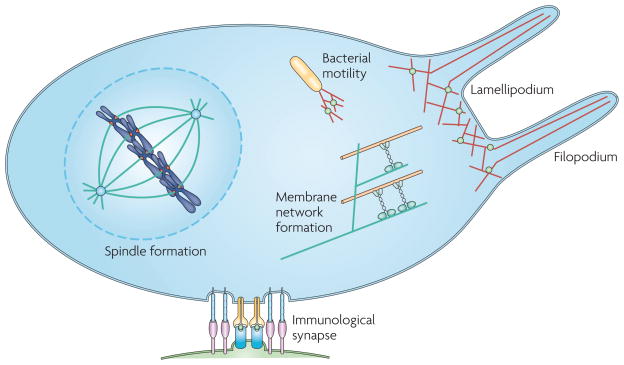
Although rebuilding a cell is a long way off, several micrometre-scale structures involved in various cellular processes have been successfully reconstituted using either purified proteins or cell-free extracts. Spindle formation has been reconstituted using Xenopus laevis cell extract and DNA-coated microspheres. Actin-based motility of the bacterium Listeria monocytogenes has been reconstituted using purified proteins. Growing actin networks involved in lamellipodial protrusions have been shown to displace membranes, and parallel actin filaments growing against membranes have been shown to generate filopodium-like protrusions. An immunological synapse has been reconstituted using a planar lipid bilayer and live T cells. Tubular membrane networks, like those found in cells, have also been reconstituted using purified kinesin molecular motors, microtubules and giant vesicles. In each of these cases, a fairly simple set of components was found to generate a remarkably complex structure that is helping us to understand the assembly, organization and behaviour of cellular processes.
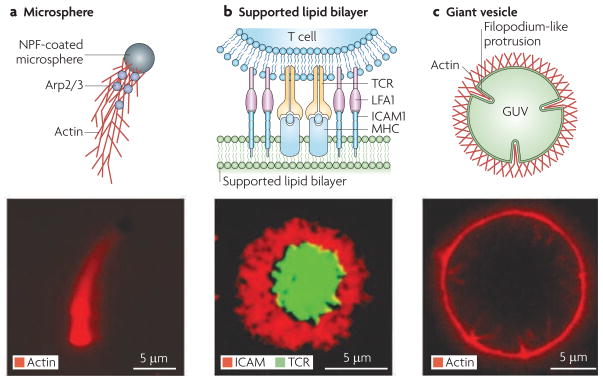
Once the specific molecular components that are involved in a cellular process are identified, they must be organized by appropriate boundary conditions to generate functional behaviour. Three primary strategies have been used to define the boundary conditions that initiate spatially organized processes. a | The surface of microspheres can be functionalized with proteins such as actin nucleation-promoting factors (NPFs), that spatially organize actin assembly in purified protein solutions or cell extracts by a process that requires the actin-related protein 2/3 (Arp2/3) complex. The lower panel is an epi-fluorescence microscopy image showing an NPF-coated microsphere propelled by a growing actin network. b | supported lipid bilayers ensure that molecular components of the system being studied can freely diffuse. They have been used to reconstitute the immunological synapse. T cell receptor (TCR) and leukocyte function-associated antigen 1 (LFA1) on the T cell bind to intracellular adhesion molecule 1 (ICAM1) and major histocompatibility complex (MHC) peptide reconstituted on the supported lipid bilayer, to form the immunological synapse. The lower panel is an epi-fluorescence microscopy image showing TCR at the centre and ICAM1 at the periphery of the immunological synapse. c | Giant unilamellar vesicles (GUVs) represent deformable substrates, and they have been used to reconstitute filopodium-like protrusions. The lower panel is an epi-fluorescence microscopy image showing actin networks on a GUV spontaneously undergoing transitions to form inward protrusions that consist of long unbranched actin filaments. Part b is reproduced, with permission, from REF. © (2005) American Association for the Advancement of Science. Part c is reproduced, with permission, from REF. © (2008) Macmillan Publishers Ltd. All rights reserved.
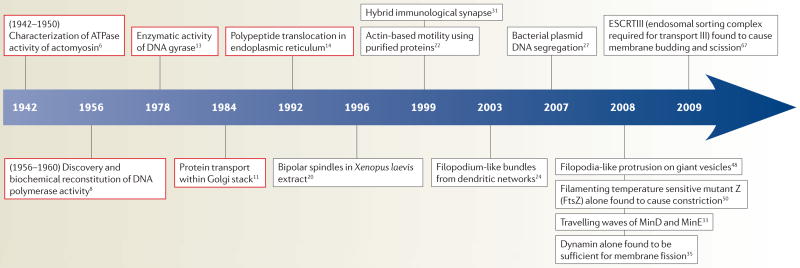
Biochemical reconstitution on a molecular-length scale (red) and cellular reconstitution on a micrometre scale (black).
References
-
- Groves JT. Bending mechanics and molecular organization in biological membranes. Annu Rev Phys Chem. 2007;58:697–717. - PubMed
-
- Garcia-Saez AJ, Chiantia S, Schwille P. Effect of line tension on the lateral organization of lipid membranes. J Biol Chem. 2007;282:33537–33544. - PubMed
-
- Karsenti E. Self-organization in cell biology: a brief history. Nature Rev Mol Cell Biol. 2008;9:255–262. - PubMed
-
- Hawking SW. The Universe in a Nutshell. Bantam; New York: 2001.
Publication types
MeSH terms
Grants and funding
LinkOut - more resources
Full Text Sources
