Impact of age and gender on the clinicopathological characteristics of bladder cancer
- PMID: 19672348
- PMCID: PMC2710066
- DOI: 10.4103/0970-1591.52916
Impact of age and gender on the clinicopathological characteristics of bladder cancer
Abstract
Purpose: To determine the impact of age and gender on the clinicopathological characteristics of histologically confirmed bladder cancer in India.
Materials and methods: From January 2001 to June 2008, records of patients with bladder cancer were evaluated for age and gender at presentation, clinical symptoms, cystoscopic finding, history of smoking, and histopathological characteristics. A total of 561 patients were identified from the computer-based hospital information system and the case files of patients.
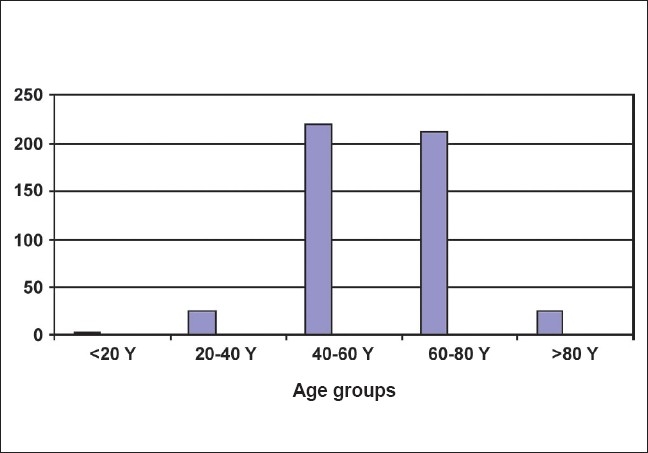
Results: A total of 97% of the patients presented with painless hematuria. The mean age was 60.2 +/- 4.4 years old (range: 18-90 years old) and the male to female ratio was 8.6:1. Transitional cell carcinoma (TCC) was the most common histological variety, which was present in 97.71% (470 of 481) of the patients. A total of 26% of the patients had muscle invasive disease at the time of presentation. However, 34.5% (166 of 481) of the patients did not show any evidence of detrusor muscle in their biopsy specimen. In patients with nonmuscle-invasive bladder carcinoma, 55% had p Ta while 45% had p T1. Overall, 44.7% (215 of 481) of the patients had low-grade disease. Among patients younger than 60 years old, low-grade (51.0% vs. 38.1%; P = 0.006) and low-stage (77.1% vs. 70.8%; P = 0.119) disease were more prevalent than in patients older than 60 years old. The incidence of smoking was much higher among males compared with females (74% vs. 22%).
Conclusion: TCC is the predominant cancer, with significant male preponderance among Indian patients. Younger-aged patients have low-grade disease. Hematuria is the most common presentation and greater awareness is needed not to overlook bladder cancer.
Keywords: Age; bladder cancer; gender; smoking; transitional cell carcinoma.
Conflict of interest statement
References
-
- Kurkure AP. Cancer incidence and patterns in urban Maharashtra. Consolidated report of the population based cancer registries. 2001
-
- Lynch CF, Cohen MB. Urinary system. Cancer. 1995;75:316–29. - PubMed
-
- Rabbani F, Cordon-Cardo C. Mutation of cell cycle regulators and their impact on superficial bladder cancer. Urol Clin North Am. 2000;27:83–102. - PubMed
-
- Madeb R, Messing EM. Gender, racial and age differences in bladder cancer incidence and mortality. Urol Oncol. 2004;22:86–92. - PubMed
-
- Messing EM, Young TB, Hunt VB, Gilchrist KW, Newton MA, Bram LL, et al. Comparison of bladder cancer outcome in men undergoing hematuria home screening versus those with standard clinical presentations. Urology. 1995;45:396–7. - PubMed