


Review
doi: 10.1155/2009/634520.
Epub 2009 Aug 6.
TIS11 family proteins and their roles in posttranscriptional gene regulation
Affiliations
- PMID: 19672455
- PMCID: PMC2722025
- DOI: 10.1155/2009/634520
Item in Clipboard
Review
TIS11 family proteins and their roles in posttranscriptional gene regulation
J Biomed Biotechnol.
2009.
Abstract
Posttranscriptional regulation of gene expression of mRNAs containing adenine-uridine rich elements (AREs) in their 3' untranslated regions is mediated by a number of different proteins that interact with these elements to either stabilise or destabilise them. The present review concerns the TPA-inducible sequence 11 (TIS11) protein family, a small family of proteins, that appears to interact with ARE-containing mRNAs and promote their degradation. This family of proteins has been extensively studied in the past decade. Studies have focussed on determining their biochemical functions, identifying their target mRNAs, and determining their roles in cell functions and diseases.
Figures
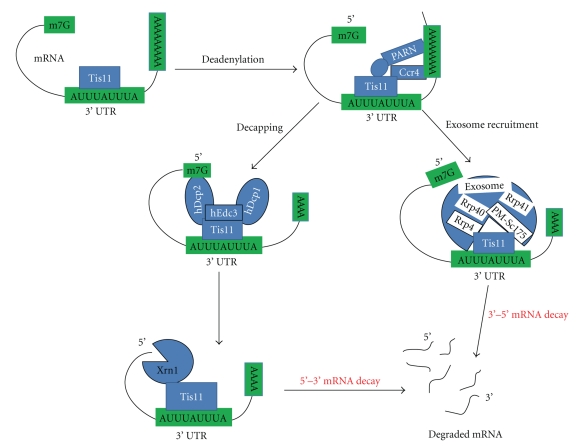
Pathways and major components of ARE-mediated mRNA decay by TIS11 proteins. TIS11 protein binds to the ARE sequence in the 3′ UTR and recruits deadenylases either directly (hCcr4) or indirectly (PARN). Deadenylated mRNA can be recruited by the exosome, a multiprotein structure containing proteins such as Rrp4, Rrp40, Rrp41, and PM-Scl75 that form the 3′ to 5′ exoribonuclease complex. Decapping of mRNA can follow deadenylation mediated by decapping enzymes such as Dcp1 and Dcp2 and degradation of mRNA can then be mediated by the 5′ to 3′ Xrn1 exonuclease.
References
-
- Blackshear PJ, Phillips RS, Ghosh S, Ramos SVB, Richfield EK, Lai WS. Zfp36l3, a rodent X chromosome gene encoding a placenta-specific member of the tristetraprolin family of CCCH tandem zinc finger proteins. Biology of Reproduction. 2005;73(2):297–307. - PubMed
-
- Ma Q, Wadleigh D, Chi T, Herschman H. The Drosophila TIS11 homologue encodes a developmentally controlled gene. Oncogene. 1994;9(11):3329–3334. - PubMed
-
- Ma Q, Herschman HR. The yeast homologue YTIS11, of the mammalian TIS11 gene family is a non-essential, glucose repressible gene. Oncogene. 1995;10(3):487–494. - PubMed
-
- Thompson MJ, Lai WS, Taylor GA, Blackshear PJ. Cloning and characterization of two yeast genes encoding members of the CCCH class of zinc finger proteins: zinc finger-mediated impairment of cell growth. Gene. 1996;174(2):225–233. - PubMed
-
- Blackshear PJ. Tristetraprolin and other CCCH tandem zinc-finger proteins in the regulation of mRNA turnover. Biochemical Society Transactions. 2002;30(6):945–952. - PubMed
Publication types
MeSH terms
Substances
LinkOut - more resources
Full Text Sources
Other Literature Sources
Miscellaneous
