


11beta-hydroxysteroid dehydrogenase type 1 regulates glucocorticoid-induced insulin resistance in skeletal muscle
- PMID: 19675138
- PMCID: PMC2768185
- DOI: 10.2337/db09-0525
11beta-hydroxysteroid dehydrogenase type 1 regulates glucocorticoid-induced insulin resistance in skeletal muscle
Abstract
Objective: Glucocorticoid excess is characterized by increased adiposity, skeletal myopathy, and insulin resistance, but the precise molecular mechanisms are unknown. Within skeletal muscle, 11beta-hydroxysteroid dehydrogenase type 1 (11beta-HSD1) converts cortisone (11-dehydrocorticosterone in rodents) to active cortisol (corticosterone in rodents). We aimed to determine the mechanisms underpinning glucocorticoid-induced insulin resistance in skeletal muscle and indentify how 11beta-HSD1 inhibitors improve insulin sensitivity.
Research design and methods: Rodent and human cell cultures, whole-tissue explants, and animal models were used to determine the impact of glucocorticoids and selective 11beta-HSD1 inhibition upon insulin signaling and action.
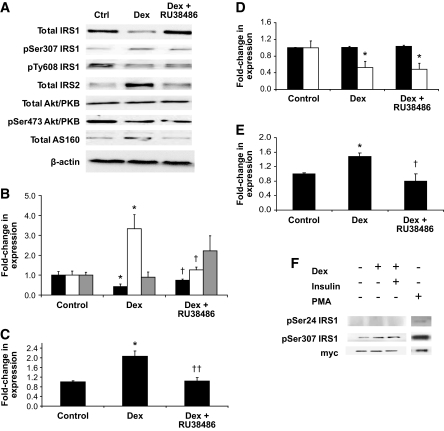
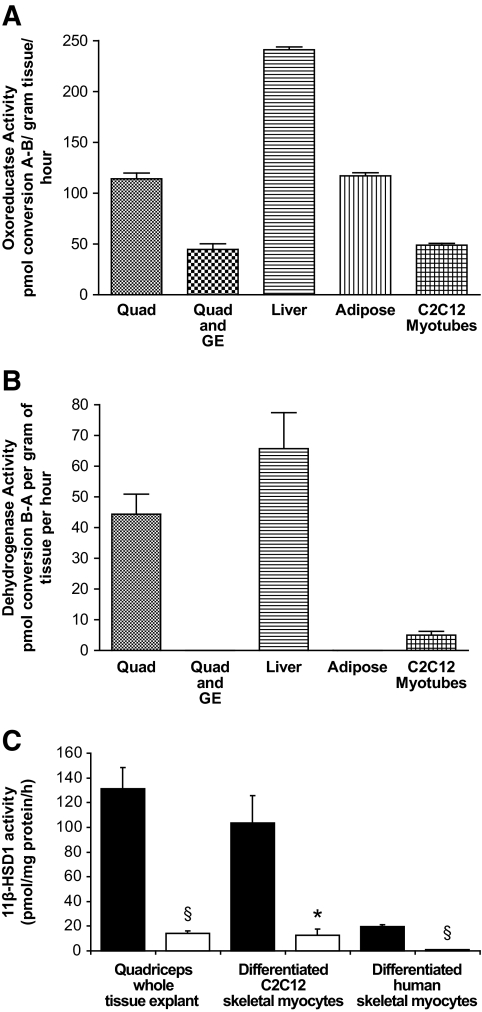
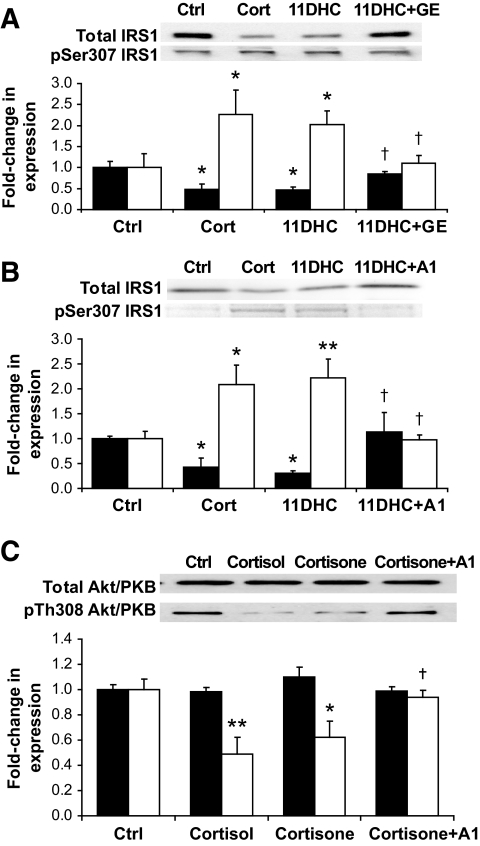
Results: Dexamethasone decreased insulin-stimulated glucose uptake, decreased IRS1 mRNA and protein expression, and increased inactivating pSer(307) insulin receptor substrate (IRS)-1. 11beta-HSD1 activity and expression were observed in human and rodent myotubes and muscle explants. Activity was predominantly oxo-reductase, generating active glucocorticoid. A1 (selective 11beta-HSD1 inhibitor) abolished enzyme activity and blocked the increase in pSer(307) IRS1 and reduction in total IRS1 protein after treatment with 11DHC but not corticosterone. In C57Bl6/J mice, the selective 11beta-HSD1 inhibitor, A2, decreased fasting blood glucose levels and improved insulin sensitivity. In KK mice treated with A2, skeletal muscle pSer(307) IRS1 decreased and pThr(308) Akt/PKB increased. In addition, A2 decreased both lipogenic and lipolytic gene expression.
Conclusions: Prereceptor facilitation of glucocorticoid action via 11beta-HSD1 increases pSer(307) IRS1 and may be crucial in mediating insulin resistance in skeletal muscle. Selective 11beta-HSD1 inhibition decreases pSer(307) IRS1, increases pThr(308) Akt/PKB, and decreases lipogenic and lipolytic gene expression that may represent an important mechanism underpinning their insulin-sensitizing action.
Figures


References
-
- Van Staa TP, Leufkens HG, Abenhaim L, Begaud B, Zhang B, Cooper C: Use of oral corticosteroids in the United Kingdom. Q J Med 2000;93:105–111 - PubMed
-
- Larsson H, Ahren B: Short-term dexamethasone treatment increases plasma leptin independently of changes in insulin sensitivity in healthy women. J Clin Endocrinol Metab 1996;81:4428–4432 - PubMed
-
- Fraser R, Ingram MC, Anderson NH, Morrison C, Davies E, Connell JM: Cortisol effects on body mass, blood pressure, and cholesterol in the general population. Hypertension 1999;33:1364–1368 - PubMed
-
- Tomlinson JW, Walker EA, Bujalska IJ, Draper N, Lavery GG, Cooper MS, Hewison M, Stewart PM: 11β-hydroxysteroid dehydrogenase type 1: a tissue-specific regulator of glucocorticoid response. Endocr Rev 2004;25:831–866 - PubMed
-
- Lavery GG, Walker EA, Draper N, Jeyasuria P, Marcos J, Shackleton CH, Parker KL, White PC, Stewart PM: Hexose-6-phosphate dehydrogenase knockout mice lack 11β-hydroxysteroid dehydrogenase type 1-mediated glucocorticoid generation. J Biol Chem 2006;281:6546–6551 - PubMed
Publication types
MeSH terms
Substances
Grants and funding
LinkOut - more resources
Full Text Sources
Medical
Molecular Biology Databases
Research Materials
Miscellaneous
