. 2009 Nov;297(5):F1457-65.
doi: 10.1152/ajprenal.90769.2008. Epub 2009 Aug 12.

Early exposure to germs modifies kidney damage and inflammation after experimental ischemia-reperfusion injury

Affiliations

Early exposure to germs modifies kidney damage and inflammation after experimental ischemia-reperfusion injury

Hye Ryoun Jang et al. Am J Physiol Renal Physiol. 2009 Nov.

Abstract

Kidney ischemia-reperfusion injury (IRI) is, in part, mediated by immune and inflammatory factors. Since microbial stimuli are known to alter immune and inflammatory responses, we hypothesized that differences in perinatal microbial status would modify renal injury following IRI. We performed bilateral renal IRI on 6-wk-old germ-free and control mice and studied the effects on kidney lymphocyte trafficking, cytokines, function, and structure. Compared with control mice, normal kidneys of germ-free mice exhibited more NKT cells and lower IL-4 levels. Postischemia, more CD8 T cells trafficked into postischemic kidneys of germ-free mice compared with control mice. Renal structural injury and functional decline following IRI were more severe in germ-free mice compared with control mice. When germ-free mice were conventionalized with the addition of bacteria to their diet, the extent of renal injury after IRI became equivalent to age-matched control mice, with similar numbers and phenotypes of T cells and NKT cells, as well as cytokine expression in both normal kidneys and postischemic kidneys of conventionalized germ-free mice and age-matched control mice. Thus microbial stimuli influence the phenotype of renal lymphocytes and the expression of cytokines of normal kidneys and also modulate the outcome of IRI.


Figures
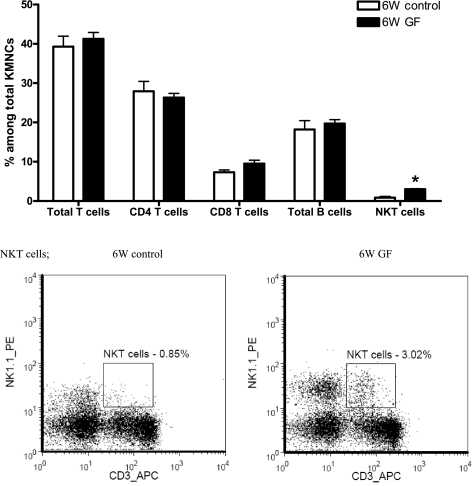
Fig. 1.
Fig. 1.
Baseline phenotype of kidney lymphocytes in control and germ-free mice. Kidney mononuclear cells (KMNCs) were isolated from naive control and germ-free mice (n = 7/group) and analyzed with flow cytometry. There was no difference in the percentages of total T cells, CD4 T cells, CD8 T cells, and total B cells among KMNCs in the kidneys of control and germ-free mice before surgery. However, there were more NKT cells in the kidneys of germ-free mice. 6W control, 6-wk-old control mice; 6W GF, 6-wk-old germ-free mice. *P < 0.05 compared with 6W control.
Fig. 2.
Fig. 2.
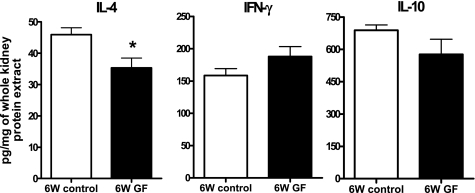
Baseline levels of IL-4, IFN-γ, and IL-10 in kidneys of control and germ-free mice. IL-4, IFN-γ, and IL-10 were measured in protein samples extracted from naive kidneys of control and germ-free mice (n = 7/group). IL-4 was significantly decreased in germ-free mice. IL-10 trended lower in germ-free mice, whereas there was a tendency for increased IFN-γ expression in renal tissues from germ-free mice. *P < 0.05 compared with 6W control.
Fig. 3.
Fig. 3.
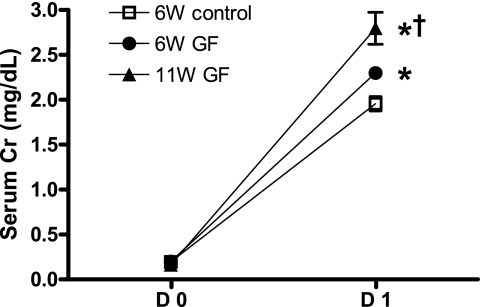
Germ-free mice show higher serum creatinine than control mice at 24 h after renal ischemia-reperfusion injury (IRI). The serum creatinine (Cr) level was measured to assess the renal function at 24 h after bilateral IRI (n = 10/group). Germ-free mice had higher serum creatinine compared with control mice. 11W GF, 11-wk-old germ free mice; D0, before bilateral IRI; D1, 24 h after bilateral IRI. *P < 0.01 compared with 6W control. †P < 0.001 compared with 6W GF.
Fig. 4.
Fig. 4.
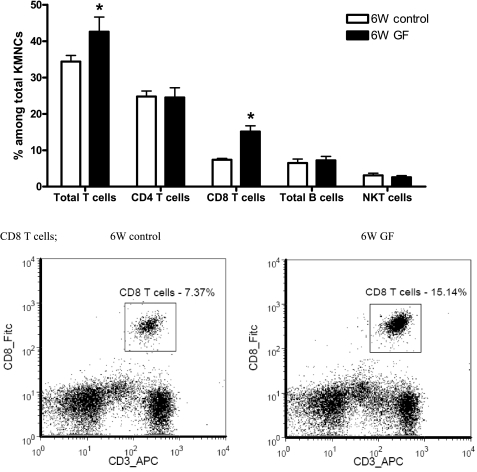
More CD8 T cells are trafficked into the postischemic kidneys of germ-free mice. Increased trafficking of CD8 T cells into the postischemic kidneys of germ-free mice caused the increase in total T cell trafficking. There was no difference in the percentages of total CD4 T cells, total B cells, and NKT cells among KMNCs isolated from the 2 groups (n = 10/group). *P < 0.05 compared with 6W control.
Fig. 5.
Fig. 5.
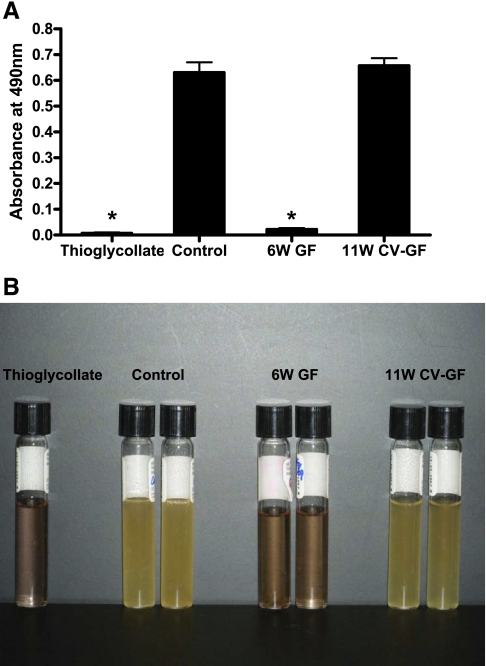
Effect of conventionalization on intestinal flora of germ-free mice. A: to conventionalize, germ-free mice were kept in a conventional specific pathogen-free (SPF) environment and were fed with fecal materials from control mice for 5 wk. The absorbance of thioglycollate medium with no inoculation and that of thioglycollate medium inoculated with germ-free mice stool were similar. The absorbance of thioglycollate medium inoculated with control mice stool and 11W CV-GF mice stool was significantly higher compared with thioglycollate medium with no inoculation. B: the stool culture of 11W CV-GF mice showed a similar degree of microbial burden as control mice. Thioglycollate, thioglycollate medium with no inoculation; control, stool culture from 6W control mice; 6W GF, stool culture from 6-wk-old germ-free mice; 11W CV-GF, stool culture from 11-wk-old conventionalized germ-free mice.*P < 0.001 compared with both control and 11W CV-GF.
Fig. 6.
Fig. 6.
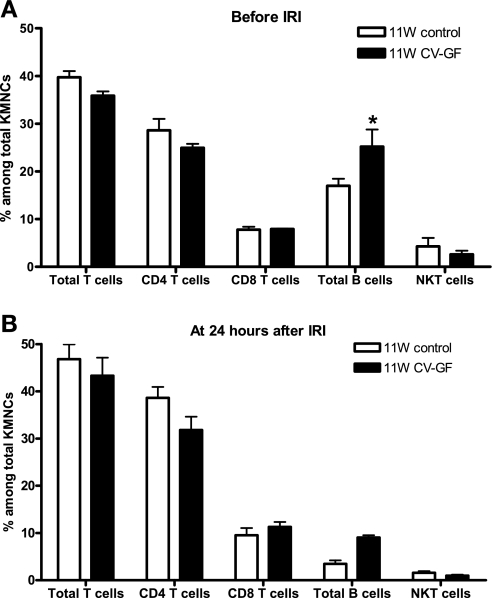
Conventionalized germ-free mice show similar phenotypes of kidney-resident lymphocytes as age-matched control mice. A: KMNCs isolated from 11W CV-GF mice were analyzed and compared with KMNCs from age-matched 11W control mice (n = 5/group). There was no difference in the percentages of total T cells, CD4 T cells, CD8 T cells, and NKT cells. Total B cells were increased in the naive kidneys of 11W CV-GF mice. B: KMNCs were analyzed again at 24 h after bilateral renal IRI (n = 10/group). The percentages of total T cells, CD4 T cells, CD8 T cells, total B cells, and NKT cells were similar between groups. 11W control; 11-wk-old control mice; 11W CV-GF; 11-wk-old conventionalized germ-free mice kept in a conventional SPF environment and fed fecal materials from control mice for 5 wk before ischemia. *P < 0.05 compared with 11W control.
Fig. 7.
Fig. 7.
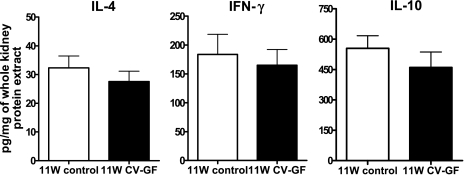
Baseline levels of IL-4, IFN-γ, and IL-10 in kidneys of conventionalized germ-free mice and age-matched control mice. IL-4, IFN-γ, and IL-10 were measured in protein samples extracted from naive kidneys of 11W control mice and 11W CV-GF mice (n = 5/group). There was no difference in the expression level of the three cytokines. Groups are defined as in Fig. 6.
Fig. 8.
Fig. 8.
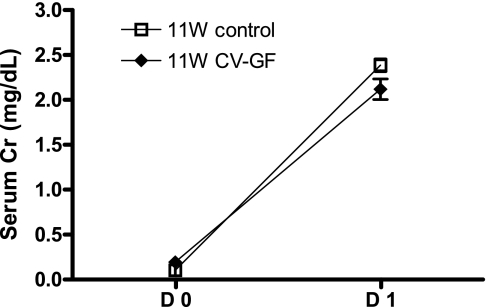
Introduction of microorganisms in germ-free mice leads to the development of equivalent kidney dysfunction after IRI to age-matched control mice. There was no difference in serum creatinine (Cr) levels measured at 24 h after bilateral renal IRI between the 2 groups. Groups are defined as in Fig. 6.
Fig. 9.
Fig. 9.
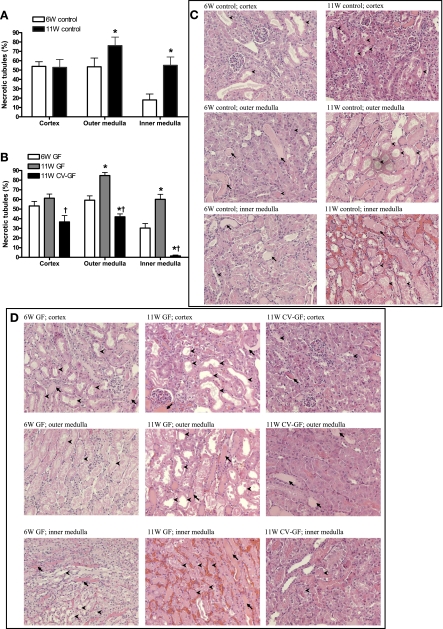
Introduction of microorganisms in germ-free mice attenuates tubular injury. A: tubular injury was scored with the percentage of necrotic tubules among total tubules. Old control (11-wk-old) mice showed significantly increased tubular injury in both the outer medulla and inner medulla compared with control (6-wk-old) mice. *P < 0.05 compared with 6W control. B: 11W CV-GF mice showed decreased tubular injury compared with germ-free mice. *P < 0.05 compared with 6W GF. †P < 0.05 compared with 11W GF. C: both the outer medulla and inner medulla of old control (11-wk-old) mice exhibited higher proportions of necrotic tubules than control (6-wk-old) mice. D: postischemic kidneys of 11W CV-GF mice showed mitigated tubular injury compared with both 6W GF and 11W GF mice. Arrowheads indicate necrotic tubules, and arrows indicate tubular casts. Groups are defined as in Figs. 1, 3, and 6.

References

    1. Anonymous. Variation and trends in incidence of childhood diabetes in Europe. EURODIAB ACE Study Group. Lancet 355: 873–876, 2000 - PubMed
    1. Ascon DB, Ascon M, Satpute S, Lopez-Briones S, Racusen L, Colvin RB, Soloski MJ, Rabb H. Normal mouse kidneys contain activated and CD3+CD4-CD8- double-negative T lymphocytes with a distinct TCR repertoire. J Leukoc Biol 84: 1400–1409, 2008 - PMC - PubMed
    1. Ascon DB, Lopez-Briones S, Liu M, Ascon M, Savransky V, Colvin RB, Soloski MJ, Rabb H. Phenotypic and functional characterization of kidney-infiltrating lymphocytes in renal ischemia reperfusion injury. J Immunol 177: 3380–3387, 2006 - PubMed
    1. Bach JF. The effect of infections on susceptibility to autoimmune and allergic diseases. N Engl J Med 347: 911–920, 2002 - PubMed
    1. Burne MJ, Daniels F, El Ghandour A, Mauiyyedi S, Colvin RB, O'Donnell MP, Rabb H. Identification of the CD4(+) T cell as a major pathogenic factor in ischemic acute renal failure. J Clin Invest 108: 1283–1290, 2001 - PMC - PubMed

Publication types

MeSH terms