


Neuropsychological status at seizure onset in children: risk factors for early cognitive deficits
- PMID: 19675309
- PMCID: PMC2730794
- DOI: 10.1212/WNL.0b013e3181b23551
Neuropsychological status at seizure onset in children: risk factors for early cognitive deficits
Abstract
Objective: This large, prospective, community-based study characterized neuropsychological functioning and academic achievement at the time of the first recognized seizure and identified risk factors for cognitive deficits.
Methods: We compared 282 children (ages 6-14 years, IQ > or =70) with a first recognized seizure to 147 healthy siblings on a battery of well-standardized and widely used neuropsychological and academic achievement tests and examined relationships with demographic and clinical variables.
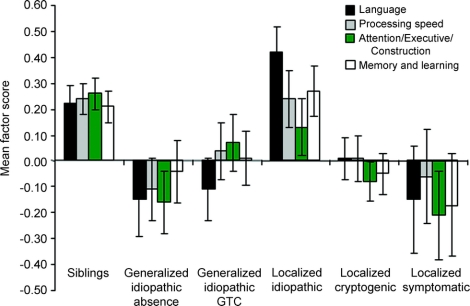
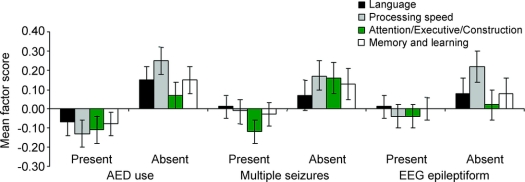
Results: In this intellectually normal cohort, 27% with just one seizure and up to 40% of those with risk factors exhibited neuropsychological deficits at or near onset. Risk factors associated with neuropsychological deficits included multiple seizures (i.e., second unprovoked seizure; odds ratio [OR] = 1.96), use of antiepileptic drugs (OR = 2.27), symptomatic/cryptogenic etiology (OR = 2.15), and epileptiform activity on the initial EEG (OR = 1.90); a child with all 4 risks is 3.00 times more likely than healthy siblings to experience neuropsychological deficits by the first clinic visit. Absence epilepsy carried increased odds for neuropsychological impairment (OR = 2.00).
Conclusions: A subgroup of intellectually normal children with seizures showed neuropsychological deficits at onset. Academic achievement was unaffected, suggesting that there is a window early in the disorder for intervention to ameliorate the impact on school performance. Therefore, the risk factors identified here (especially if multiple risks are present) warrant swift referral for neuropsychological evaluation early in the course of the condition.
Figures
Comment in
-
No kidding: high risk of cognitive difficulty in new-onset pediatric epilepsy.Neurology. 2009 Aug 18;73(7):496-7. doi: 10.1212/WNL.0b013e3181b2358a. Epub 2009 Aug 12. Neurology. 2009. PMID: 19675308 No abstract available.
-
Teaching the teachers: data to benefit school systems and doctors about children with newly diagnosed epilepsy.Epilepsy Curr. 2010 Mar;10(2):38-9. doi: 10.1111/j.1535-7511.2009.01348.x. Epilepsy Curr. 2010. PMID: 20231920 Free PMC article. No abstract available.
References
-
- Farwell JR, Dodrill CB, Batzel LW. Neuropsychological abilities of children with epilepsy. Epilepsia 1985;26:395–400. - PubMed
-
- Seidenberg M, Beck N, Geisser M, et al. Academic achievement of children with epilepsy. Epilepsia 1986;27:753–759. - PubMed
-
- Aldenkamp AP, Arends J. Effects of epileptiform EEG discharges on cognitive function: is the concept of “transient cognitive impairment” still valid? Epilepsy Behav 2004;5 suppl 1:S25–S34. - PubMed
