


The association between food insecurity and mortality among HIV-infected individuals on HAART
- PMID: 19675463
- PMCID: PMC3740738
- DOI: 10.1097/QAI.0b013e3181b627c2
The association between food insecurity and mortality among HIV-infected individuals on HAART
Abstract
Background: Food insecurity is increasingly recognized as a barrier to optimal treatment outcomes, but there is little data on this issue. We assessed associations between food insecurity and mortality among HIV-infected antiretroviral therapy-treated individuals in Vancouver, British Columbia, and whether body max index (BMI) modified associations.
Methods: Individuals were recruited from the British Columbia HIV/AIDS drug treatment program in 1998 and 1999 and were followed until June 2007 for outcomes. Food insecurity was measured with the Radimer/Cornell questionnaire. Cox proportional hazard models were used to determine associations between food insecurity, BMI, and nonaccidental deaths when controlling for confounders.
Results: Among 1119 participants, 536 (48%) were categorized as food insecure and 160 (14%) were categorized as underweight (BMI < 18.5). After a median follow-up time of 8.2 years, 153 individuals (14%) had died from nonaccidental deaths. After controlling for adherence, CD4 counts, and socioeconomic variables, people who were food insecure and underweight were nearly 2 times more likely to die (adjusted hazard ratio = 1.94, 95% confidence interval = 1.10 to 3.40) compared with people who were not food insecure or underweight. There was also a trend toward increased risk of mortality among people who were food insecure and not underweight (adjusted hazard ratio = 1.40, 95% confidence interval = 0.91 to 2.05). In contrast, people who were underweight but food secure were not more likely to die.
Conclusions: Food insecurity is a risk factor for mortality among antiretroviral therapy-treated individuals in British Columbia, particularly among individuals who are underweight. Innovative approaches to address food insecurity should be incorporated into HIV treatment programs.
Conflict of interest statement
Figures
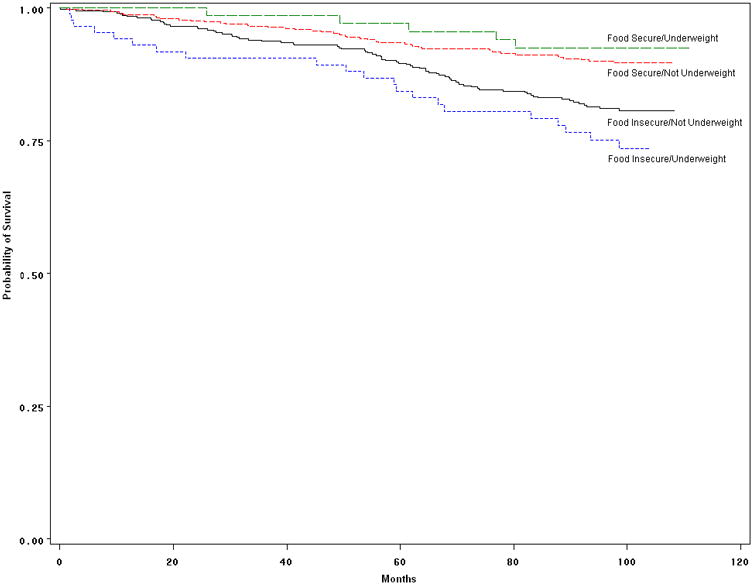
| People remaining in the study | 0 months | 20 months | 40 months | 60 months | 80 months | 100 months |
| Food Insecure/Underweight | 87 (7.8%) | 75 (6.7%) | 73 (6.5%) | 68 (6.1%) | 62 (5.5%) | 40 (3.6%) |
| Food Insecure/Not Underweight | 449 (40.1%) | 418 (37.4%) | 394 (35.2%) | 362 (32.4%) | 331 (29.6%) | 156 (13.9%) |
| Food Secure/Underweight | 73 (6.5%) | 70 (6.3%) | 68 (6.1%) | 65 (5.8%) | 60 (5.4%) | 38 (3.4%) |
| Food Secure/Not Underweight | 510 (45.6%) | 485 (43.3%) | 464 (41.5%) | 442 (39.5%) | 428 (38.2%) | 232 (20.7%) |
References
-
- Hogg RS, O'Shaughnessy MV, Gataric N, et al. Decline in deaths from AIDS due to new antiretrovirals. Lancet. 1997;349(9061):1294. - PubMed
-
- Hogg RS, Yip B, Chan KJ, et al. viral load after initiating triple-drug therapy. JAMA. 2001;286(20):2568–2577. - PubMed
-
- Jain S, Schwarcz S, Katz M, Gulati R, McFarland W. Elevated risk of death for African Americans with AIDS, San Francisco, 1996-2002. J Health Care Poor Underserved. 2006 Aug;17(3):493–503. - PubMed
-
- Tegger MK, Crane HM, Tapia KA, Uldall KK, Holte SE, Kitahata MM. The effect of mental illness, substance use, and treatment for depression on the initiation of highly active antiretroviral therapy among HIV-infected individuals. AIDS Patient Care STDS. 2008 Mar;22(3):233–243. - PubMed
Publication types
MeSH terms
Grants and funding
LinkOut - more resources
Full Text Sources
Medical
Research Materials
