Review
. 2009 Aug 13;63(3):287-303.
doi: 10.1016/j.neuron.2009.06.026.

The role of apolipoprotein E in Alzheimer's disease

Affiliations
Review

The role of apolipoprotein E in Alzheimer's disease

Jungsu Kim et al. Neuron. .

Abstract

The epsilon4 allele of apolipoprotein E (APOE) is the major genetic risk factor for Alzheimer's disease (AD). Although there have been numerous studies attempting to elucidate the underlying mechanism for this increased risk, how apoE4 influences AD onset and progression has yet to be proven. However, prevailing evidence suggests that the differential effects of apoE isoforms on Abeta aggregation and clearance play the major role in AD pathogenesis. Other potential mechanisms, such as the differential modulation of neurotoxicity and tau phosphorylation by apoE isoforms as well as its role in synaptic plasticity and neuroinflammation, have not been ruled out. Inconsistent results among studies have made it difficult to define whether the APOE epsilon4 allele represents a gain of toxic function, a loss of neuroprotective function, or both. Therapeutic strategies based on apoE propose to reduce the toxic effects of apoE4 or to restore the physiological, protective functions of apoE.


Figures
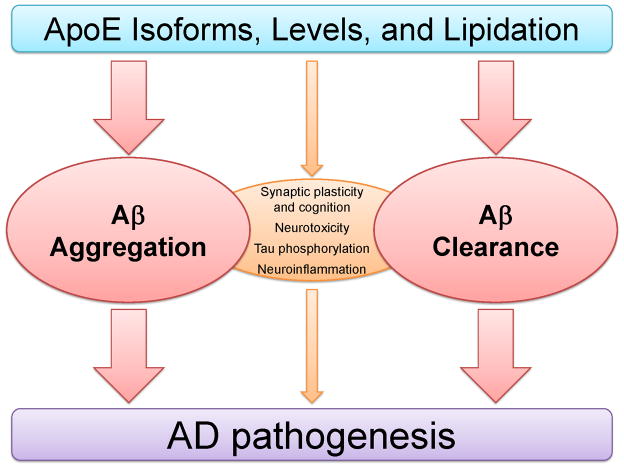
Figure 1
Figure 1. Pathogenic Mechanisms of ApoE in Alzheimer’s Disease
Several mechanisms have been proposed to understand the differential effects of apoE isoforms on AD pathogenesis. Evidence suggests that the major effect of apoE isoforms on the risk of developing AD is via its effect on Aβ aggregation and clearance, influencing the onset of Aβ deposition. Other mechanisms, including the effects of apoE isoforms on synaptic function, neurotoxicity, tau hyper-phosphorylation, and neuroinflammation, may also contribute to the disease process. Independent of APOE genotype, differences in the apoE levels and lipidation state may also mediate processes involved in AD pathogenesis.
Figure 2
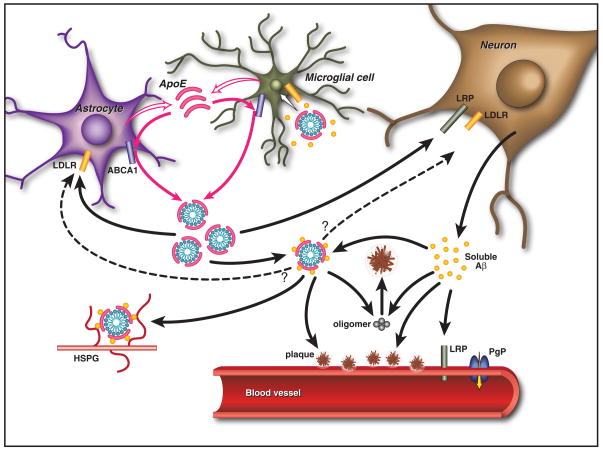
Figure 2. Effects of ApoE on Aβ Metabolism and Deposition
ApoE is primarily produced by both astrocytes and microglia and is subsequently lipidated by ABCA1 to form lipoprotein particles. In the extracellular space, lipidated apoE binds to soluble Aβ in an isoform-dependent pattern (E2>E3>E4) and influences the formation of parenchymal amyloid plaques and transport of Aβ within the CNS. ApoE is endocytosed into various cell types within the brain by different members of the LDL receptor family, including LDLR and LRP1. ApoE may also facilitate the cellular uptake of Aβ through the endocytosis of a complex of apoE-containing lipoprotein particles bound to Aβ in a manner that likely depends upon the isoforms and its level of lipidation. Furthermore, apoE has been shown to directly enhance both the degradation of Aβ within microglial cells and the ability of astrocytes to clear diffuse Aβ deposits (Jiang et al., 2008; Koistinaho et al., 2004). Aβ associated with apoE-containing lipoprotein particles may also be retained within the CNS through their binding to heparin sulfate proteoglycan (HSPG) moieties present in the extracellular space (Mahley and Rall, 2000). At the BBB, soluble Aβ is predominantly transported from the interstitial fluid into the bloodstream via LRP1 and P-glycoprotein (Cirrito et al., 2005; Zlokovic, 2008). ApoE has been shown to slow the transport of Aβ across the BBB in an isoform-dependent manner (E4>E3>E2) (Bell et al., 2007; Deane et al., 2008; Ito et al., 2007). In addition, apoE can influence the pathogenesis of CAA in an APP transgenic mouse model, with apoE4 increasing the amount of vascular plaques in comparison to apoE3 (Fryer et al., 2005b).

References

    1. Aleshkov S, Abraham CR, Zannis VI. Interaction of nascent ApoE2, ApoE3, and ApoE4 isoforms expressed in mammalian cells with amyloid peptide beta (1–40). Relevance to Alzheimer’s disease. Biochemistry. 1997;36:10571–10580. - PubMed
    1. Alexander GE, Chen K, Pietrini P, Rapoport SI, Reiman EM. Longitudinal PET Evaluation of Cerebral Metabolic Decline in Dementia: A Potential Outcome Measure in Alzheimer’s Disease Treatment Studies. Am J Psychiatry. 2002;159:738–745. - PubMed
    1. Andersen OM, Reiche J, Schmidt V, Gotthardt M, Spoelgen R, Behlke J, von Arnim CA, Breiderhoff T, Jansen P, Wu X, et al. Neuronal sorting protein-related receptor sorLA/LR11 regulates processing of the amyloid precursor protein. Proc Natl Acad Sci U S A. 2005;102:13461–13466. - PMC - PubMed
    1. Anderson R, Barnes JC, Bliss TV, Cain DP, Cambon K, Davies HA, Errington ML, Fellows LA, Gray RA, Hoh T, et al. Behavioural, physiological and morphological analysis of a line of apolipoprotein E knockout mouse. Neuroscience. 1998;85:93–110. - PubMed
    1. Arendt T, Schindler C, Bruckner MK, Eschrich K, Bigl V, Zedlick D, Marcova L. Plastic neuronal remodeling is impaired in patients with Alzheimer’s disease carrying apolipoprotein epsilon 4 allele. J Neurosci. 1997;17:516–529. - PMC - PubMed

Publication types