. 2009 Dec;23(12):4117-25.
doi: 10.1096/fj.09-137729. Epub 2009 Aug 13.

Nebulin plays a direct role in promoting strong actin-myosin interactions

Affiliations

Nebulin plays a direct role in promoting strong actin-myosin interactions

Marie-Louise Bang et al. FASEB J. 2009 Dec.

Abstract

The role of the actin filament-associated protein nebulin on mechanical and kinetic properties of the actomyosin motor was investigated in skeletal muscle of wild-type (wt) and nebulin-deficient (nebulin(-)(/)(-)) mice that were 1 d old, an age at which sarcomeric structure is still well preserved. In Ca2+-activated skinned fibers from psoas muscle, we determined the Ca2+ dependence of isometric force and stiffness, the rate of force redevelopment after unloaded shortening (k(TR)), the power during isotonic shortening, and the unloaded shortening velocity (V(0)). Our results show a 65% reduction in isometric force in nebulin(-)(/)(-) fibers at saturating [Ca2+], whereas neither thin-filament length nor the Ca2+ sensitivity of the contractile system is affected. Stiffness measurements indicate that the reduction in isometric force is due to a reduction in the number of actin-attached myosin motors, whereas the force of the motor is unchanged. Furthermore, in nebulin(-)(/)(-) fibers, k(TR) is decreased by 57%, V(0) is increased by 63%, and the maximum power is decreased by 80%. These results indicate that, in the absence of nebulin, the attachment probability of the myosin motors to actin is decreased, revealing a direct role for nebulin in promoting strong actomyosin interactions responsible for force and power production.


Figures
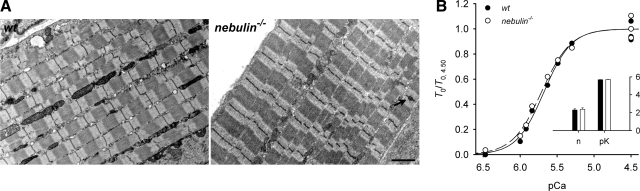
Figure 1.
Figure 1.
Comparison of sarcomere structure and force-pCa relation between wt and nebulin/ psoas muscle fibers from 1-d-old mice. A) Transmission electron microscopy on longitudinal sections of psoas muscle from wt and nebulin/ mice. Arrow indicates a zone of Z-line widening. Scale bar = 2 μm. B) Force-pCa relation in fiber bundles from wt and nebulin/ mice. Solid (wt) and dashed (nebulin/) lines are Hill sigmoidal equations (Eq. 1) fitted to data. Inset: mean ± se values of the parameters. wt psoas: bundle length, 1.00 mm; sarcomere length, 2.57 μm; CSA, 2300 μm2; T0, 71 kPa; temperature, 13.5°C. nebulin/ psoas: bundle length, 1.50 mm; sarcomere length, 2.60 μm; CSA, 4300 μm2; T0, 24 kPa; temperature, 13.4°C.
Figure 2.
Figure 2.
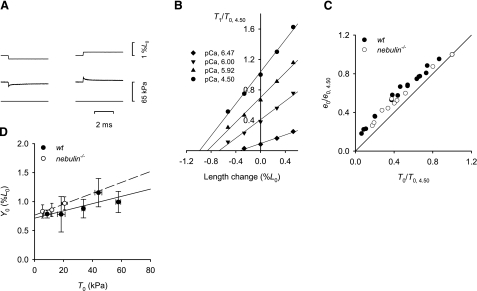
Relation between strain and isometric force in fiber bundles from wt and nebulin/ psoas muscles. A) Force response (middle trace) to a length step (top trace) in a fiber bundle from wt mouse activated at pCa 4.50; left, step release; right, step stretch of similar size; bottom trace, force baseline. Bundle length, 1.37 mm; average sarcomere length, 2.60 μm; CSA, 4400 μm2; temperature, 13.2°C. B) T1 relations for 4 pCa values. T1 values are plotted relative to T0 at pCa 4.50 (T0,4.50). Different symbols refer to different pCa values, as indicated in the inset. Continuous lines are linear regressions fitted to the experimental points for each pCa. Same fiber bundle as in A. C) Relation between stiffness e0 relative to that at pCa 4.50 (e0,4.50), and relative isometric force determined at different pCa values both in wt and nebulin/ mice. Continuous line expresses direct proportionality. Data are pooled from 3 fibers for both wt and nebulin/ mice. D) Relation between fiber strain Y0 (mean ± se) and isometric force at different pCa values, determined in 3 fiber bundles each from wt and nebulin/ mice and grouped in classes of force. Lines are linear regressions to points from wt (solid line) and nebulin/ (dashed line) data. Mean ± se values of the parameters for wt and nebulin/ mice are reported in Table 2.
Figure 3.
Figure 3.
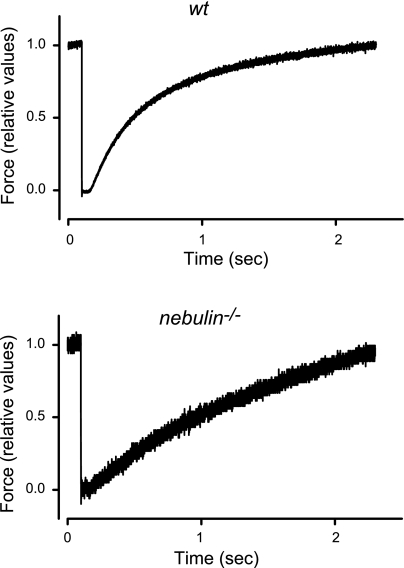
Isometric force redevelopment after a period of unloaded shortening in maximally activated fiber bundles from wt and nebulin/ mice (pCa 4.50). Force is normalized to the value preceding the ramp release (∼10% L0). wt psoas: bundle length, 1.26 mm; average sarcomere length, 2.62 μm; CSA, 4200 μm2; isometric force, 50 kPa; temperature, 12.8°C. nebulin/ psoas: bundle length, 0.92 mm; average sarcomere length, 2.60 μm; CSA, 4500 μm2; isometric force, 20 kPa; temperature, 13.0°C.
Figure 4.
Figure 4.
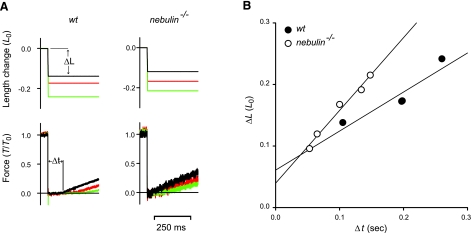
Unloaded shortening velocity V0 determined using the slack test in fiber bundles from wt and nebulin/ mice. A) Force responses (bottom panels) to rapid shortening steps of different magnitudes (ΔL; top panels). Δt (shown here for the smaller ΔL in a wt fiber bundle) is the time necessary for the force to begin to redevelop. B) Relation between ΔL and Δt in wt and in nebulin/ fibers. V0se), measured by the slope of the relation, is 0.64 ± 0.17 L0/s in wt and 1.18 ± 0.10 L0/s in nebulin/ mice. wt psoas: bundle length, 1.04 mm; average sarcomere length, 2.60 μm; CSA, 3500 μm2; isometric force, 82 kPa; temperature, 13.1°C. nebulin/ psoas: same fiber bundle as in Fig. 1.
Figure 5.
Figure 5.
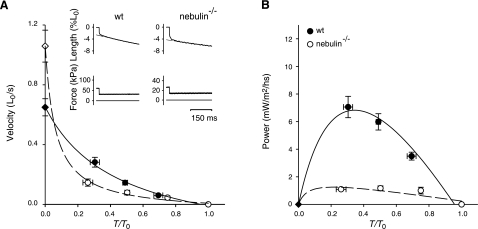
Relation between shortening velocity and power output vs. force in fiber bundles from wt and nebulin/ psoas muscles. A) Force-velocity relations from wt (4 bundles) and nebulin/ mice (4 bundles). Inset: sample records of length (top trace) after a drop of force from T0 to 0.5 T0 (middle trace); bottom trace, force baseline. Left panel, wt; right panel, nebulin/. Slope of the dashed line fitted to the steady shortening phase measures shortening velocity. Diamonds on the ordinate are V0 values measured with the slack-test method (see Fig. 4). Force T is relative to isometric value T0. Points are means ± se from data grouped in classes of force; n = 4–7. Solid (wt) and dashed (nebulin/) lines are Hill hyperbolic equations (Eq. 2) fitted to the points. Mean ± se values of parameters of the hyperbolic equations are reported in Table 3. B) Power-force relations obtained from the same data as in A. Lines are obtained from the Hill equation fitted to the force-velocity data in A.

References

    1. Jin J P, Wang K. Nebulin as a giant actin-binding template protein in skeletal muscle sarcomere. Interaction of actin and cloned human nebulin fragments. FEBS Lett. 1991;281:93–96. - PubMed
    1. Pfuhl M, Winder S J, Pastore A. Nebulin, a helical actin binding protein. EMBO J. 1994;13:1782–1789. - PMC - PubMed
    1. Wang K, Knipfer M, Huang Q Q, van Heerden A, Hsu L C, Gutierrez G, Quian X L, Stedman H. Human skeletal muscle nebulin sequence encodes a blueprint for thin filament architecture: sequence motifs and affinity profiles of tandem repeats and terminal SH3. J Biol Chem. 1996;271:4304–4314. - PubMed
    1. Littlefield R, Almenar-Queralt A, Fowler V M. Actin dynamics at pointed ends regulates thin filament length in striated muscle. Nat Cell Biol. 2001;3:544–551. - PubMed
    1. McElhinny A S, Kolmerer B, Fowler V M, Labeit S, Gregorio C C. The N-terminal end of nebulin interacts with tropomodulin at the pointed ends of the thin filaments. J Biol Chem. 2001;276:583–592. - PubMed

Publication types

LinkOut - more resources